
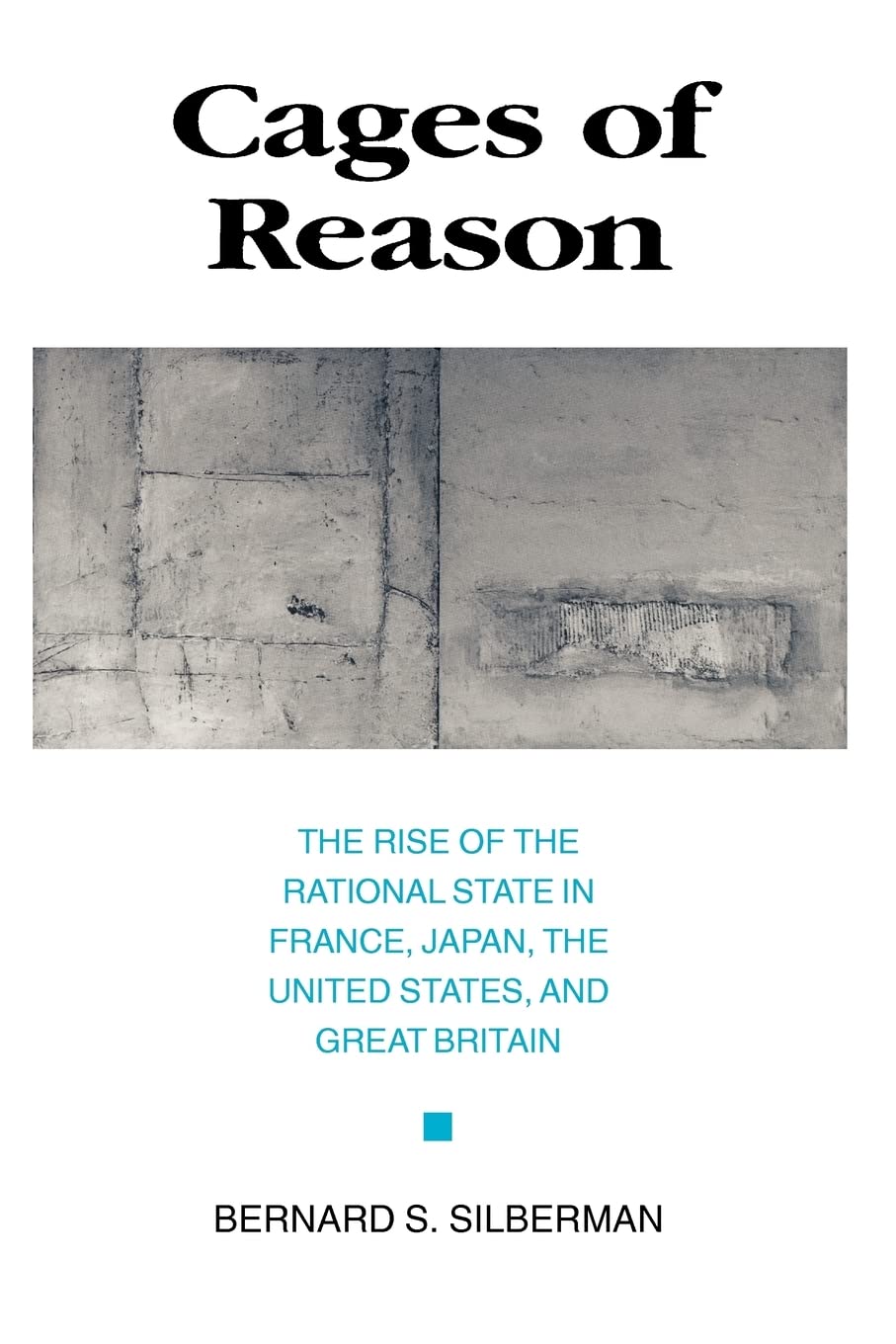
Title
Cages of Reason: The Rise of the Rational State in France, Japan, the United States, and Great Britain,Used
Sold by Ergodebooks, an authorized reseller.
Returns accepted within 30 days | support@ergodebooks.com
Shipping Information
- Free Standard Shipping — United States only
- Processing Time: 3–5 business days
- Estimated Delivery: 6–10 business days after dispatch
- Double-boxed, fully insured & discreetly packaged
- Tracking number sent via email once dispatched
Returns & Refund
Returns accepted within 30 days of delivery.
Damaged or Defective Item
Free return shipping + replacement or full refund
Wrong Item Received
Free return shipping + replacement or full refund
Change of Mind
Return shipping at customer's expense · 25% restocking fee applies
Payment Option

Blending political, historical, and sociological analysis, Bernard S. Silberman offers a provocative explanation for the bureaucratic development of the modern state. The study of modern state bureaucracy has its origins in Max Weber's analysis of the modes of social domination, which Silberman takes as his starting point.Whereas Weber contends that the administration of all modern nationstates would eventually converge in one form characterized by rationality and legal authority, Silberman argues that the process of bureaucratic rationalization took, in fact, two courses. One path is characterized by permeable organizational boundaries and the allocation of information by 'professionals.' The other features welldefined boundaries and the allocation of information by organizational rules. Through case studies of France, Japan, the United States, and Great Britain, Silberman demonstrates that this divergence stems from differences in leadership structure and in levels of uncertainty about leadership succession in the nineteenth century.Silberman concludes that the rise of bureacratic rationality was primarily a response to political problems rather than social and economic concerns. Cages of Reason demonstrates how rationalization can have occurred over a wide range of cultures at various levels of economic development. It will be of considerable interest to readers in a number of disciplines: political science, sociology, history, and public administration.'Silberman has produced an invaluable, densely packed work that those with deep knowledge of public administrative development will find extremely rewarding.' David H. Rosenbloom, American Political Science Review'An erudite, incisive, and vibrant book, the product of intensive study and careful reflection. Given its innovative theoretical framework and the wealth of historical materials contained in it, this study will generate debate and stimulate research in sociology, political science, and organizational theory. It is undoubtedly the best book on the comparative evolution of the modern state published in the last decade.'Mauro F. Guillen, Contemporary Sociology
⚠️ WARNING (California Proposition 65):
This product may contain chemicals known to the State of California to cause cancer, birth defects, or other reproductive harm.
For more information, please visit www.P65Warnings.ca.gov.
- Q: What is the main focus of 'Cages of Reason'? A: 'Cages of Reason' by Bernard S. Silberman analyzes the bureaucratic development of the modern state in various countries, including France, Japan, the United States, and Great Britain, exploring how these processes were influenced by political rather than social or economic factors.
- Q: How does this book contribute to the understanding of state bureaucracy? A: Silberman offers a unique perspective by arguing that the evolution of bureaucratic rationalization took two distinct paths, influenced by leadership structures and uncertainty in succession, providing valuable insights for scholars in political science, sociology, and public administration.
- Q: What are the key themes discussed in the book? A: Key themes include the divergence in bureaucratic development across cultures, the impact of political leadership on state structures, and the historical context that shaped modern bureaucracies in the nineteenth century.
- Q: Who is the author of 'Cages of Reason'? A: The author is Bernard S. Silberman, a scholar known for his contributions to the fields of political science and sociology.
- Q: When was 'Cages of Reason' published? A: 'Cages of Reason' was published on June 1, 1993.
- Q: What is the format of the book? A: The book is available in paperback format with a total of 495 pages.
- Q: What kind of analysis does Silberman use in the book? A: Silberman employs a blend of political, historical, and sociological analysis to explore the bureaucratic development of modern states.
- Q: Are there case studies included in 'Cages of Reason'? A: Yes, the book includes case studies from France, Japan, the United States, and Great Britain to illustrate the differences in bureaucratic rationalization.
- Q: What do reviewers say about the book? A: Reviewers commend 'Cages of Reason' for its dense, rewarding content and innovative theoretical framework, highlighting its potential to stimulate debate and research in related fields.
- Q: Is 'Cages of Reason' suitable for academic study? A: Yes, the book is suitable for academic study and is of considerable interest to students and professionals in political science, sociology, history, and public administration.