
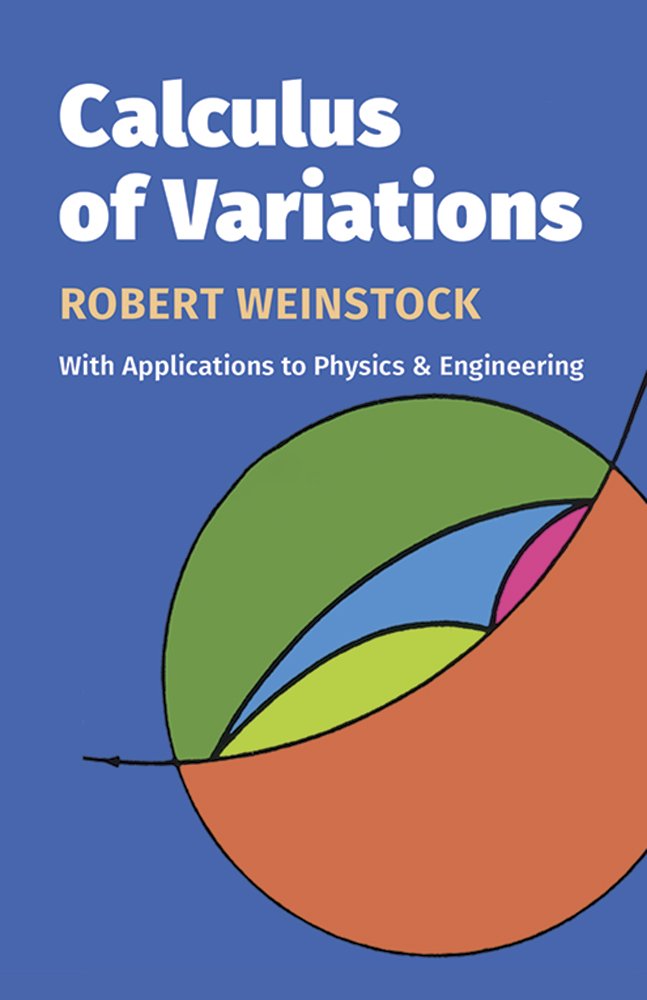
Title
Calculus Of Variations: With Applications To Physics And Engineering
Sold by Ergodebooks, an authorized reseller.
Returns accepted within 30 days | support@ergodebooks.com
Shipping Information
- Free Standard Shipping — United States only
- Processing Time: 3–5 business days
- Estimated Delivery: 6–10 business days after dispatch
- Double-boxed, fully insured & discreetly packaged
- Tracking number sent via email once dispatched
Returns & Refund
Returns accepted within 30 days of delivery.
Damaged or Defective Item
Free return shipping + replacement or full refund
Wrong Item Received
Free return shipping + replacement or full refund
Change of Mind
Return shipping at customer's expense · 25% restocking fee applies
Payment Option

This book by Robert Weinstock was written to fill the need for a basic introduction to the calculus of variations. Simply and easily written, with an emphasis on the applications of this calculus, it has long been a standard reference of physicists, engineers, and applied mathematicians. The author begins slowly, introducing the reader to the calculus of variations, and supplying lists of essential formulae and derivations. Later chapters cover isoperimetric problems, geometrical optics, Fermat's principle, dynamics of particles, the SturmLiouville eigenvalueeigenfunction problem, the theory of elasticity, quantum mechanics, and electrostatics. Each chapter ends with a series of exercises which should prove very useful in determining whether the material in that chapter has been thoroughly grasped.The clarity of exposition makes this book easily accessible to anyone who has mastered firstyear calculus with some exposure to ordinary differential equations. Physicists and engineers who find variational methods evasive at times will find this book particularly helpful.'I regard this as a very useful book which I shall refer to frequently in the future.' J. L. Synge, Bulletin of the American Mathematical Society.
⚠️ WARNING (California Proposition 65):
This product may contain chemicals known to the State of California to cause cancer, birth defects, or other reproductive harm.
For more information, please visit www.P65Warnings.ca.gov.
- Q: What are the dimensions of the book? A: The book measures five point four three inches in length, zero point seven one inches in width, and eight point five inches in height.
- Q: How many pages does this book have? A: This book contains three hundred fifty-two pages, providing a comprehensive introduction to the calculus of variations.
- Q: What type of binding does the book have? A: The book is available in paperback binding, making it lightweight and easy to handle.
- Q: What is the reading level of this book? A: This book is suitable for anyone who has mastered first-year calculus and has some exposure to ordinary differential equations.
- Q: Is this book useful for beginners? A: Yes, beginners will find this book helpful as it starts with basic concepts and gradually introduces more complex topics.
- Q: Can this book help me with engineering applications? A: Yes, the book emphasizes applications in physics and engineering, making it a valuable resource for both fields.
- Q: How should I store this book? A: Store the book in a cool, dry place, upright on a shelf to maintain its shape and prevent damage.
- Q: Is this book suitable for high school students? A: Yes, high school students with a good grasp of calculus can benefit from this book's clear explanations and exercises.
- Q: What if the book arrives damaged? A: If the book arrives damaged, you should contact the seller for a return or exchange as per their policy.
- Q: How do I care for this book? A: To care for the book, avoid exposure to moisture and direct sunlight, and handle it gently to prevent wear.
- Q: Does this book cover advanced topics? A: Yes, it covers advanced topics such as quantum mechanics and the theory of elasticity, beneficial for more experienced readers.
- Q: Are there exercises in each chapter? A: Yes, each chapter ends with a series of exercises designed to reinforce the material covered.
- Q: Is this book frequently referenced by professionals? A: Yes, many professionals in physics and engineering reference this book due to its clarity and practical applications.
- Q: Can this book help with college-level calculus? A: Yes, it is suitable for college-level calculus students seeking to understand variations and their applications.
- Q: Who is the author of this book? A: The book is authored by Robert Weinstock, who has written extensively on the calculus of variations.
- Q: Is there a glossary of terms in the book? A: The book does not specifically mention a glossary, but it provides essential formulae and derivations throughout the text.