
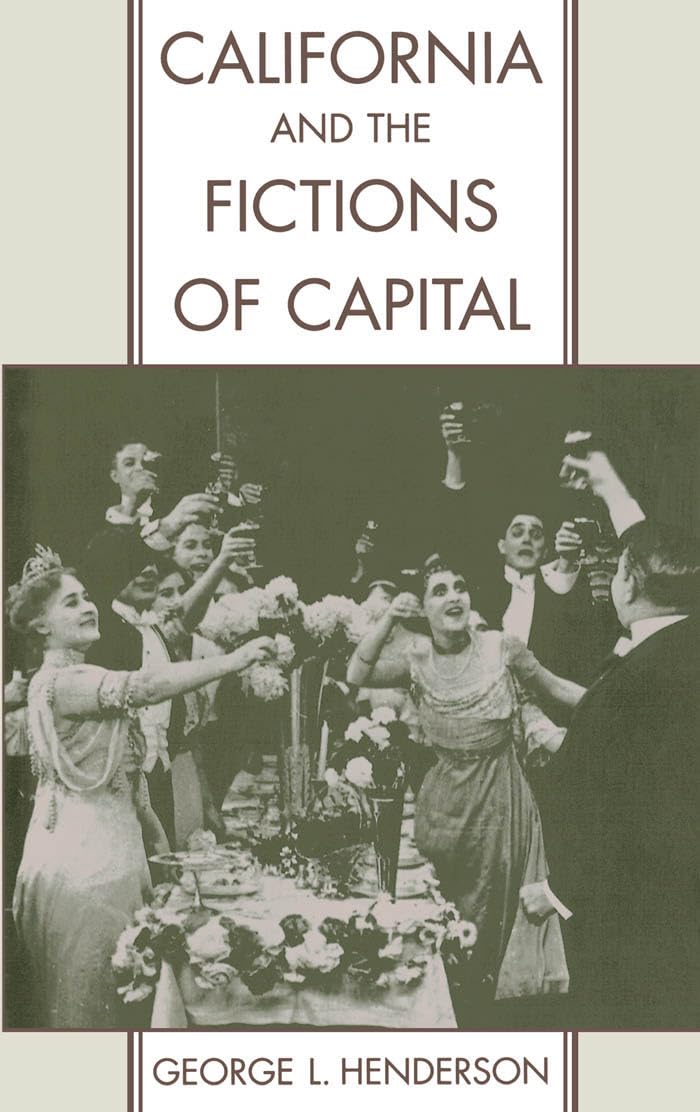
Title
California and the Fictions of Capital (Commonwealth Center Studies in American Culture),Used
Sold by Ergodebooks, an authorized reseller.
Returns accepted within 30 days | support@ergodebooks.com
Shipping Information
- Free Standard Shipping — United States only
- Processing Time: 3–5 business days
- Estimated Delivery: 6–10 business days after dispatch
- Double-boxed, fully insured & discreetly packaged
- Tracking number sent via email once dispatched
Returns & Refund
Returns accepted within 30 days of delivery.
Damaged or Defective Item
Free return shipping + replacement or full refund
Wrong Item Received
Free return shipping + replacement or full refund
Change of Mind
Return shipping at customer's expense · 25% restocking fee applies
Payment Option

Between the frequently recounted events of the Gold Rush and the Great Depression stretches a period of California history that is equally crucial but less often acknowledged. In his fresh, synthetic consideration of these inbetween years, George L. Henderson points specifically to the takeoff of California's rural juggernaut between the 1880s and middle 1920sthe upward spiral of city bids for country dollars and rural bids for urban investments. These decades were salve for mining's risky finances yet groundwork for the chaotic 1930s. Moreover, Henderson argues that much like the two important periods which framed it, this era produced a cultural and literary apparatus that attempted to grapple with capital's machinations, if only to legitimate them in the end.Central to California and the Fictions of Capital is a theory of how the circulation of capital wove itself into agriculture. The book asks why it mattered to capital that agriculture was based in Nature, and then explores the procedures through which images of Nature became central to capitalism's story of itself. What unique possibilities did Nature offer to circuits of capital and what was their role in suturing the urban and rural together? How did boom and bust intervene and set the pace for regional change? How was capital linked to the racializing of working bodies? And why was the capitalist imperative expressed in landscape alterations like irrigation? Such are the key questions informing this bold, farreaching volume.Beyond political economy, the book also looks to the rural juggernaut's cultural and literary work, which was stamped by celebratory, if fretful, ruminations. In all sorts of textsbut especially in novels by Frank Norris, Mary Austin, Harold Bell Wright, and many other writersdifficult questions surfaced. Capital was seen in terms of its spillage into rural frontiers, just as rural frontiers were seen in terms of movements of capital. Capital was the new geography of money. But for whom did it work? Which identities did it favor? In mapping the real and imaginary realms that capital occupied, Henderson locates the banker, land developer, and engineerheroes of California fiction as well as the fictionalized 'new woman' of the capitalist, agrarian West. He unravels the colliding representations of race, gender, and class, while linking their treatment to the naturalizing rhetoric of capital's agrarian turn.In part a tour of California as a virtual laboratory for refining the circulation of capital, and in part an investigation of how the state's literati, with rare exception, reconceived economy in the name of class, gender, and racial privilege, this study will appeal to all students and scholars of California'sand the American West'seconomic, environmental, and cultural past.
⚠️ WARNING (California Proposition 65):
This product may contain chemicals known to the State of California to cause cancer, birth defects, or other reproductive harm.
For more information, please visit www.P65Warnings.ca.gov.
- Q: What is the main focus of 'California and the Fictions of Capital'? A: The book explores California's economic history, particularly the relationship between capital and agriculture during the late 19th and early 20th centuries.
- Q: Who is the author of this book? A: The author is George L. Henderson.
- Q: What type of binding does this book have? A: The book is available in hardcover binding.
- Q: How many pages does the book contain? A: The book contains 304 pages.
- Q: When was 'California and the Fictions of Capital' published? A: The book was published on December 31, 1998.
- Q: What are the key themes discussed in the book? A: Key themes include the circulation of capital, the intersection of agriculture and nature, and the cultural implications of economic changes in California.
- Q: Is this book suitable for students and scholars? A: Yes, the book is designed to appeal to students and scholars interested in California's economic, environmental, and cultural history.
- Q: What kind of historical periods does the book address? A: The book addresses the period between the Gold Rush and the Great Depression, focusing on California's economic development during that time.
- Q: Does the book discuss the impact of race and gender on economic issues? A: Yes, it explores how capital's mechanisms interacted with issues of race, gender, and class in the context of California's history.
- Q: What academic series is this book part of? A: The book is part of the Commonwealth Center Studies in American Culture series.