
Title
Callaloo Nation: Metaphors Of Race And Religious Identity Among South Asians In Trinidad (Latin America Otherwise),Used
Sold by Ergodebooks, an authorized reseller.
Returns accepted within 30 days | support@ergodebooks.com
Shipping Information
- Free Standard Shipping — United States only
- Processing Time: 3–5 business days
- Estimated Delivery: 6–10 business days after dispatch
- Double-boxed, fully insured & discreetly packaged
- Tracking number sent via email once dispatched
Returns & Refund
Returns accepted within 30 days of delivery.
Damaged or Defective Item
Free return shipping + replacement or full refund
Wrong Item Received
Free return shipping + replacement or full refund
Change of Mind
Return shipping at customer's expense · 25% restocking fee applies
Payment Option

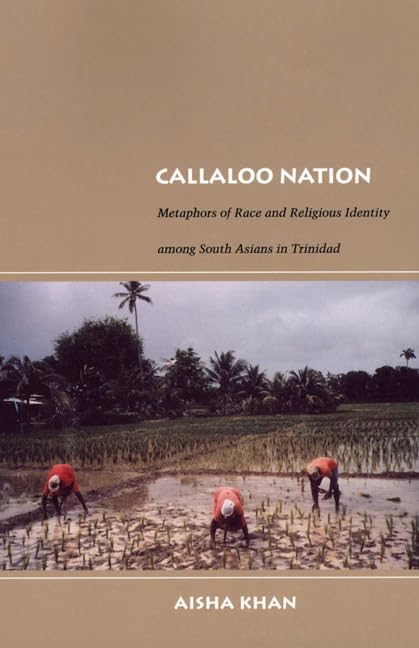
Mixingwhether referred to as mestizaje, callaloo, hybridity, creolization, or multiculturalismis a foundational cultural trope in Caribbean and Latin American societies. Historically entwined with colonial, anticolonial, and democratic ideologies, ideas about mixing are powerful forces in the ways identities are interpreted and evaluated. As Aisha Khan shows in this ethnography, they reveal the tension that exists between identity as a source of equality and identity as an instrument through which social and cultural hierarchies are reinforced. Focusing on the Indian diaspora in the Caribbean, Khan examines this paradox as it is expressed in key dimensions of Hindu and Muslim cultural history and social relationships in southern Trinidad. In vivid detail, she describes how disempowered communities create livable conditions for themselves while participating in a broader culture that both celebrates and denies difference.Khan combines ethnographic research she conducted in Trinidad over the course of a decade with extensive archival research to explore how Hindu and Muslim IndoTrinidadians interpret authority, generational tensions, and the transformations of Indian culture in the Caribbean through metaphors of mixing. She demonstrates how ambivalence about the desirability of a callaloo nationa multicultural societyis manifest around practices and issues, including rituals, labor, intermarriage, and class mobility. Khan maintains that metaphors of mixing are pervasive and worth paying attention to: the assumptions and concerns they communicate are key to unraveling who IndoTrinidadians imagine themselves to be and how identities such as race and religion shape and are shaped by the politics of multiculturalism.
⚠️ WARNING (California Proposition 65):
This product may contain chemicals known to the State of California to cause cancer, birth defects, or other reproductive harm.
For more information, please visit www.P65Warnings.ca.gov.