
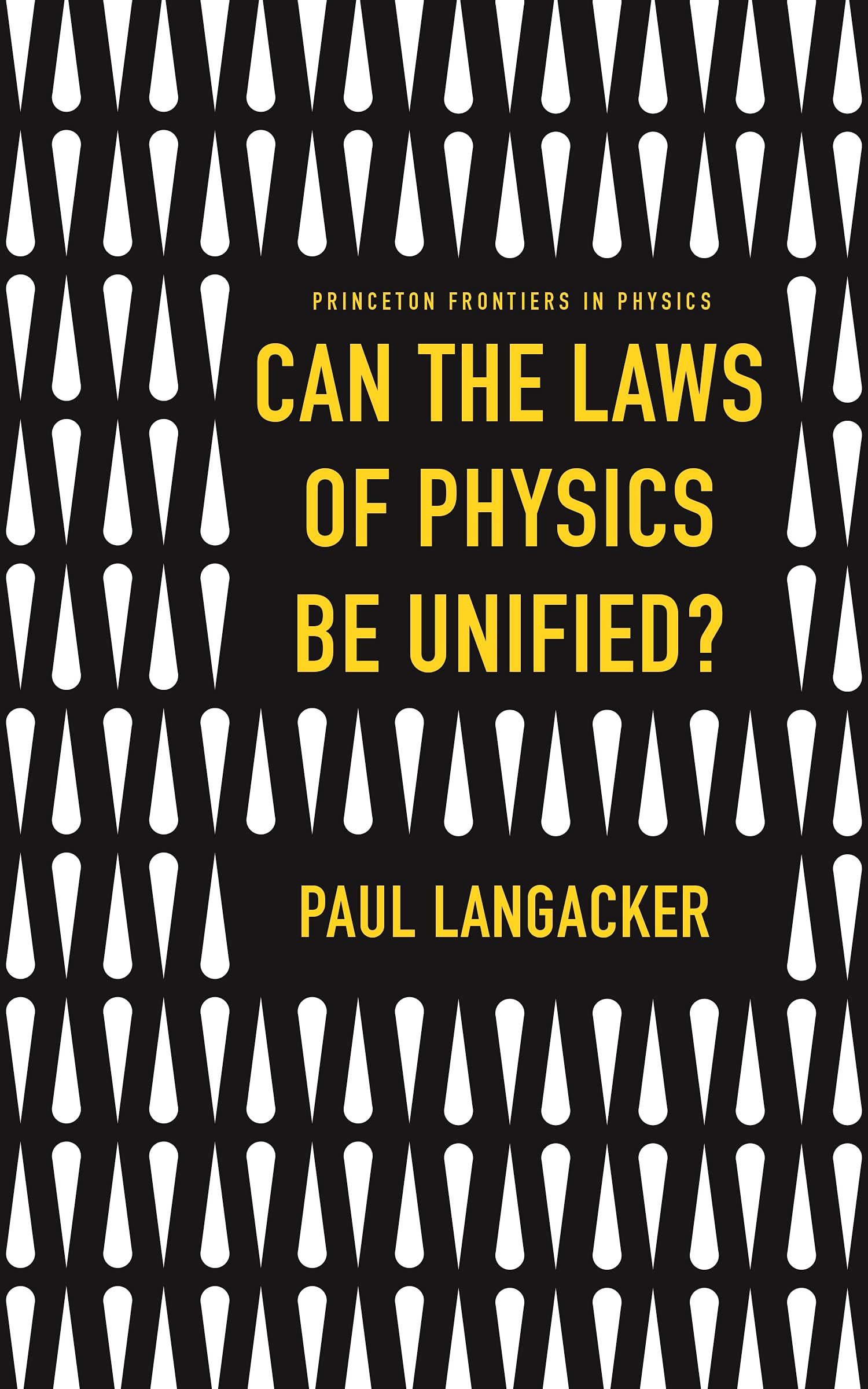
Title
Can the Laws of Physics Be Unified? (Princeton Frontiers in Physics),Used
Sold by Ergodebooks, an authorized reseller.
Returns accepted within 30 days | support@ergodebooks.com
Shipping Information
- Free Standard Shipping — United States only
- Processing Time: 3–5 business days
- Estimated Delivery: 6–10 business days after dispatch
- Double-boxed, fully insured & discreetly packaged
- Tracking number sent via email once dispatched
Returns & Refund
Returns accepted within 30 days of delivery.
Damaged or Defective Item
Free return shipping + replacement or full refund
Wrong Item Received
Free return shipping + replacement or full refund
Change of Mind
Return shipping at customer's expense · 25% restocking fee applies
Payment Option

A concise introduction to the cuttingedge science of particle physicsThe standard model of particle physics describes our current understanding of nature's fundamental particles and their interactions, yet gaps remain. For example, it does not include a quantum theory of gravity, nor does it explain the existence of dark matter. Once complete, however, the standard model could provide a unified description of the very building blocks of the universe. Researchers have been chasing this dream for decades, and many wonder whether such a dream can ever be made a reality.Can the Laws of Physics Be Unified? is a short introduction to this exciting frontier of physics. The book is accessibly written for students and researchers across the sciences, and for scientifically minded general readers. Paul Langacker begins with an overview of the key breakthroughs that have shaped the standard model, and then describes the fundamental particles, their interactions, and their role in cosmology. He goes on to explain field theory, internal symmetries, YangMills theories, strong and electroweak interactions, the Higgs boson discovery, and neutrino physics. Langacker then looks at the questions that are still unanswered: What is the nature of the mysterious dark matter and dark energy that make up roughly 95 percent of the universe? Why is there more matter than antimatter? How can we reconcile quantum mechanics and general relativity?Can the Laws of Physics Be Unified? describes the promising theoretical ideas and new experiments that could provide answers and weighs our prospects for establishing a truly unified theory of the smallest constituents of nature and their interactions.
⚠️ WARNING (California Proposition 65):
This product may contain chemicals known to the State of California to cause cancer, birth defects, or other reproductive harm.
For more information, please visit www.P65Warnings.ca.gov.