If you have any questions, you are always welcome to contact us. We'll get back to you as soon as possible, withing 24 hours on weekdays.
Customer service
All questions about your order, return and delivery must be sent to our customer service team by e-mail at yourstore@yourdomain.com
Sale & Press
If you are interested in selling our products, need more information about our brand or wish to make a collaboration, please contact us at press@yourdomain.com
Help
If you have any questions, you are always welcome to contact us. We'll get back to you as soon as possible, withing 24 hours on weekdays.
Customer service
All questions about your order, return and delivery must be sent to our customer service team by e-mail at yourstore@yourdomain.com
Sale & Press
If you are interested in selling our products, need more information about our brand or wish to make a collaboration, please contact us at press@yourdomain.com
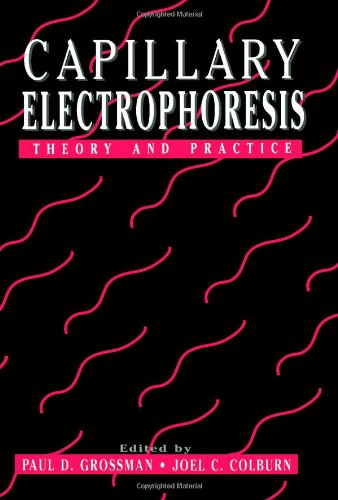
This book is designed to be a practical guide, used by wide audience, including those new to CE, those more experienced, routine users, those interested in technology development, and those involved with applications research. References have been emphasized to allow the reader to explore the detailed specifics and theoretical foundations.This book draws together the rapidly evolving, diverse, and multidisciplinary subject of capillary electrophoresis (CE). It is designed as a practical guide to be used by a wide audience, including those new to CE as well as more experienced users. This volume presents the capabilities, limitations, potentials, and future challenges facing each area of CE. Key aspects of this technique, such as high resolution capability, full automation, high speed separations, quantification of nanoliter sample volumes, and simultaneous multiple detection capabilities are presented in a concise and logical fashion. This book is designed to help you make the most of your CE separations, and includes comprehensive information on:Electroosmosis, separation efficiency, and Joule heatingDetection methodsIndepth discussion of the separation principles and capabilities of the major modes of CESieving gel electrophoresisIsoelectric focusingFree solution CEMicellar electrokinetic capillary chromatographyEntangled polymer matrixbased separationDetailed treatment of the application of CE to a wide range of molecules, supplemented with extensive "handson" illustrations
⚠️ WARNING (California Proposition 65):
This product may contain chemicals known to the State of California to cause cancer,
birth defects, or other reproductive harm.
For MAP (Minimum Advertised Price) violations and Intellectual Property (IP) or Trademark concerns, please contact:
support@ergodebooks.com
⚠️ California Proposition 65 Warning: Some products sold on this website may expose you to chemicals known to the State of California to cause cancer, birth defects, or other reproductive harm. For more information, visit www.P65Warnings.ca.gov.