
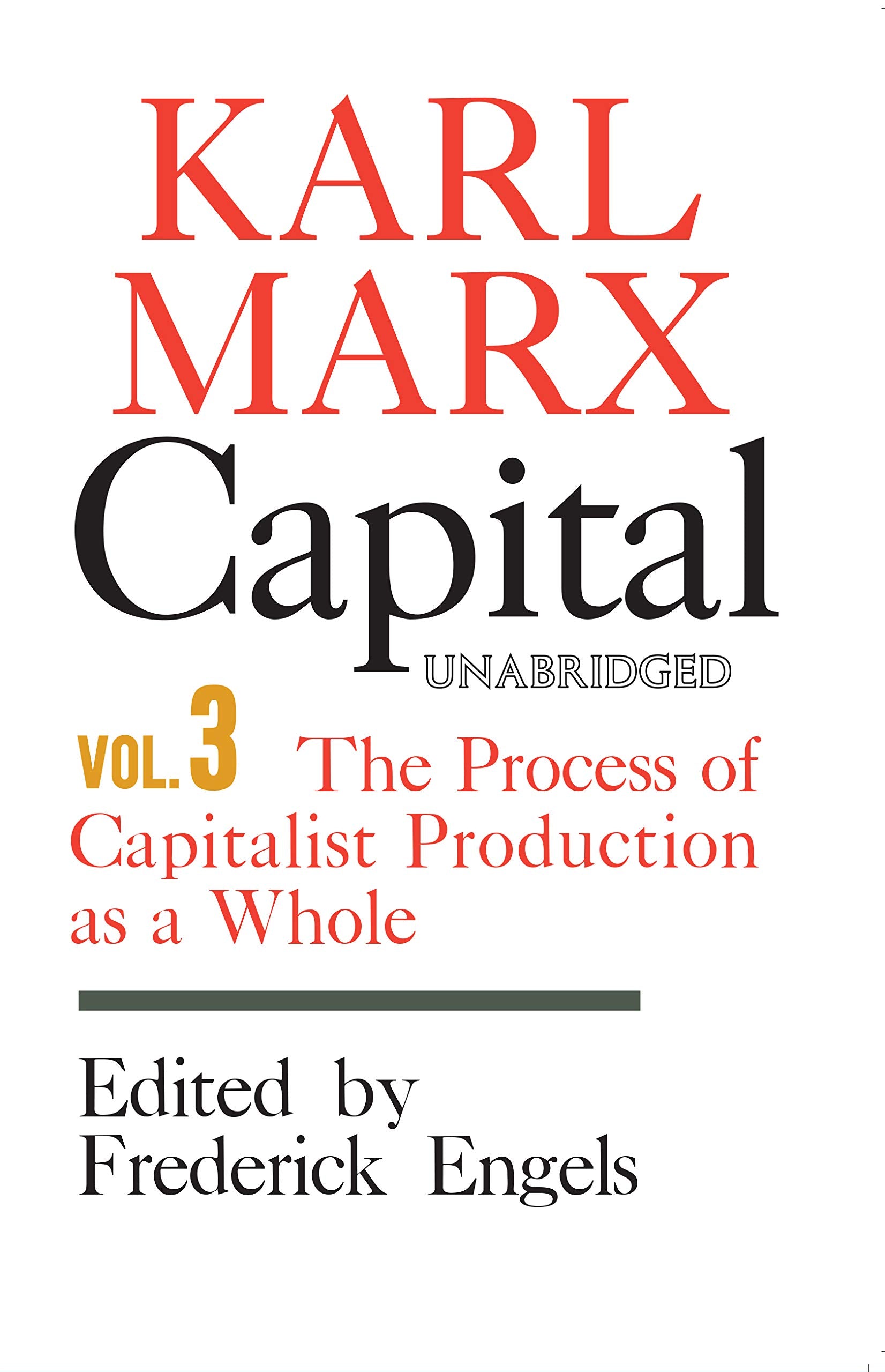
Capital: A Critique of Political Economy Volume 3: The Process of Capitalist Production as a Whole,New
$27.54
Title
Capital: A Critique of Political Economy Volume 3: The Process of Capitalist Production as a Whole,New
Free Standard Shipping Across USA
Quantity
Sold by Ergodebooks, an authorized reseller.
Returns accepted within 30 days | support@ergodebooks.com
Shipping Information
- Free Standard Shipping — United States only
- Processing Time: 3–5 business days
- Estimated Delivery: 6–10 business days after dispatch
- Double-boxed, fully insured & discreetly packaged
- Tracking number sent via email once dispatched
Returns & Refund
Returns accepted within 30 days of delivery.
Damaged or Defective Item
Free return shipping + replacement or full refund
Wrong Item Received
Free return shipping + replacement or full refund
Change of Mind
Return shipping at customer's expense · 25% restocking fee applies
All returns require a Return Authorization (RA) number before sending.
View Full Return & Refund Policy
Payment Option

Capital, Vol 3, subtitled The Process of Capitalist Production as a Whole, was prepared by Friedrich Engels from notes left by Marx & published in 1894. It's in seven parts:1.The conversion of Surplus Value into Profit & the rate of Surplus Value into the rate of Profit2.Conversion of Profit into Average Profit3.The Law of the Tendency of the Rate of Profit to Fall4.Conversion of Commodity Capital & Money Capital into Commercial Capital & MoneyDealing (Merchant's) Capital5.Division of Profit Into Interest & Profit of Enterprise, Interest Bearing Capital6.Transformation of SurplusProfit into Ground Rent7.Revenues & Their SourcesThe work is best known today for part 3, which in summary says that as the organic fixed capital requirements of production rise as a result of advancements in production generally, the rate of profit tends to fall. This result, which orthodox Marxists believe is a principal contradictory characteristic leading to an inevitable collapse of the capitalist order, was held, as a result of various contradictions in the capitalist mode of production, result in crises whose resolution necessitates the emergence of an entirely new mode of production as the culmination of the same historical dialectic that led to the emergence of capitalism from prior forms.
⚠️ WARNING (California Proposition 65):
This product may contain chemicals known to the State of California to cause cancer, birth defects, or other reproductive harm.
For more information, please visit www.P65Warnings.ca.gov.
- Q: How many pages does this book have? A: This book has nine hundred forty-eight pages. It provides an in-depth analysis of capitalist production as explained by Karl Marx.
- Q: What is the binding type of this book? A: This book is paperback bound. It offers a flexible and lightweight reading experience.
- Q: What are the dimensions of this book? A: The book measures five point five one inches in length, two point zero one inches in width, and eight point two seven inches in height. These dimensions make it easy to handle and store.
- Q: Who is the author of this book? A: The author of this book is Karl Marx. He is a renowned philosopher and economist known for his critical analysis of capitalism.
- Q: Who published this book? A: This book was published by International Publishers Co., Inc. They specialize in works on economic theory and philosophy.
- Q: What is the main topic of this book? A: The main topic of this book is the critique of political economy, focusing on the processes of capitalist production. It discusses various aspects of economic theory.
- Q: Is this book suitable for beginners? A: This book may not be suitable for beginners. It delves into complex economic theories that require prior knowledge of Marxist principles.
- Q: How should I read this book for best understanding? A: To best understand this book, it's recommended to read it slowly and take notes. Engaging with supplementary materials on Marxist theory may also help.
- Q: Can I use this book for academic purposes? A: Yes, this book is ideal for academic purposes. It is often used in economics and political science courses.
- Q: How should I store this book? A: Store this book in a cool, dry place. Keeping it away from direct sunlight will help preserve its condition.
- Q: What is the best way to care for this book? A: To care for this book, avoid bending the spine and keep it clean. Wipe it gently with a dry cloth if needed.
- Q: Can I return this book if I'm not satisfied? A: Yes, you can return this book if you're not satisfied, according to the seller's return policy. Check the specific terms for details.
- Q: What if the book arrives damaged? A: If the book arrives damaged, you should contact the seller immediately for a replacement or refund. Document the damage with photos if possible.
- Q: Is there a warranty for this book? A: No, books typically do not come with a warranty. However, check with the seller for any satisfaction guarantees.
- Q: How does this book compare to other works by Marx? A: This book is more comprehensive than some of Marx's earlier works. It focuses specifically on the overall process of capitalist production.
- Q: Is this book appropriate for all ages? A: This book is primarily intended for adult readers. It discusses complex economic theories that may not be suitable for younger audiences.