
Title
Capital Cities: Varieties and Patterns of Development and Relocation (Routledge Research in Planning and Urban Design),Used
Sold by Ergodebooks, an authorized reseller.
Returns accepted within 30 days | support@ergodebooks.com
Shipping Information
- Free Standard Shipping — United States only
- Processing Time: 3–5 business days
- Estimated Delivery: 6–10 business days after dispatch
- Double-boxed, fully insured & discreetly packaged
- Tracking number sent via email once dispatched
Returns & Refund
Returns accepted within 30 days of delivery.
Damaged or Defective Item
Free return shipping + replacement or full refund
Wrong Item Received
Free return shipping + replacement or full refund
Change of Mind
Return shipping at customer's expense · 25% restocking fee applies
Payment Option

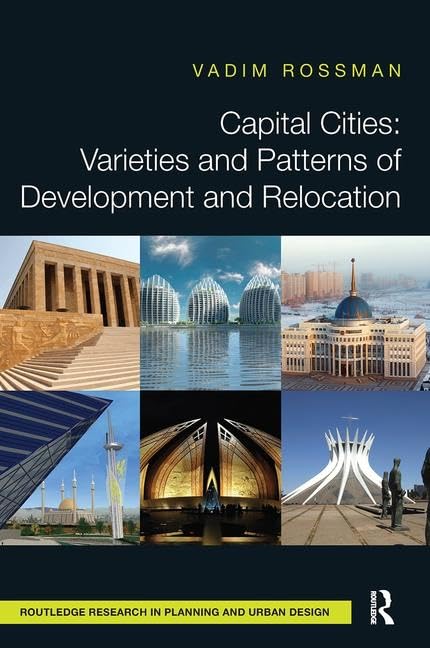
The issue of capital city relocation is a topic of debate for more than forty countries across the world. In this first book to discuss the issue, Vadim Rossman offers an indepth analysis of the subject, highlighting the global trends and the key factors that motivate different countries to consider such projects, analyzing the outcomes and drawing lessons from recent capital city transfers worldwide for governments and policymakers.Capital Cities studies the approaches and the methodologies that inform such decisions and debates. Special attention is given to the study of the universal patterns of relocation and patterns specific to particular continents and megaregions and particular political regimes. The study emphasizes the role of capital city transfers in the context of nation and statebuilding and offers a new framework for thinking about capital cities, identifying six strategies that drive these decisions, representing the economic, political, geographic, cultural and security considerations.Confronting the popular hypercritical attitudes towards new designed capital cities, Vadim Rossman shows the complex motives that underlie the proposals and the important role that new capitals might play in conflict resolution in the context of ethnic, religious and regional rivalries and federalist transformations of the state, and is seeking to identify the success and failure factors and more efficient implementation strategies. Drawing upon the insights from spatial economics, comparative federalist studies, urban planning and architectural criticism, the book also traces the evolution of the concept of the capital city, showing that the design, iconography and the location of the capital city play a critical role in the success and the viability of the state.
⚠️ WARNING (California Proposition 65):
This product may contain chemicals known to the State of California to cause cancer, birth defects, or other reproductive harm.
For more information, please visit www.P65Warnings.ca.gov.