
Title
Capital, Coercion, and Postcommunist States,Used
Sold by Ergodebooks, an authorized reseller.
Returns accepted within 30 days | support@ergodebooks.com
Shipping Information
- Free Standard Shipping — United States only
- Processing Time: 3–5 business days
- Estimated Delivery: 6–10 business days after dispatch
- Double-boxed, fully insured & discreetly packaged
- Tracking number sent via email once dispatched
Returns & Refund
Returns accepted within 30 days of delivery.
Damaged or Defective Item
Free return shipping + replacement or full refund
Wrong Item Received
Free return shipping + replacement or full refund
Change of Mind
Return shipping at customer's expense · 25% restocking fee applies
Payment Option

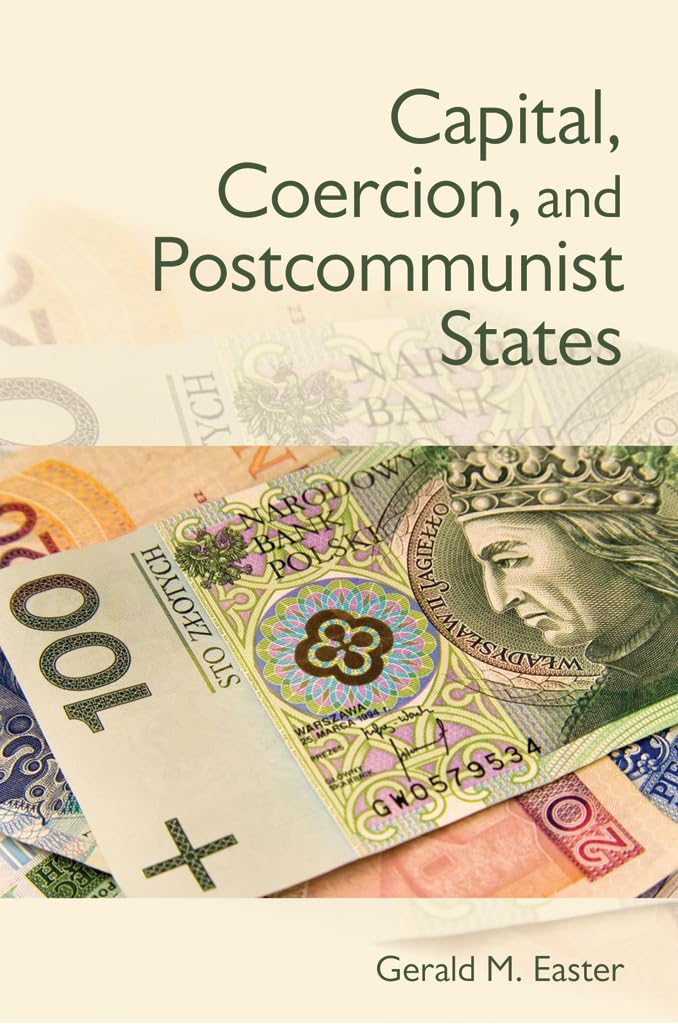
Winner of Davis Book Prize in Political and Social Science (ASEEES; 2013)Winner of Ed A. Hewitt Book Prize for Political Economy (ASEEES; 2013)The postcommunist transitions produced two very different types of states. The "contractual" state is associated with the countries of Eastern Europe, which moved toward democratic regimes, consensual relations with society, and clear boundaries between political power and economic wealth. The "predatory" state is associated with the successors to the USSR, which instead developed authoritarian regimes, coercive relations with society, and poorly defined boundaries between the political and economic realms. In Capital, Coercion, and Postcommunist States, Gerald M. Easter shows how the cumulative result of the many battles between state coercion and societal capital over taxation gave rise to these distinctive transition outcomes. Easter's fiscal sociology of the postcommunist state highlights the interconnected paths that led from the fiscal crisis of the old regime through the revenue bargains of transitional tax regimes to the eventual reconfiguration of statesociety relations. His focused comparison of Poland and Russia exemplifies postcommunism's divergent institutional forms. The Polish case shows how conflicts over taxation influenced the emergence of a ruleoflaw contractual state, socialmarket capitalism, and civil society. The Russian case reveals how revenue imperatives reinforced the emergence of a rulebylaw predatory state, concessionsstyle capitalism, and dependent society.
⚠️ WARNING (California Proposition 65):
This product may contain chemicals known to the State of California to cause cancer, birth defects, or other reproductive harm.
For more information, please visit www.P65Warnings.ca.gov.