
Title
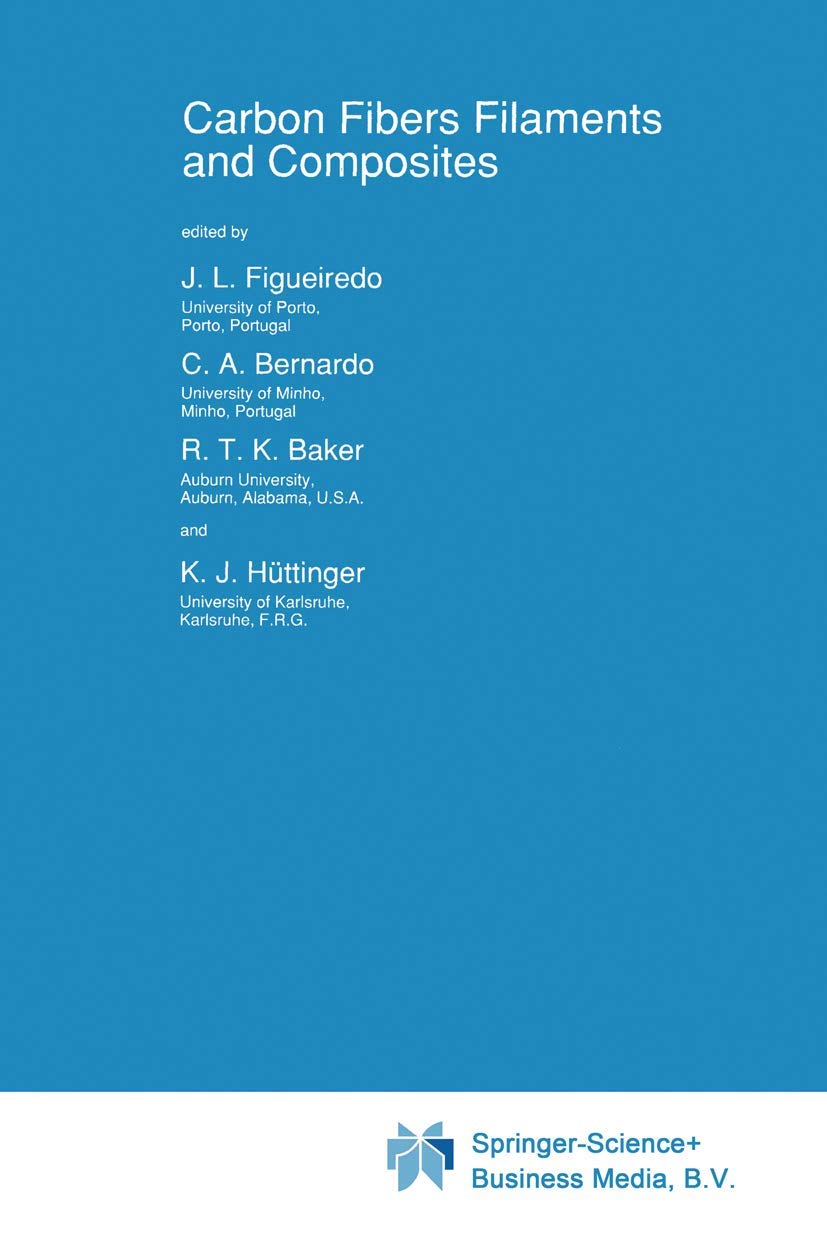
Carbon Fibers Filaments and Composites (NATO Science Series E:, 177),Used
Sold by Ergodebooks, an authorized reseller.
Returns accepted within 30 days | support@ergodebooks.com
Shipping Information
- Free Standard Shipping — United States only
- Processing Time: 3–5 business days
- Estimated Delivery: 6–10 business days after dispatch
- Double-boxed, fully insured & discreetly packaged
- Tracking number sent via email once dispatched
Returns & Refund
Returns accepted within 30 days of delivery.
Damaged or Defective Item
Free return shipping + replacement or full refund
Wrong Item Received
Free return shipping + replacement or full refund
Change of Mind
Return shipping at customer's expense · 25% restocking fee applies
Payment Option

Conventional synthetic materials, like metals, ceramics or glass, are usually isotropic substances, and their suitability for structural applications is achieved by morphological design and combination in the macroscopic scale. However, in modem engineering this is often not acceptable. As an alternative, the use of nonhomogeneous, anisotropic materials, with significant stiffness and strength only in the directions these mechanical properties are really needed, can lead to enormous material (and weight) savings. This is the case of multiphase systems called composite materials. In these composites, different material parts are added and arranged geometrically, under clearly designed and controlled conditions. Usually, a structure of fibers provides strength and stiffness and a matrix helds them together, whilst providing the geometric form. Carbon fibers are among the highperformance fibers employed in these advanced structural composites, which are profoundly changing many of today's high technology industries. New research and development challenges in this area include upgrading the manufacturing process of fibers and composites, in order to improve characteristics and reduce costs, and modifying the interfacial properties between fibers and matrix, to guarantee better mechanical properties. The interdisciplinary nature of this "new frontier" is obvious, involving chemistry, materials science, chemical and mechanical engineering. Other topics, which more often are treated separately, are also important for the understanding of the processes of fiber production. Carbon filaments is one such topic, as the study of their mechanisms of nucleation and growth is clearly quite relevant to the production of vapourgrown carbon fibers.
⚠️ WARNING (California Proposition 65):
This product may contain chemicals known to the State of California to cause cancer, birth defects, or other reproductive harm.
For more information, please visit www.P65Warnings.ca.gov.