
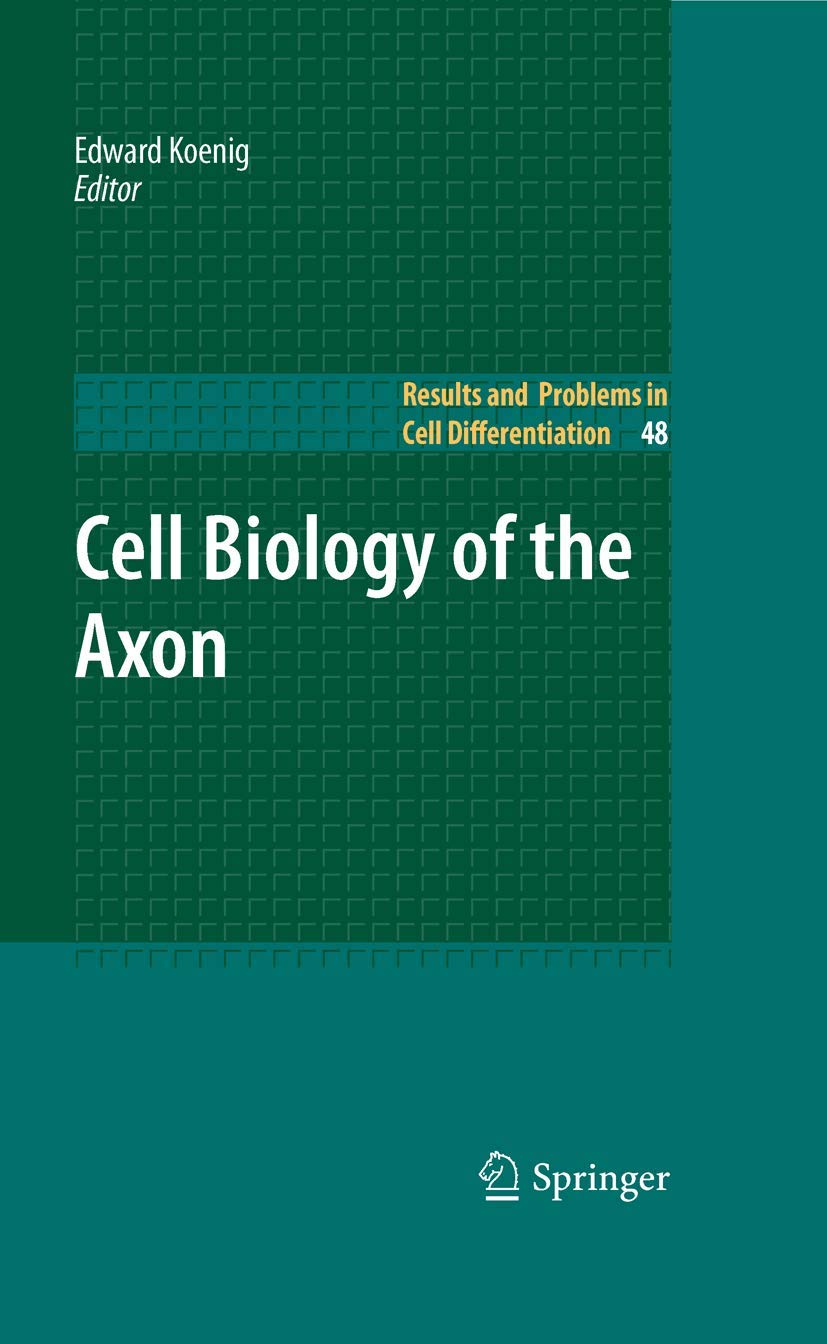
Title
Cell Biology Of The Axon (Results And Problems In Cell Differentiation, 48)
Sold by Ergodebooks, an authorized reseller.
Returns accepted within 30 days | support@ergodebooks.com
Shipping Information
- Free Standard Shipping — United States only
- Processing Time: 3–5 business days
- Estimated Delivery: 6–10 business days after dispatch
- Double-boxed, fully insured & discreetly packaged
- Tracking number sent via email once dispatched
Returns & Refund
Returns accepted within 30 days of delivery.
Damaged or Defective Item
Free return shipping + replacement or full refund
Wrong Item Received
Free return shipping + replacement or full refund
Change of Mind
Return shipping at customer's expense · 25% restocking fee applies
Payment Option

Product Description Recent Years Have Witnessed Striking Advances In Research On Axons At A Cellular Level That Substantially Impact Our Current Understanding Of Axonal Biology. Newer Findings And Their Ramifications Are Critically Reviewed In The 16 Chapters Of This Volume By Authors Highly Qualified By Virtue Of Their Scientific Contributions To Research Areas They Know And Write About. Five Basic Areas (I To V) Germane To Axonal Biology Are Highlighted, Beginning With (I) Signaling Interactions Mediating Myelination, And Differentiation Of Axonal Membrane Domains; (Iia) Issues Surrounding Organization And Transport Dynamics Of Neurofilaments In Axons, (Iib) Mechanisms Regulating Microtubule Organization And Dynamics, Misregulation Of Which Causes Axonal Degeneration, And (Iic) The Roles Actin Binding Proteins Play In Regulating Organization And Functions Of The Actin Filament System In Mature And Growing Axons; (Iiia) Myosin Motor Proteins And Cargoes Intrinsic To The Axon Compartment, (Iiib) Mitochondrial Transport Motors, And Imperatives Governing Transport Dynamics And Directional Delivery, (Iiic) Mechanisms Mediating Retrograde Signaling Associated With Ngfs Role In Trophicdependent Neuronal Survival, And (Iiid) Potential For Impaired Subcellular Targeting Of A Synuclein As A Mechanism For Accumulation Of Lewy Body Inclusions In Synucleinopathies; (Iva) Occurrence And Organization Of Discrete Ribosomecontaining Domains In Axons, (Ivb) Endogenous Mrnas, Classes Of Proteins Translated Locally, And Rnp Trafficking In Axons, (Ivc) Importance Of Locally Synthesized Nuclear Encoded Mitochondrial Proteins For Maintenance, Function And Survival Of Axons, (Ivd) Occurrence Of Rna Trafficking From Glial Cells To Axons, And Significance Glial Rna Transcripts May Play In Expression In Axons And Axon Terminals, (Ive) Rna Trafficking And Localization Of Rna Transcripts In Axonal Growth Cones, And Signaling Pathways That Modulate Local Protein Synthesis For Directional Elongation, And (Ivf) Genetic And Molecular Defects Underlying Spinal Muscular Atrophy, And Roles That Smn Gene Product Plays As A Molecular Chaperone In Mrna Transport And Translation; (Va) Injuryinduced Local Synthesis Of A Protein Forming A Retrograde Signaling Complex In Axons To Stimulate Regeneration, And (Vb) Endogenous And Exogenous Factors That Condition Axonal Regenerative Capacity In Pns And Cns, Including Injuryinduced Activation Of Specific Genes Governing Regeneration.Emergent Complexities Revealed In This Volume Compel A Major Revision In The Traditional Conceptual Model Of The Axons Intrinsic Makeup And Capacities. From The Back Cover Recent Years Have Witnessed Striking Advances In Research On Axons At A Cellular Level That Substantially Impact Our Current Understanding Of Axonal Biology. Newer Findings And Their Ramifications Are Critically Reviewed In The 16 Chapters Of This Volume By Authors Highly Qualified By Virtue Of Their Scientific Contributions To Research Areas They Know And Write About. Five Basic Areas (I To V) Germane To Axonal Biology Are Highlighted, Beginning With (I) Signaling Interactions Mediating Myelination, And Differentiation Of Axonal Membrane Domains; (Iia) Issues Surrounding Organization And Transport Dynamics Of Neurofilaments In Axons, (Iib) Mechanisms Regulating Microtubule Organization And Dynamics, Misregulation Of Which Causes Axonal Degeneration, And (Iic) The Roles Actin Binding Proteins Play In Regulating Organization And Functions Of The Actin Filament System In Mature And Growing Axons; (Iiia) Myosin Motor Proteins And Cargoes Intrinsic To The Axon Compartment, (Iiib) Mitochondrial Transport Motors, And Imperatives Governing Transport Dynamics And Directional Delivery, (Iiic) Mechanisms Mediating Retrograde Signaling Associated With Ngfs Role In Trophicdependent Neuronal Survival, And (Iiid) Potential For Impaired Subcellular Targeting Of A Synuclein As A Mechanism For Accumulation Of Lewy Bo
⚠️ WARNING (California Proposition 65):
This product may contain chemicals known to the State of California to cause cancer, birth defects, or other reproductive harm.
For more information, please visit www.P65Warnings.ca.gov.
- Q: What is the page count of this book? A: This book contains three hundred seventy-six pages. It provides an in-depth exploration of axonal biology.
- Q: What are the dimensions of 'Cell Biology of the Axon'? A: The book measures six point fourteen inches in length, zero point eighty-eight inches in width, and nine point twenty-one inches in height.
- Q: What type of binding does this book have? A: This book is bound in hardcover. It ensures durability and a professional appearance.
- Q: Who is the author of this book? A: The author of this book is Edward Koenig. He is recognized for his contributions to the field of cell biology.
- Q: What category does this book belong to? A: This book falls under the category of Biochemistry. It focuses on the cellular aspects of axonal biology.
- Q: What is the main theme of this book? A: The main theme revolves around recent advances in axonal research. It critically reviews significant findings and their implications.
- Q: How do I use this book for my studies? A: You can use this book as a reference for advanced studies in cell biology. It is ideal for researchers and students interested in axonal biology.
- Q: Is this book suitable for beginners in biology? A: No, this book is not primarily aimed at beginners. It is best suited for those with a foundational understanding of biochemistry.
- Q: Can I find practical applications in this book? A: Yes, the book discusses practical implications of axonal research. It highlights areas relevant to neuroscience and regenerative medicine.
- Q: How should I store this book to keep it in good condition? A: Store this book in a cool, dry place away from direct sunlight. This will help preserve the quality of the hardcover and pages.
- Q: Is there any special care needed for the book's binding? A: No special care is needed for the hardcover binding. However, handle it gently to avoid damage to the spine.
- Q: What if the book arrives damaged? A: If the book arrives damaged, you should contact the seller immediately. Most retailers provide options for returns or exchanges.
- Q: Does this book come with a warranty? A: No, books typically do not come with a warranty. However, check with the retailer for their return policy.
- Q: What should I do if I can't find information in this book? A: If you can't find what you need, consider checking the index or glossary. These sections can help you locate specific topics.
- Q: Are there any illustrations or figures in this book? A: Yes, the book includes various illustrations and figures. These visuals complement the text and enhance understanding of complex concepts.