If you have any questions, you are always welcome to contact us. We'll get back to you as soon as possible, withing 24 hours on weekdays.
Customer service
All questions about your order, return and delivery must be sent to our customer service team by e-mail at yourstore@yourdomain.com
Sale & Press
If you are interested in selling our products, need more information about our brand or wish to make a collaboration, please contact us at press@yourdomain.com
Help
If you have any questions, you are always welcome to contact us. We'll get back to you as soon as possible, withing 24 hours on weekdays.
Customer service
All questions about your order, return and delivery must be sent to our customer service team by e-mail at yourstore@yourdomain.com
Sale & Press
If you are interested in selling our products, need more information about our brand or wish to make a collaboration, please contact us at press@yourdomain.com
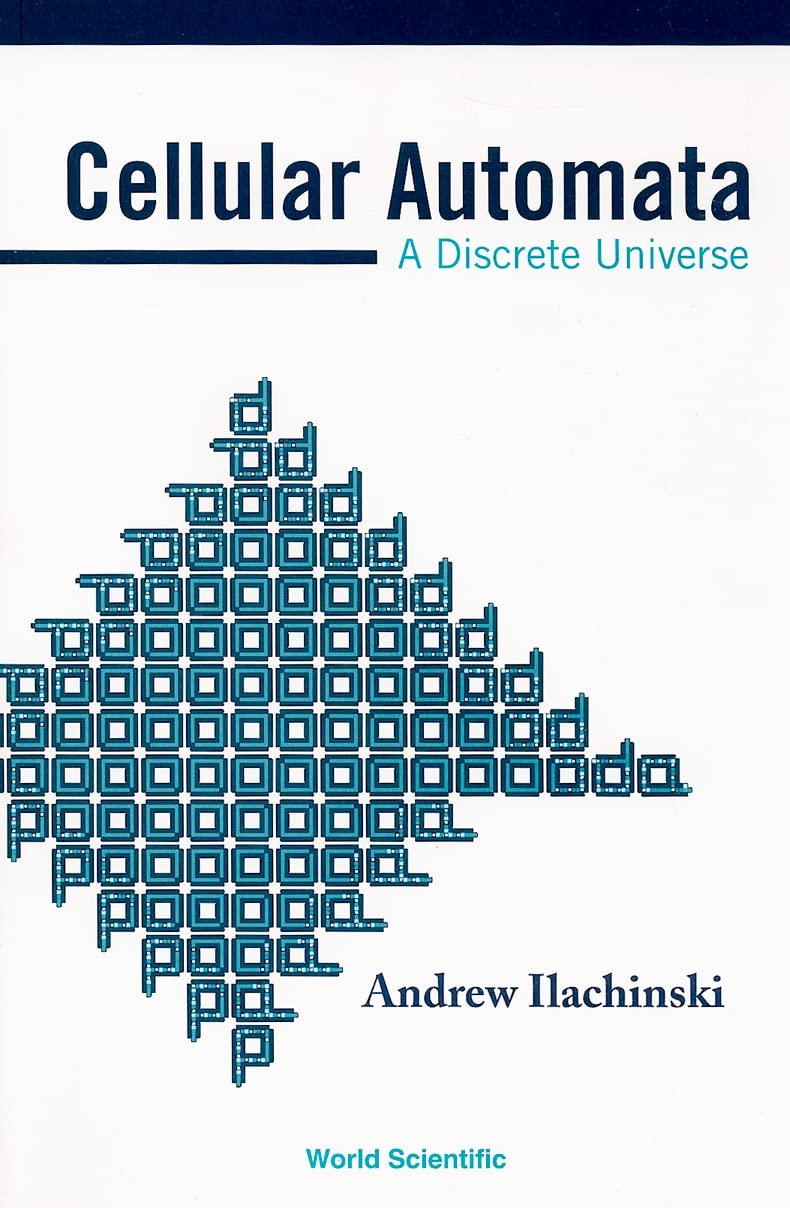
Cellular automata are a class of spatially and temporally discrete mathematical systems characterized by local interaction and synchronous dynamical evolution. Introduced by the mathematician John von Neumann in the 1950s as simple models of biological selfreproduction, they are prototypical models for complex systems and processes consisting of a large number of simple, homogeneous, locally interacting components. Cellular automata have been the focus of great attention over the years because of their ability to generate a rich spectrum of very complex patterns of behavior out of sets of relatively simple underlying rules. Moreover, they appear to capture many essential features of complex selforganizing cooperative behavior observed in real systems.This book provides a summary of the basic properties of cellular automata, and explores in depth many important cellularautomatarelated research areas, including artificial life, chaos, emergence, fractals, nonlinear dynamics, and selforganization. It also presents a broad review of the speculative proposition that cellular automata may eventually prove to be theoretical harbingers of a fundamentally new informationbased, discrete physics. Designed to be accessible at the junior/senior undergraduate level and above, the book will be of interest to all students, researchers, and professionals wanting to learn about order, chaos, and the emergence of complexity. It contains an extensive bibliography and provides a listing of cellular automata resources available on the World Wide Web.
⚠️ WARNING (California Proposition 65):
This product may contain chemicals known to the State of California to cause cancer,
birth defects, or other reproductive harm.
For MAP (Minimum Advertised Price) violations and Intellectual Property (IP) or Trademark concerns, please contact:
support@ergodebooks.com
⚠️ California Proposition 65 Warning: Some products sold on this website may expose you to chemicals known to the State of California to cause cancer, birth defects, or other reproductive harm. For more information, visit www.P65Warnings.ca.gov.