
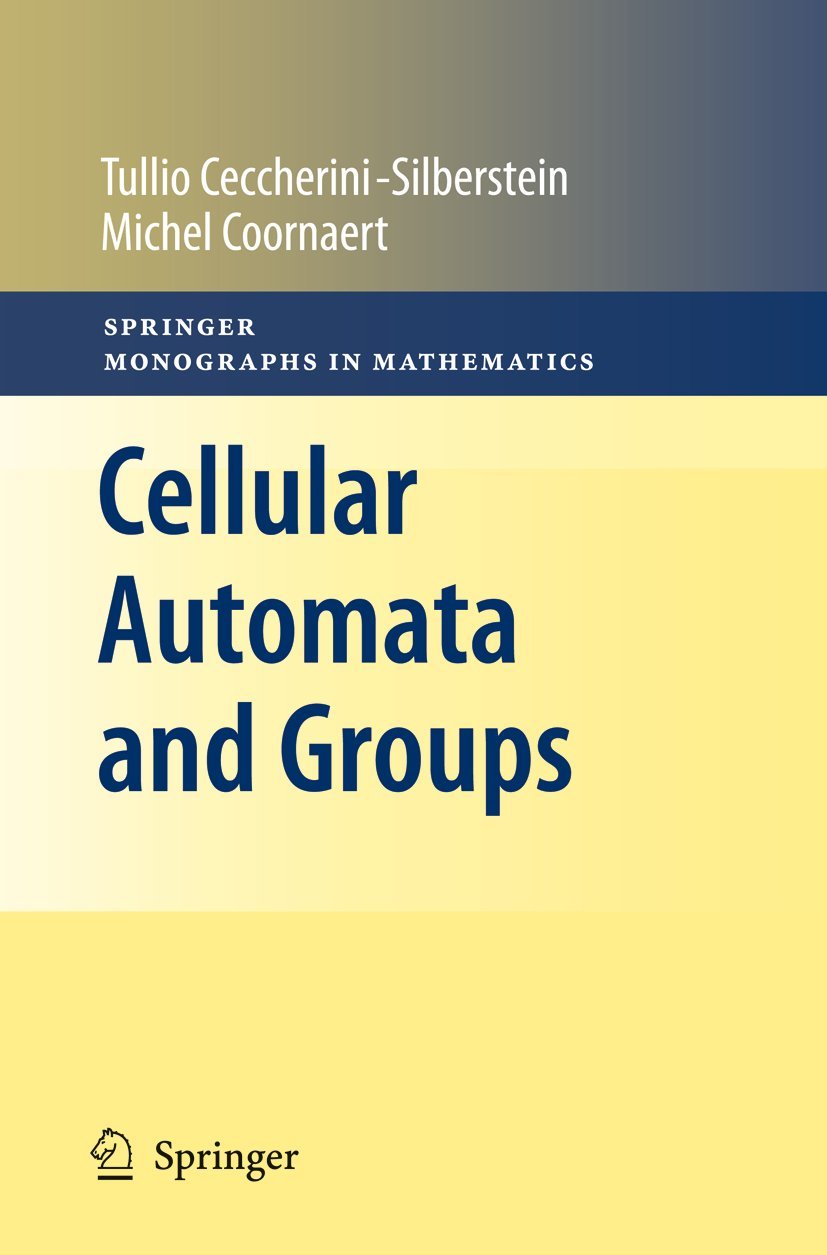
Title
Cellular Automata And Groups (Springer Monographs In Mathematics)
Sold by Ergodebooks, an authorized reseller.
Returns accepted within 30 days | support@ergodebooks.com
Shipping Information
- Free Standard Shipping — United States only
- Processing Time: 3–5 business days
- Estimated Delivery: 6–10 business days after dispatch
- Double-boxed, fully insured & discreetly packaged
- Tracking number sent via email once dispatched
Returns & Refund
Returns accepted within 30 days of delivery.
Damaged or Defective Item
Free return shipping + replacement or full refund
Wrong Item Received
Free return shipping + replacement or full refund
Change of Mind
Return shipping at customer's expense · 25% restocking fee applies
Payment Option

Cellular Automata Were Introduced In The First Half Of The Last Century By John Von Neumann Who Used Them As Theoretical Models For Selfreproducing Machines. The Authors Present A Selfcontained Exposition Of The Theory Of Cellular Automata On Groups And Explore Its Deep Connections With Recent Developments In Geometric Group Theory, Symbolic Dynamics, And Other Branches Of Mathematics And Theoretical Computer Science. The Topics Treated Include In Particular The Garden Of Eden Theorem For Amenable Groups, And The Gromovweiss Surjunctivity Theorem As Well As The Solution Of The Kaplansky Conjecture On The Stable Finiteness Of Group Rings For Sofic Groups. The Volume Is Entirely Selfcontained, With 10 Appendices And More Than 300 Exercises, And Appeals To A Large Audience Including Specialists As Well As Newcomers In The Field. It Provides A Comprehensive Account Of Recent Progress In The Theory Of Cellular Automata Based On The Interplay Between Amenability, Geometric And Combinatorial Group Theory, Symbolic Dynamics And The Algebraic Theory Of Group Rings Which Are Treated Here For The First Time In Book Form.
⚠️ WARNING (California Proposition 65):
This product may contain chemicals known to the State of California to cause cancer, birth defects, or other reproductive harm.
For more information, please visit www.P65Warnings.ca.gov.
- Q: How many pages does this book have? A: This book has four hundred sixty pages. It offers a comprehensive exploration of cellular automata and their connections with various mathematical theories.
- Q: What is the binding type of this book? A: This book is hardcover. The durable binding enhances its longevity, making it suitable for extensive use.
- Q: What are the dimensions of the book? A: The book measures six inches in length, one point two six inches in width, and nine point two five inches in height. These dimensions make it a standard-sized book for easy handling.
- Q: Who is the author of this book? A: The author is Tullio Ceccherini-Silberstein. He presents the theory of cellular automata and their mathematical implications in this work.
- Q: What is the main topic covered in the book? A: The main topic is the theory of cellular automata. It delves into connections with geometric group theory, symbolic dynamics, and theoretical computer science.
- Q: Is this book suitable for beginners? A: Yes, the book is suitable for both specialists and newcomers. It provides a self-contained exposition, making it accessible for those new to the topic.
- Q: Can you explain the Garden of Eden theorem mentioned in the book? A: Yes, the Garden of Eden theorem is discussed in relation to amenable groups. It explores conditions under which certain cellular automata configurations can emerge.
- Q: What are some unique features of this book? A: The book includes ten appendices and over three hundred exercises. These features enhance the learning experience and provide practical applications of the concepts discussed.
- Q: What should I do if I find a mistake in the book? A: If you find a mistake, it is advisable to contact the publisher for clarification or corrections. They can provide guidance on any errors in the text.
- Q: How do I care for this hardcover book? A: To care for the book, keep it in a dry place and avoid direct sunlight. Regularly dust the cover and pages to maintain its condition.
- Q: Is there a warranty for this book? A: Typically, books do not come with warranties. However, you can inquire with the seller about their return policy for defective copies.
- Q: What if the book arrives damaged? A: If the book arrives damaged, contact the seller immediately for a replacement or refund. Ensure to provide details and pictures of the damage.
- Q: Are there exercises included in the book? A: Yes, there are over three hundred exercises included. These exercises help reinforce the concepts and theories presented throughout the book.
- Q: Is this book part of a series? A: Yes, this book is part of the Springer Monographs in Mathematics series. It contributes to the broader discussion in mathematical research.
- Q: What is the focus of the appendices in the book? A: The appendices cover additional topics and provide supplementary material that complements the main text, enhancing reader understanding.
- Q: Does this book include any illustrations? A: Yes, the book features fifty-two black and white illustrations. These visuals aid in the comprehension of complex concepts related to cellular automata.