

Title

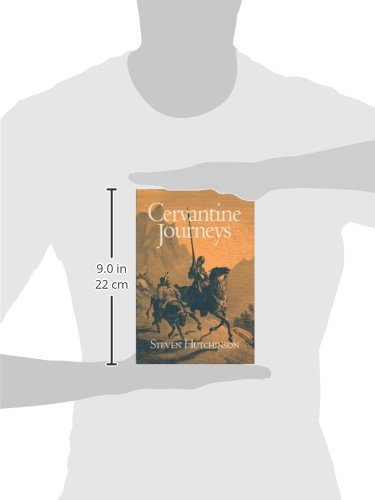
Cervantine Journeys,Used
Sold by Ergodebooks, an authorized reseller.
Returns accepted within 30 days | support@ergodebooks.com
Shipping Information
- Free Standard Shipping — United States only
- Processing Time: 3–5 business days
- Estimated Delivery: 6–10 business days after dispatch
- Double-boxed, fully insured & discreetly packaged
- Tracking number sent via email once dispatched
Returns & Refund
Returns accepted within 30 days of delivery.
Damaged or Defective Item
Free return shipping + replacement or full refund
Wrong Item Received
Free return shipping + replacement or full refund
Change of Mind
Return shipping at customer's expense · 25% restocking fee applies
Payment Option

Hutchinson focuses initially on movement as concept and metaphor, affirming its centrality in the conceptualization of all discursive activities. He draws on an array of authors including Heraclitus, Plato, Longinus, Rabelais, Nietzsche, Saussure, Frances Yates, Kristeva, Meschonnic, and Deleuze to demonstrate the "motion" of discourse and of those engaged in it. He then turns to Cervantes' novels to show how metaphors of movement and travel, appearing on nearly every page, dominate the conceptualization of the soul, the self, desire, love, and life processes. Viewing travel as a composite of concurrent modes of experience with differing content and rhythms, Hutchinson considers the concept of errancy, the nature of "place" and the traveler's shifting relations with it, and the values that travel may have as a motion, displacement, encounter, and goal. Of key importance are the means of improvisation developed en route. His reexamination of Bakhtin's "chronotope" in light of Cervante's novels reveals the dynamic character of timespaces in which travelers move. He shows, moreover, that unlike typical Renaissance utopias the many worlds of Cervantes' novels have the principles of becoming and dissolution inscribed in them.Reflecting on the narrative of journeys both as memory and invention, Hutchinson concludes with an examination of the relations between travel experience and travel narrative and a discussion of the whereabouts of writers and readers in Cervantes' novels. The narration of journeys, he argues, necessitates and encourages improvisatory writing.
⚠️ WARNING (California Proposition 65):
This product may contain chemicals known to the State of California to cause cancer, birth defects, or other reproductive harm.
For more information, please visit www.P65Warnings.ca.gov.