
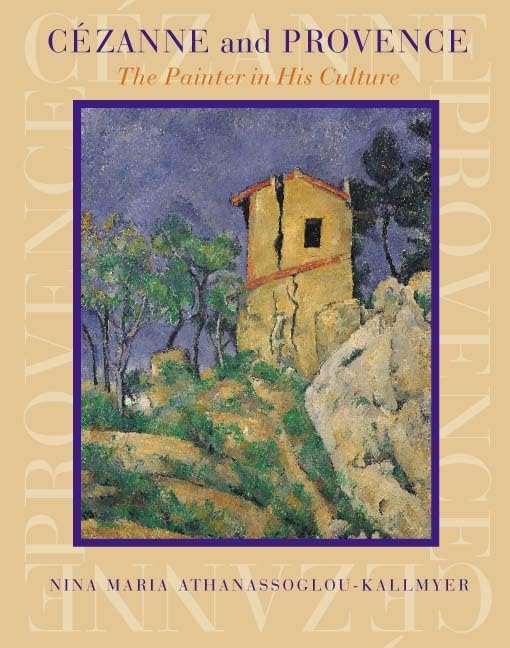
Title
Cezanne and Provence: The Painter in His Culture,Used
Sold by Ergodebooks, an authorized reseller.
Returns accepted within 30 days | support@ergodebooks.com
Shipping Information
- Free Standard Shipping — United States only
- Processing Time: 3–5 business days
- Estimated Delivery: 6–10 business days after dispatch
- Double-boxed, fully insured & discreetly packaged
- Tracking number sent via email once dispatched
Returns & Refund
Returns accepted within 30 days of delivery.
Damaged or Defective Item
Free return shipping + replacement or full refund
Wrong Item Received
Free return shipping + replacement or full refund
Change of Mind
Return shipping at customer's expense · 25% restocking fee applies
Payment Option

In 1886 Paul Czanne left Paris permanently to settle in his native AixenProvence. Nina M. AthanassoglouKallmyer argues that, far from an escapist venture like Gauguin's stay in Brittany or Monet's visits to Normandy, Czanne's departure from Paris was a deliberate abandonment intimately connected with latenineteenthcentury French regionalist politics.Like many of his childhood friends, Czanne detested the homogenizing effects of modernism and bourgeois capitalism on the culture, people, and landscapes of his beloved Provence. Turning away from the mainstream modernist aesthetic of his impressionist years, Czanne sought instead to develop a new artistic tradition more evocative of his Provenal heritage. AthanassoglouKallmyer shows that Provence served as a distinct and defining cultural force that shaped all aspects of Czanne's approach to representation, including subject matter, style, and technical treatment. For instance, his selfportraits and portraits of family members reflect a specifically Provenal sense of identity. And Czanne's Provenal landscapes express an increasingly traditionalist style firmly grounded in details of local history and even geology. These landscapes, together with images of bathers, cardplayers, and other figures, were key facets of Czanne's imaginary reconstruction of Provence as primordial and idyllica modern French Arcadia.Highly original and lavishly illustrated, Czanne and Provence gives us an entirely new Czanne: no longer the quintessential icon of generic, depersonalized modernism, but instead a selfconsciously provincial innovator of mainstream styles deeply influenced by Provenal culture, places, and politics.
⚠️ WARNING (California Proposition 65):
This product may contain chemicals known to the State of California to cause cancer, birth defects, or other reproductive harm.
For more information, please visit www.P65Warnings.ca.gov.