If you have any questions, you are always welcome to contact us. We'll get back to you as soon as possible, withing 24 hours on weekdays.
Customer service
All questions about your order, return and delivery must be sent to our customer service team by e-mail at yourstore@yourdomain.com
Sale & Press
If you are interested in selling our products, need more information about our brand or wish to make a collaboration, please contact us at press@yourdomain.com
Help
If you have any questions, you are always welcome to contact us. We'll get back to you as soon as possible, withing 24 hours on weekdays.
Customer service
All questions about your order, return and delivery must be sent to our customer service team by e-mail at yourstore@yourdomain.com
Sale & Press
If you are interested in selling our products, need more information about our brand or wish to make a collaboration, please contact us at press@yourdomain.com
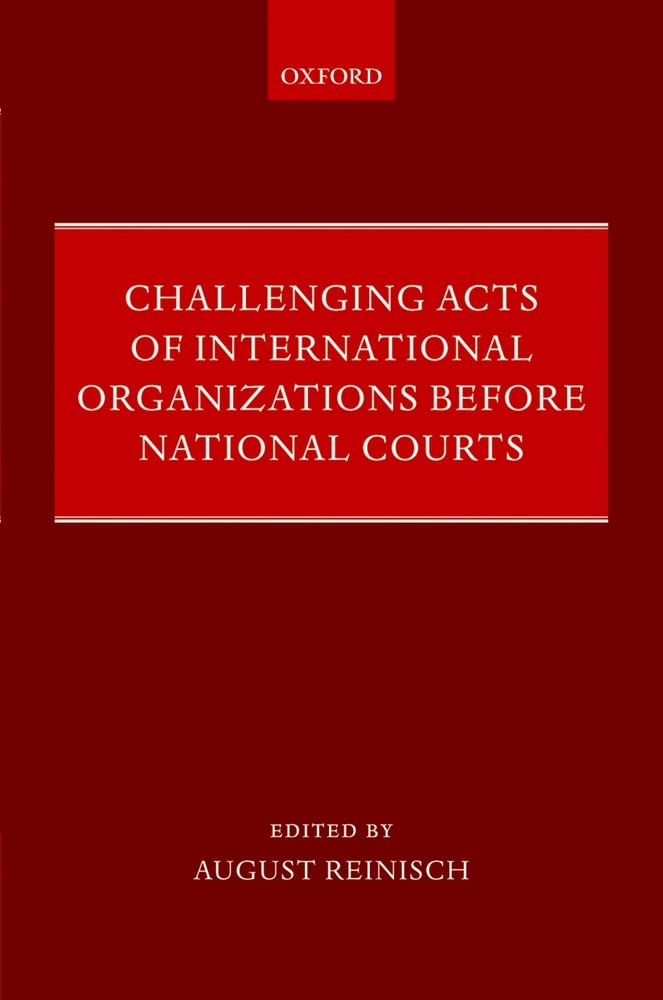
As the Kadihype following the 2008 European Court of Justice judgment demonstrated, there are many problems associated with the judicial review of acts of international organizations. This book is the first to present a broader overview of how acts of international organizations have been challenged before national courts. It covers such diverse organizations as the United Nations, its subsidiary organs, such as the specialized international criminal courts for the former Yugoslavia and Rwanda, the European Patent Office, the European Schools, EUROCONTROL, OPEC, and INTERPOL.Building extensively on the case law of domestic courts, the chapters highlight reoccurring legal issues in light of four working hypotheses. These relate to the nature of judicial review of the acts of international organizations, its interdependence with domestic methods of incorporating international law, the conditions of a human rightsbased review, and the tension between the independent functioning of an organization and guaranteeing legal protection against its acts.This approach ensures consistency among the book's chapters, which each focus on a different organization. Its conclusion brings the different findings together and analyses them in the light of the working hypotheses. It also discusses whether attempts to secure a certain minimum level of legal protection against acts of international organizations through judicial review by national courts may contribute to securing greater accountability of international organizations.
⚠️ WARNING (California Proposition 65):
This product may contain chemicals known to the State of California to cause cancer,
birth defects, or other reproductive harm.
For MAP (Minimum Advertised Price) violations and Intellectual Property (IP) or Trademark concerns, please contact:
support@ergodebooks.com
⚠️ California Proposition 65 Warning: Some products sold on this website may expose you to chemicals known to the State of California to cause cancer, birth defects, or other reproductive harm. For more information, visit www.P65Warnings.ca.gov.