
Title
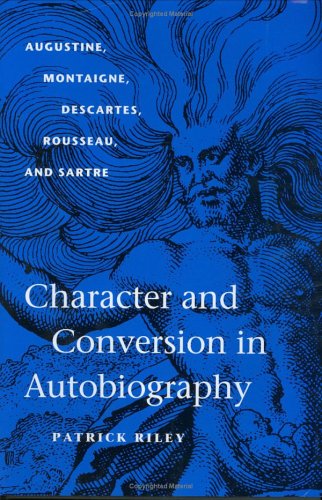
Character and Conversion in Autobiography: Augustine, Montaigne, Descartes, Rousseau, and Sartre,New
Sold by Ergodebooks, an authorized reseller.
Returns accepted within 30 days | support@ergodebooks.com
Shipping Information
- Free Standard Shipping — United States only
- Processing Time: 3–5 business days
- Estimated Delivery: 6–10 business days after dispatch
- Double-boxed, fully insured & discreetly packaged
- Tracking number sent via email once dispatched
Returns & Refund
Returns accepted within 30 days of delivery.
Damaged or Defective Item
Free return shipping + replacement or full refund
Wrong Item Received
Free return shipping + replacement or full refund
Change of Mind
Return shipping at customer's expense · 25% restocking fee applies
Payment Option

What happens, asks Patrick Riley, when a life transformed becomes an autobiography? What is the relationship between the subjective upheaval of conversion and the representation of character? Who, then, is this 'self' writing the narrative of a life? Thinking of conversion as a radical turning point or fulcrum on which incompatible configurations of character are precariously balanced, Riley examines both historically and tropologically the paradoxes of identity and life writing that conversion raises. While conversion can motivate the writing of an autobiography that ties together threads of a life story, it also implies a fragmentation of character. As it creates a unified framework for the subjects history, it also disrupts any stable conception of the self.Beginning with Augustines Confessions as the canonical model of religious conversion, the author investigates the changing forms of conversion in selected works by Montaigne and Descartes, culminating in reformulations by Rousseau and Sartre. Moving from a purely religious rebirth to works grounded in a personal philosophy or aesthetic vocation, the autobiographies considered in this book stand as episodes in a genealogy of conversion.Riley argues that the metamorphoses of character inherent to conversion disrupt any interpretation or even representation of the self as static. It is no longer clear that the narrator represents the subject in any but a nominal way. In fact, Riley contends, the subject of an autobiography can never be selfidentical.Challenging predominant theories of subjectivity in autobiography, Character and Conversion in Autobiography recognizes subjectivity as a dynamic process and suggests a redefinition of how we examine character and life writing.
⚠️ WARNING (California Proposition 65):
This product may contain chemicals known to the State of California to cause cancer, birth defects, or other reproductive harm.
For more information, please visit www.P65Warnings.ca.gov.