
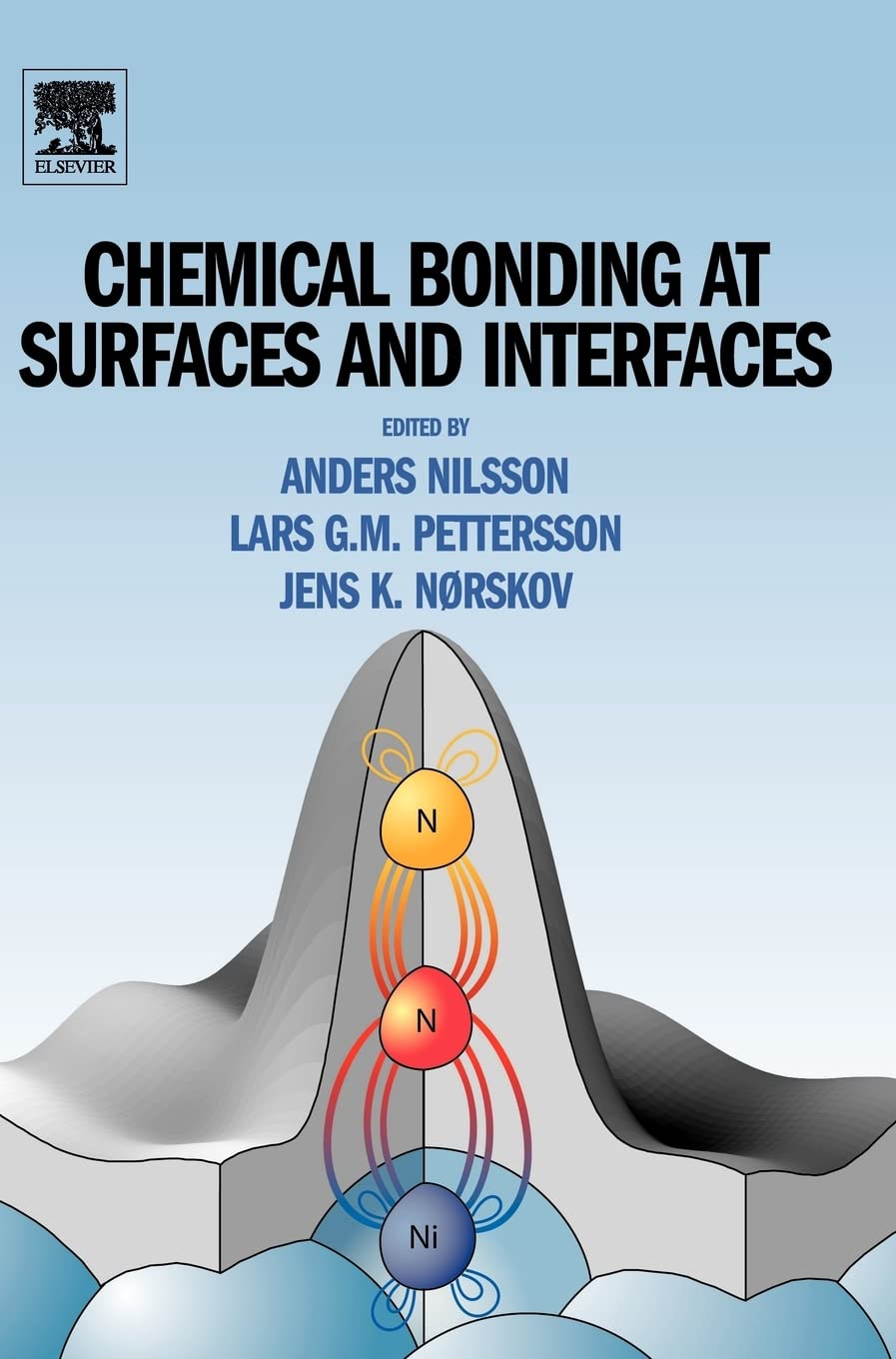
Title
Chemical Bonding At Surfaces And Interfaces
Sold by Ergodebooks, an authorized reseller.
Returns accepted within 30 days | support@ergodebooks.com
Shipping Information
- Free Standard Shipping — United States only
- Processing Time: 3–5 business days
- Estimated Delivery: 6–10 business days after dispatch
- Double-boxed, fully insured & discreetly packaged
- Tracking number sent via email once dispatched
Returns & Refund
Returns accepted within 30 days of delivery.
Damaged or Defective Item
Free return shipping + replacement or full refund
Wrong Item Received
Free return shipping + replacement or full refund
Change of Mind
Return shipping at customer's expense · 25% restocking fee applies
Payment Option

Molecular surface science has made enormous progress in the past 30 years. The development can be characterized by a revolution in fundamental knowledge obtained from simple model systems and by an explosion in the number of experimental techniques. The last 10 years has seen an equally rapid development of quantum mechanical modeling of surface processes using Density Functional Theory (DFT).Chemical Bonding at Surfaces and Interfaces focuses on phenomena and concepts rather than on experimental or theoretical techniques. The aim is to provide the common basis for describing the interaction of atoms and molecules with surfaces and this to be used very broadly in science and technology.The book begins with an overview of structural information on surface adsorbates and discusses the structure of a number of important chemisorption systems. Chapter 2 describes in detail the chemical bond between atoms or molecules and a metal surface in the observed surface structures. A detailed description of experimental information on the dynamics of bondformation and bondbreaking at surfaces make up Chapter 3. Followed by an indepth analysis of aspects of heterogeneous catalysis based on the dband model. In Chapter 5 adsorption and chemistry on the enormously important Si and Ge semiconductor surfaces are covered. In the remaining two Chapters the book moves on from solidgas interfaces and looks at solidliquid interface processes. In the final chapter an overview is given of the environmentally important chemical processes occurring on mineral and oxide surfaces in contact with water and electrolytes. Gives examples of how modern theoretical DFT techniques can be used to design heterogeneous catalysts This book suits the rapid introduction of methods and concepts from surface science into a broad range of scientific disciplines where the interaction between a solid and the surrounding gas or liquid phase is an essential component Shows how insight into chemical bonding at surfaces can be applied to a range of scientific problems in heterogeneous catalysis, electrochemistry, environmental science and semiconductor processing Provides both the fundamental perspective and an overview of chemical bonding in terms of structure, electronic structure and dynamics of bond rearrangements at surfaces
⚠️ WARNING (California Proposition 65):
This product may contain chemicals known to the State of California to cause cancer, birth defects, or other reproductive harm.
For more information, please visit www.P65Warnings.ca.gov.