
Title
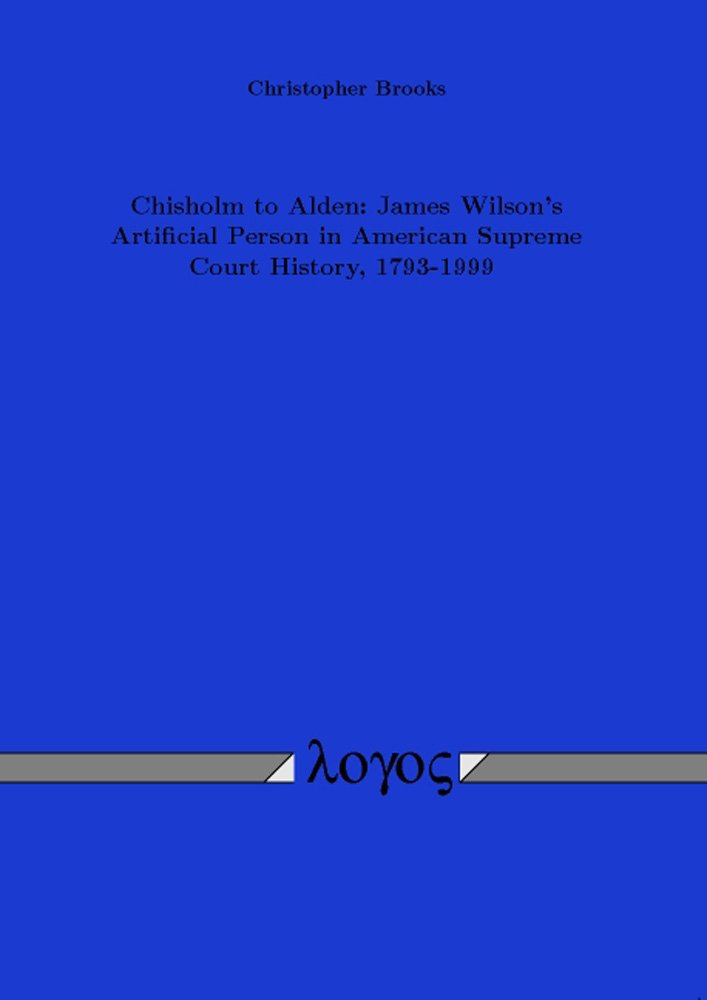
Chisholm to Alden: James Wilson's Artificial Person in American Supreme Court History, 17931999,Used
Sold by Ergodebooks, an authorized reseller.
Returns accepted within 30 days | support@ergodebooks.com
Shipping Information
- Free Standard Shipping — United States only
- Processing Time: 3–5 business days
- Estimated Delivery: 6–10 business days after dispatch
- Double-boxed, fully insured & discreetly packaged
- Tracking number sent via email once dispatched
Returns & Refund
Returns accepted within 30 days of delivery.
Damaged or Defective Item
Free return shipping + replacement or full refund
Wrong Item Received
Free return shipping + replacement or full refund
Change of Mind
Return shipping at customer's expense · 25% restocking fee applies
Payment Option

Most simply said, this dissertation is about whether the citizen of one state of the United States may sue another state of the United States despite the Eleventh Amendment to the United States Constitution, which reads: The Judicial power of the United States shall not be construed to extend to any suit in law or equity, commenced or prosecuted against one of the United States by Citizens of another State, or by Citizens or Subjects of any Foreign State. Though this provision addresses the broader issue of states' sovereignty, the principle objective of this work, Chisholm to Alden: James Wilson's "Artificial Person" in American Constitutional History, 17931999, is on the suability of the states. To appropriately appraise this subject, I investigate what the original intent of those who wrote the Constitution was and what various Courts in the history of US jurisprudence consider that intent or meaning to have been, ending with the textualistoriginalist Justices of the 1990s, many or whom remain on the bench today. This is a discombobulating task, for there were so many differing opinions at the Federal Convention as to what the text meant, that there cannot be just one. Therefore, taking a look at some of the major cases that address states' suability in US Supreme Court history, I focus on the more specific question of what could have reasonably been meant by the Founders on states' suability. The point of departure for this venture is Chisholm v. Georgia (1793), since it was the impetus for the Eleventh Amendment, with aspecial focus on James Wilson's opinion in the case. From there, selected cases from theMarshall Court through to the 1999 case of Alden v. Maine are carefully discussed as a meansof discovering whether or not the states were ever actually suable and which cases may haveled more modern Courts astray.
⚠️ WARNING (California Proposition 65):
This product may contain chemicals known to the State of California to cause cancer, birth defects, or other reproductive harm.
For more information, please visit www.P65Warnings.ca.gov.