If you have any questions, you are always welcome to contact us. We'll get back to you as soon as possible, withing 24 hours on weekdays.
Customer service
All questions about your order, return and delivery must be sent to our customer service team by e-mail at yourstore@yourdomain.com
Sale & Press
If you are interested in selling our products, need more information about our brand or wish to make a collaboration, please contact us at press@yourdomain.com
Help
If you have any questions, you are always welcome to contact us. We'll get back to you as soon as possible, withing 24 hours on weekdays.
Customer service
All questions about your order, return and delivery must be sent to our customer service team by e-mail at yourstore@yourdomain.com
Sale & Press
If you are interested in selling our products, need more information about our brand or wish to make a collaboration, please contact us at press@yourdomain.com
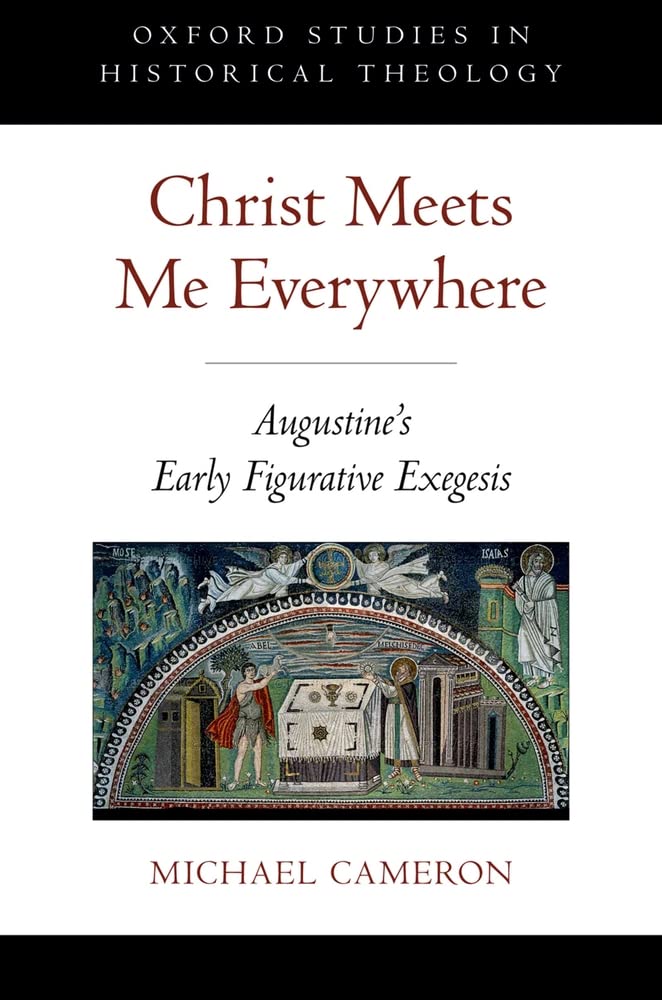
Most readers first encounter Augustine's love for Scripture's words in the many biblical allusions of his masterwork, the Confessions. Augustine does not merely quote texts, but in many ways makes Scripture itself tell the story. In his journey from darkness to light, Augustine becomes Adam in the Garden of Eden, the Prodigal Son of Jesus' parable, and the Pauline double personality at once devoted to and rebellious against God's law. Throughout he speaks the words of the Psalms as if he had written them. Crucial to Augustine's selfportrayal is his skill at transposing himself into the texts. He sees their properties and dynamics as his own, and by extension, every believing reader's own. In Christ Meets Me Everywhere, Michael Cameron argues that Augustine wanted to train readers of Scripture to transpose themselves into the texts in the same way he did, by the same process of figuration that he found at Scripture's core. Augustine discovered this skill by learning to read Scripture as a work of divine rhetoric that mirrors the humility of the human Christ who forms humble readers to ascend its spiritual heights. Tracking Augustine's developing skill in reading Scripture's figures as microcosms of the history of salvation during the first fifteen years of his Christian life, Cameron shows how Christ's selftransposition into Scripture's readers became the key to Augustine's hermeneutics.
⚠️ WARNING (California Proposition 65):
This product may contain chemicals known to the State of California to cause cancer,
birth defects, or other reproductive harm.
For MAP (Minimum Advertised Price) violations and Intellectual Property (IP) or Trademark concerns, please contact:
support@ergodebooks.com
⚠️ California Proposition 65 Warning: Some products sold on this website may expose you to chemicals known to the State of California to cause cancer, birth defects, or other reproductive harm. For more information, visit www.P65Warnings.ca.gov.