
Title
Christianization and Commonwealth in Early Medieval Europe: A Ritual Interpretation,Used
Sold by Ergodebooks, an authorized reseller.
Returns accepted within 30 days | support@ergodebooks.com
Shipping Information
- Free Standard Shipping — United States only
- Processing Time: 3–5 business days
- Estimated Delivery: 6–10 business days after dispatch
- Double-boxed, fully insured & discreetly packaged
- Tracking number sent via email once dispatched
Returns & Refund
Returns accepted within 30 days of delivery.
Damaged or Defective Item
Free return shipping + replacement or full refund
Wrong Item Received
Free return shipping + replacement or full refund
Change of Mind
Return shipping at customer's expense · 25% restocking fee applies
Payment Option

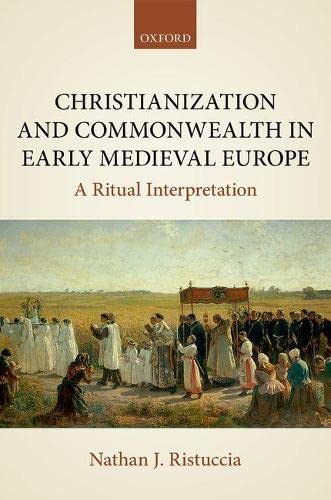
Christianization and Commonwealth in Early Medieval Europe reexamines the alterations in Western European life that followed widespread conversion to Christianitythe phenomena traditionally termed 'Christianization'. It refocuses scholarly paradigms for Christianization around the development of mandatory rituals. One prominent ritual, Rogationtide supplies an ideal case study demonstrating a new paradigm of 'Christianization without religion.' Christianization in the Middle Ages was not a slow process through which a Christian system of religious beliefs and practices replaced an earlier pagan system. In the Middle Ages, religion did not exist in the sense of a fixed system of belief bounded off from other spheres of life. Rather, Christianization was primarily ritual performance. Being a Christian meant joining a local church community.After the fall of Rome, mandatory rituals such as Rogationtide arose to separate a Christian commonwealth from the pagans, heretics, and Jews outside it. A Latin West between the polis and the parish had its own institutionthe Rogation processionfor organizing local communities. For medieval people, sectarian borders were often flexible and rituals served to demarcate these borders. Rogationtide is an ideal case study of this demarcation, because it was an emotionally powerful feast, which combined pageantry with doctrinal instruction, community formation, social ranking, devotional exercises, and bodily mortification. As a result, rival groups quarrelled over the holiday's meaning and procedure, sometimes violently, in order to reshape the local order and ban people and practices as nonChristian.
⚠️ WARNING (California Proposition 65):
This product may contain chemicals known to the State of California to cause cancer, birth defects, or other reproductive harm.
For more information, please visit www.P65Warnings.ca.gov.