
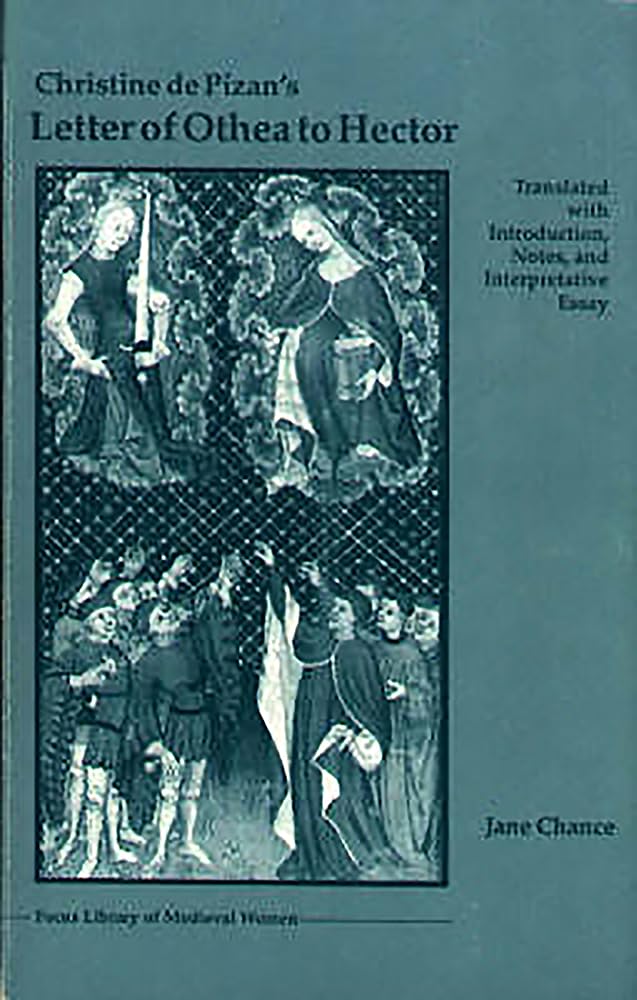
Title
Christine De Pizan'S Letter Of Othea To Hector,New
Sold by Ergodebooks, an authorized reseller.
Returns accepted within 30 days | support@ergodebooks.com
Shipping Information
- Free Standard Shipping — United States only
- Processing Time: 3–5 business days
- Estimated Delivery: 6–10 business days after dispatch
- Double-boxed, fully insured & discreetly packaged
- Tracking number sent via email once dispatched
Returns & Refund
Returns accepted within 30 days of delivery.
Damaged or Defective Item
Free return shipping + replacement or full refund
Wrong Item Received
Free return shipping + replacement or full refund
Change of Mind
Return shipping at customer's expense · 25% restocking fee applies
Payment Option

Christine De Pizan (1364?1430) Was The First French Woman Poet To Make Her Living By The Pen, And The First Female Interpreter Of Classical Myths; She Held Enormous Power In The French Court And Influenced Late Medieval Culture In France And In England In A Number Of Ways. The Letter Of Othea To Hector, Her Most Popular Work, Is A Series Of A Hundred Verse Texts About A Mythological Figure Or Moment, With Prose Moral Glosses Explaining How To Readthe Myth In Order To Improve Human Character. It Is Translated Here With Introduction, Notes, And Interpretative Essay.
⚠️ WARNING (California Proposition 65):
This product may contain chemicals known to the State of California to cause cancer, birth defects, or other reproductive harm.
For more information, please visit www.P65Warnings.ca.gov.
- Q: What is the page count of Christine de Pizan's Letter of Othea to Hector? A: This book contains one hundred seventy-six pages. It's a comprehensive work that includes an introduction, notes, and an interpretative essay.
- Q: What type of binding does this book have? A: The book is available in paperback binding. This makes it lightweight and flexible for easy reading.
- Q: What are the dimensions of this book? A: The dimensions of the book are five point three one inches in length, zero point five one inches in width, and eight point four inches in height.
- Q: How is Christine de Pizan's Letter of Othea to Hector structured? A: The book features a series of one hundred verse texts paired with prose moral glosses. This structure helps explain classical myths to improve human character.
- Q: What kind of literary work is this book? A: This work falls under the category of Criticism and Theory. It explores classical myths through a feminist lens.
- Q: Who is the author of this book? A: The author of this book is Jane Chance. She provides a scholarly perspective on Christine de Pizan's influential writing.
- Q: How do I read and understand the myths presented in the book? A: You can read the myths alongside the prose glosses for guidance. These glosses offer insights on character improvement through mythological interpretation.
- Q: Is this book suitable for academic study? A: Yes, this book is suitable for academic study. It includes critical notes and an interpretative essay that enrich understanding of Pizan's work.
- Q: What age group is this book appropriate for? A: This book is suitable for mature readers, particularly those interested in literary criticism and feminist theory.
- Q: How should I store this paperback book? A: Store the book in a cool, dry place away from direct sunlight. This will help preserve its condition over time.
- Q: Can I clean the pages of this book? A: No, do not attempt to clean the pages. Instead, handle the book with clean hands to avoid smudging.
- Q: What if my copy of the book arrives damaged? A: If your copy arrives damaged, contact the seller for a return or replacement. Most sellers have policies in place for such issues.
- Q: Are there any special shipping options for this book? A: Standard shipping options are usually available, but check with the seller for any expedited or discreet shipping options.
- Q: How does this book compare to other works in feminist literature? A: This book is a pioneering work in feminist literature, offering unique insights into medieval culture and classical myths compared to its contemporaries.
- Q: Is there an introduction in this book? A: Yes, there is an introduction included. It provides context and helps understand Christine de Pizan's influence on literature.