
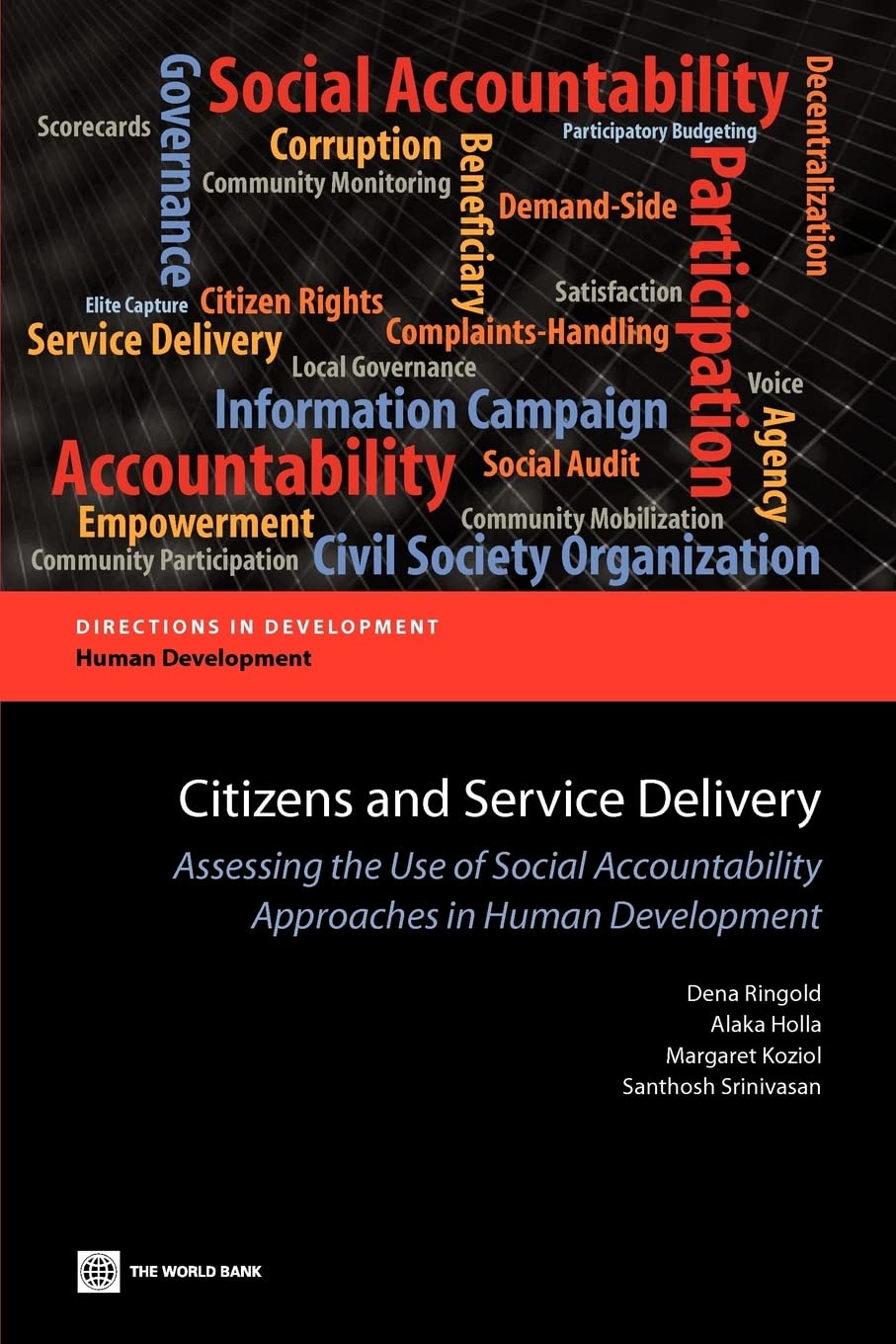
Title
Citizens and Service Delivery: Assessing the Use of Social Accountability Approaches in Human Development Sectors (Directions in,Used
Sold by Ergodebooks, an authorized reseller.
Returns accepted within 30 days | support@ergodebooks.com
Shipping Information
- Free Standard Shipping — United States only
- Processing Time: 3–5 business days
- Estimated Delivery: 6–10 business days after dispatch
- Double-boxed, fully insured & discreetly packaged
- Tracking number sent via email once dispatched
Returns & Refund
Returns accepted within 30 days of delivery.
Damaged or Defective Item
Free return shipping + replacement or full refund
Wrong Item Received
Free return shipping + replacement or full refund
Change of Mind
Return shipping at customer's expense · 25% restocking fee applies
Payment Option

In many low and middle income countries, dismal failures in the quality of public service delivery such as absenteeism among teachers and doctors and leakages of public funds have driven the agenda for better governance and accountability. This has raised interest in the idea that citizens can contribute to improved quality of service delivery by holding policymakers and providers of services accountable. This proposition is particularly resonant when it comes to the human development sectors health, education and social protection which involve close interactions between providers and citizens/users of services. Governments, NGOs, and donors alike have been experimenting with various "social accountability" tools that aim to inform citizens and communities about their rights, the standards of service delivery they should expect, and actual performance; and facilitate access to formal redress mechanisms to address service failures. The report reviews how citizens individually and collectively can influence service delivery through access to information and opportunities to use it to hold providers both frontline service providers and program managers accountable. It focuses on social accountability measures that support the use of information to increase transparency and service delivery and grievance redress mechanisms to help citizens use information to improve accountability. The report takes stock of what is known from international evidence and from within projects supported by the World Bank to identify knowledge gaps, key questions and areas for further work. It synthesizes experience to date; identifies what resources are needed to support more effective use of social accountability tools and approaches; and formulates considerations for their use in human development. The report concludes that the relationships between citizens, policymakers, program managers, and service providers are complicated, not always direct or easily altered through a single intervention, such as an information campaign or scorecard exercise. The evidence base on social accountability mechanisms in the HD sectors is under development. There is a small but growing set of evaluations which test the impact of information interventions on service delivery and HD outcomes. There is ample space for future experiments to test how to make social accountability work at the country level.
⚠️ WARNING (California Proposition 65):
This product may contain chemicals known to the State of California to cause cancer, birth defects, or other reproductive harm.
For more information, please visit www.P65Warnings.ca.gov.