If you have any questions, you are always welcome to contact us. We'll get back to you as soon as possible, withing 24 hours on weekdays.
Customer service
All questions about your order, return and delivery must be sent to our customer service team by e-mail at yourstore@yourdomain.com
Sale & Press
If you are interested in selling our products, need more information about our brand or wish to make a collaboration, please contact us at press@yourdomain.com
Help
If you have any questions, you are always welcome to contact us. We'll get back to you as soon as possible, withing 24 hours on weekdays.
Customer service
All questions about your order, return and delivery must be sent to our customer service team by e-mail at yourstore@yourdomain.com
Sale & Press
If you are interested in selling our products, need more information about our brand or wish to make a collaboration, please contact us at press@yourdomain.com
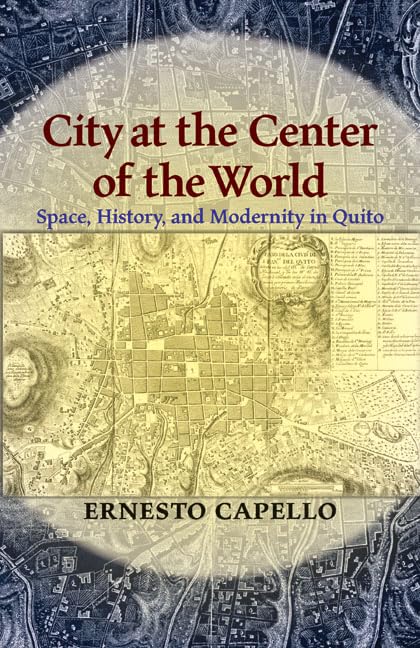
In the seventeenth century, local Jesuits and Franciscans imagined Quito as the new Rome. It was the site of miracles and home of saintly inhabitants, the origin of crusades into the surrounding wilderness, and the purveyor of civilization to the entire region. By the early twentieth century, elites envisioned the city as the heart of a modern, advanced societypoised at the physical and metaphysical centers of the world.In this original cultural history, Ernesto Capello analyzes the formation of memory, myth, and modernity through the eyes of Quitos diverse populations. By employing Mikhail Bakhtins concept of chronotopes, Capello views the configuration of time and space in narratives that defined Quitos identity and its place in the world. He explores the proliferation of these imaginings in architecture, museums, monuments, tourism, art, urban planning, literature, religion, indigenous rights, and politics. To Capello, these tropes began to crystallize at the end of the nineteenth century, serving as a tool for distinct groups who laid claim to history for economic or political gain during the upheavals of modernism.As Capello reveals, Quitos society and its stories mutually constituted each other. In the process of both destroying and renewing elements of the past, each chronotope fed and perpetuated itself. Modern Quito thus emerged at the crux of Hispanism and Liberalism, as an independent global society struggling to keep the memory of its colonial and indigenous roots alive.
⚠️ WARNING (California Proposition 65):
This product may contain chemicals known to the State of California to cause cancer,
birth defects, or other reproductive harm.
For MAP (Minimum Advertised Price) violations and Intellectual Property (IP) or Trademark concerns, please contact:
support@ergodebooks.com
⚠️ California Proposition 65 Warning: Some products sold on this website may expose you to chemicals known to the State of California to cause cancer, birth defects, or other reproductive harm. For more information, visit www.P65Warnings.ca.gov.