
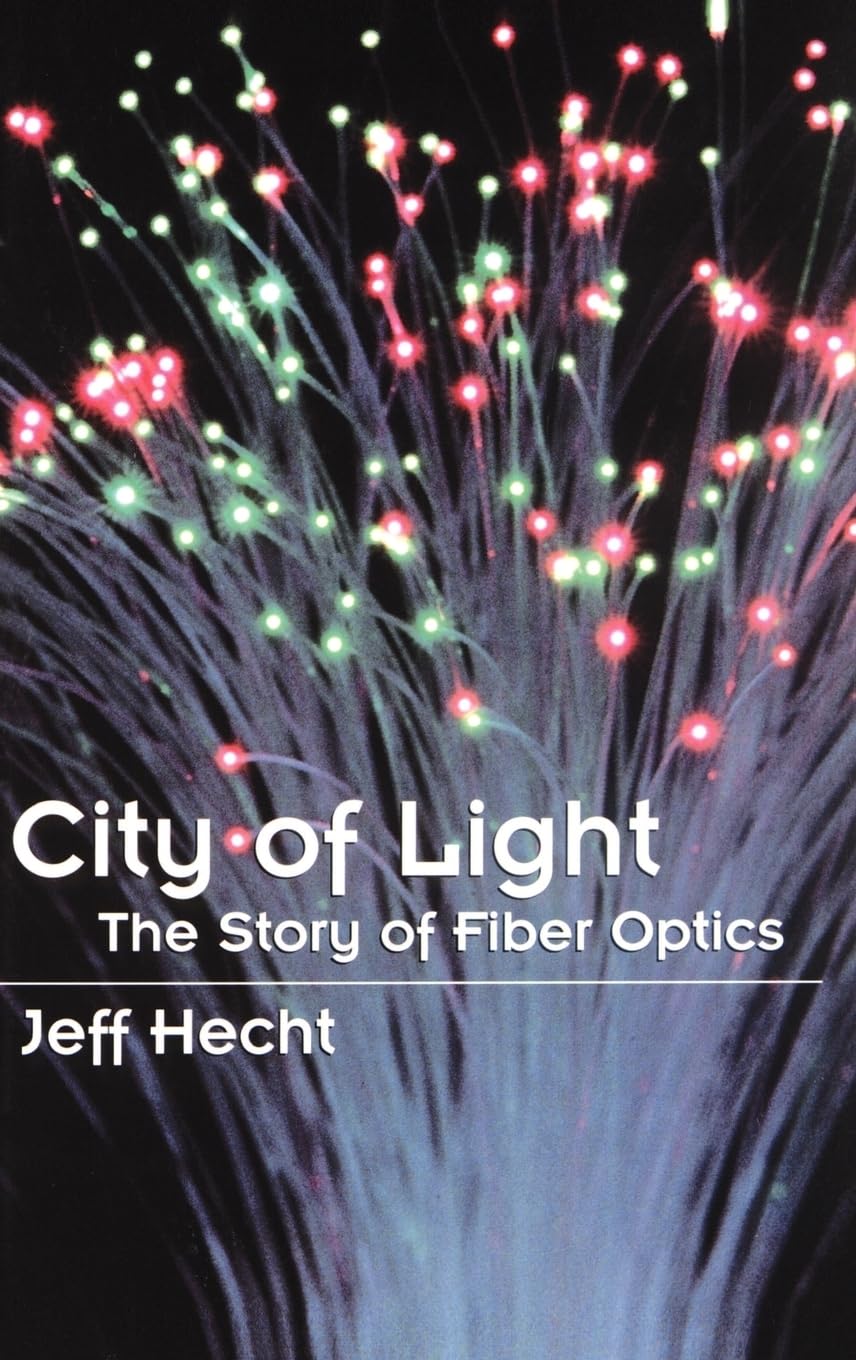
Title
City Of Light: The Story Of Fiber Optics (Sloan Technology)
Sold by Ergodebooks, an authorized reseller.
Returns accepted within 30 days | support@ergodebooks.com
Shipping Information
- Free Standard Shipping — United States only
- Processing Time: 3–5 business days
- Estimated Delivery: 6–10 business days after dispatch
- Double-boxed, fully insured & discreetly packaged
- Tracking number sent via email once dispatched
Returns & Refund
Returns accepted within 30 days of delivery.
Damaged or Defective Item
Free return shipping + replacement or full refund
Wrong Item Received
Free return shipping + replacement or full refund
Change of Mind
Return shipping at customer's expense · 25% restocking fee applies
Payment Option

City Of Light Tells The Story Of Fiber Optics, Tracing Its Transformation From 19Thcentury Parlor Trick Into The Foundation Of Our Global Communications Network. Written For A Broad Audience By A Journalist Who Has Covered The Field For Twenty Years, The Book Is A Lively Account Of Both The People And The Ideas Behind This Revolutionary Technology.The Basic Concept Underlying Fiber Optics Was First Explored In The 1840S When Researchers Used Jets Of Water To Guide Light In Laboratory Demonstrations. The Idea Caught The Public Eye Decades Later When It Was Used To Create Stunning Illuminated Fountains At Many Of The Great Victorian Exhibitions. The Modern Version Of Fiber Opticsusing Flexible Glass Fibers To Transmit Lightwas Discovered Independently Five Times Through The First Half Of The Century, And One Of Its First Key Applications Was The Endoscope, Which For The First Time Allowed Physicians To Look Inside The Body Without Surgery. Endoscopes Became Practical In 1956 When A College Undergraduate Discovered How To Make Solid Glass Fibers With A Glass Cladding.With The Invention Of The Laser, Researchers Grew Interested In Optical Communications. While Bell Labs And Others Tried To Send Laser Beams Through The Atmosphere Or Hollow Light Pipes, A Small Group At Standard Telecommunication Laboratories Looked At Guiding Light By Transparent Fibers. Led By Charles K. Kao, They Proposed The Idea Of Fiberoptic Communications And Demonstrated That Contrary To What Many Researchers Thought Glass Could Be Made Clear Enough To Transmit Light Over Great Distances. Following These Ideas, Corning Glass Works Developed The First Lowloss Glass Fibers In 1970.From This Point Fiberoptic Communications Developed Rapidly. The First Experimental Phone Links Were Tested On Live Telephone Traffic In 1977 And Within Half A Dozen Years Longdistance Companies Were Laying Fiber Cables For Their National Backbone Systems. In 1988, The First Transatlantic Fiberoptic Cable Connected Europe With North America, And Now Fiber Optics Are The Key Element In Global Communications.The Story Continues Today As Fiber Optics Spread Through The Communication Grid That Connects Homes And Offices, Creating Huge Information Pipelines And Replacing Copper Wires. The Book Concludes With A Look At Some Of The Exciting Potential Developments Of This Technology.
⚠️ WARNING (California Proposition 65):
This product may contain chemicals known to the State of California to cause cancer, birth defects, or other reproductive harm.
For more information, please visit www.P65Warnings.ca.gov.
- Q: What is the page count of 'City of Light: The Story of Fiber Optics'? A: The book has three hundred forty-eight pages. It is a comprehensive account of fiber optics and its history.
- Q: What are the dimensions of the book? A: The dimensions are nine point three inches in length, one point two inches in width, and six point four two inches in height. This size makes it a manageable read.
- Q: What type of binding does this book have? A: The book is bound in hardcover. This binding provides durability for frequent handling.
- Q: Who is the author of this book? A: The author is Jeff Hecht. He is a journalist with over twenty years of experience in the field of fiber optics.
- Q: What is the main topic of 'City of Light'? A: The book focuses on the history and development of fiber optics. It explores its transformation into a crucial technology for global communications.
- Q: How should I approach reading this book? A: You can read this book at your own pace. It is written for a broad audience, making it accessible to both novices and experts.
- Q: Is this book suitable for beginners in technology? A: Yes, it is suitable for beginners. The language is engaging and the concepts are explained clearly for all readers.
- Q: What age group is this book recommended for? A: This book is generally suitable for teenagers and adults. It covers complex ideas but is written in an approachable style.
- Q: Can this book be used for educational purposes? A: Yes, it can be used for educational purposes. It provides historical context and scientific explanations that can enhance learning.
- Q: How should I store this book to keep it in good condition? A: Store the book upright in a cool, dry place. Avoid exposure to direct sunlight to preserve the cover and pages.
- Q: Can I clean the book if it gets dirty? A: Yes, you can gently wipe the cover with a soft, dry cloth. Avoid using water or cleaning solutions on the pages.
- Q: What should I do if the book arrives damaged? A: If the book arrives damaged, contact the retailer for a return or exchange. Most retailers have policies in place for damaged items.
- Q: What is the warranty policy for this book? A: Books typically do not come with a warranty. However, check with the seller for their specific return policy.
- Q: How can I find out more about the author's background? A: You can look up Jeff Hecht online. He has a rich history in journalism and has written extensively on fiber optics.
- Q: Is there a digital version of this book available? A: Yes, a digital version may be available. Check online retailers for eBook options.
- Q: What makes this book unique compared to other technology books? A: This book uniquely combines historical narrative with technical insight, making fiber optics accessible and engaging.