
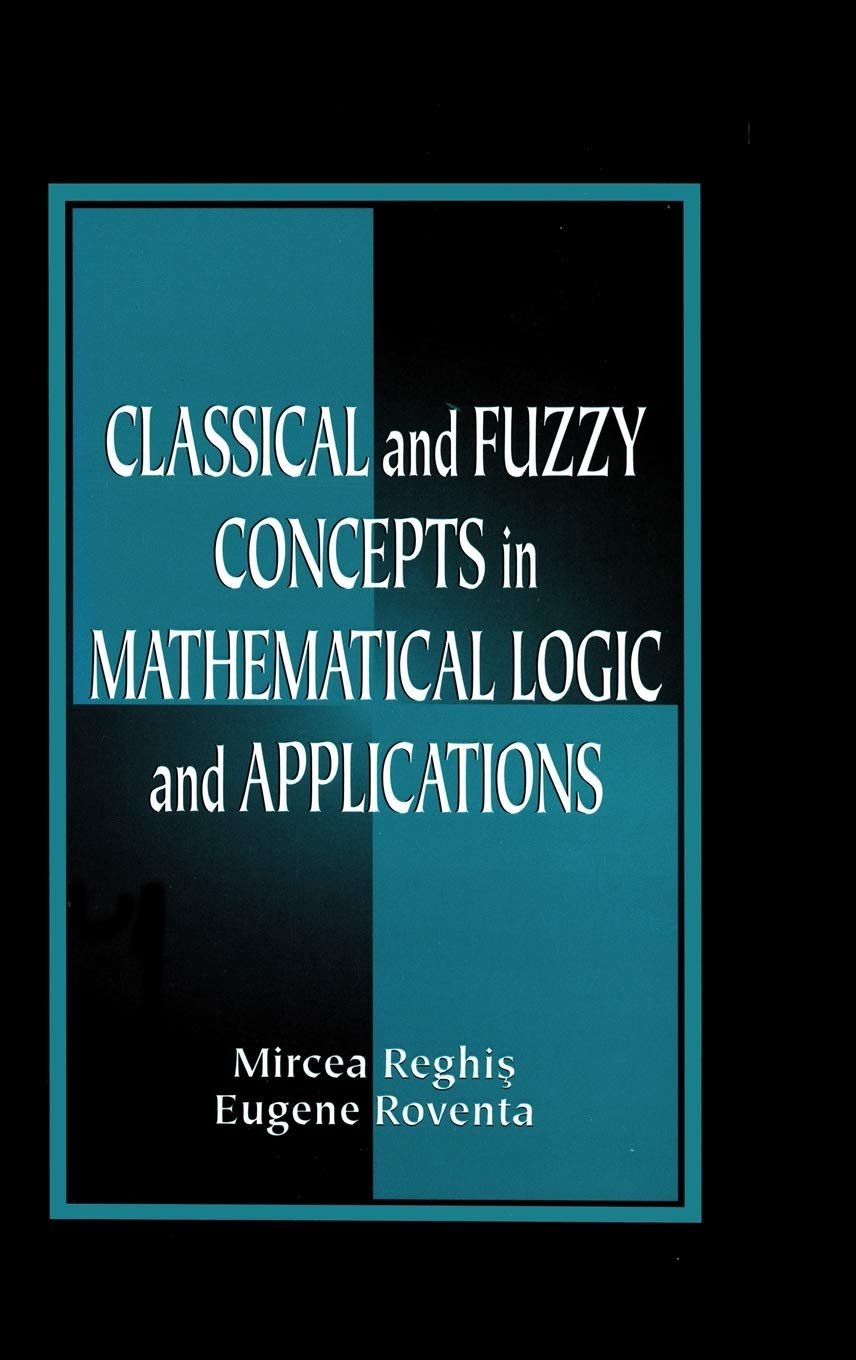
Title
Classical And Fuzzy Concepts In Mathematical Logic And Applications, Professional Version,Used
Sold by Ergodebooks, an authorized reseller.
Returns accepted within 30 days | support@ergodebooks.com
Shipping Information
- Free Standard Shipping — United States only
- Processing Time: 3–5 business days
- Estimated Delivery: 6–10 business days after dispatch
- Double-boxed, fully insured & discreetly packaged
- Tracking number sent via email once dispatched
Returns & Refund
Returns accepted within 30 days of delivery.
Damaged or Defective Item
Free return shipping + replacement or full refund
Wrong Item Received
Free return shipping + replacement or full refund
Change of Mind
Return shipping at customer's expense · 25% restocking fee applies
Payment Option

Classical and Fuzzy Concepts in Mathematical Logic and Applications provides a broad, thorough coverage of the fundamentals of twovalued logic, multivalued logic, and fuzzy logic.Exploring the parallels between classical and fuzzy mathematical logic, the book examines the use of logic in computer science, addresses questions in automatic deduction, and describes efficient computer implementation of proof techniques.Specific issues discussed include: Propositional and predicate logicLogic networksLogic programmingProof of correctnessSemanticsSyntaxCompletenesssNoncontradictionTheorems of Herbrand and KalmanThe authors consider that the teaching of logic for computer science is biased by the absence of motivations, comments, relevant and convincing examples, graphic aids, and the use of color to distinguish language and metalanguage. Classical and Fuzzy Concepts in Mathematical Logic and Applications discusses how the presence of these facts trigger a stirring, decisive insight into the understanding process. This view shapes this work, reflecting the authors' subjective balance between the scientific and pedagogic components of the textbook.Usually, problems in logic lack relevance, creating a gap between classroom learning and applications to reallife problems. The book includes a variety of applicationoriented problems at the end of almost every section, including programming problems in PROLOG III. With the possibility of carrying out proofs with PROLOG III and other software packages, readers will gain a firsthand experience and thus a deeper understanding of the idea of formal proof.
⚠️ WARNING (California Proposition 65):
This product may contain chemicals known to the State of California to cause cancer, birth defects, or other reproductive harm.
For more information, please visit www.P65Warnings.ca.gov.