
Title
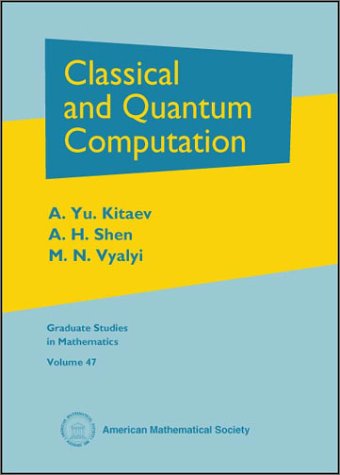
Classical and Quantum Computation (Graduate Studies in Mathematics),New
Sold by Ergodebooks, an authorized reseller.
Returns accepted within 30 days | support@ergodebooks.com
Shipping Information
- Free Standard Shipping — United States only
- Processing Time: 3–5 business days
- Estimated Delivery: 6–10 business days after dispatch
- Double-boxed, fully insured & discreetly packaged
- Tracking number sent via email once dispatched
Returns & Refund
Returns accepted within 30 days of delivery.
Damaged or Defective Item
Free return shipping + replacement or full refund
Wrong Item Received
Free return shipping + replacement or full refund
Change of Mind
Return shipping at customer's expense · 25% restocking fee applies
Payment Option

This book is an introduction to a new rapidly developing theory of quantum computing. It begins with the basics of classical theory of computation: Turing machines, Boolean circuits, parallel algorithms, probabilistic computation, NPcomplete problems, and the idea of complexity of an algorithm. The second part of the book provides an exposition of quantum computation theory. It starts with the introduction of general quantum formalism (pure states, density matrices, and superoperators), universal gate sets and approximation theorems. Then the authors study various quantum computation algorithms: Grover's algorithm, Shor's factoring algorithm, and the Abelian hidden subgroup problem. In concluding sections, several related topics are discussed (parallel quantum computation, a quantum analog of NPcompleteness, and quantum errorcorrecting codes).Rapid development of quantum computing started in 1994 with a stunning suggestion by Peter Shor to use quantum computation for factoring large numbersan extremely difficult and timeconsuming problem when using a conventional computer. Shor's result spawned a burst of activity in designing new algorithms and in attempting to actually build quantum computers. Currently, the progress is much more significant in the former: A sound theoretical basis of quantum computing is under development and many algorithms have been suggested.In this concise text, the authors provide solid foundations to the theoryin particular, a careful analysis of the quantum circuit modeland cover selected topics in depth. Included are a complete proof of the SolovayKitaev theorem with accurate algorithm complexity bounds, approximation of unitary operators by circuits of doubly logarithmic depth. Among other interesting topics are toric codes and their relation to the anyon approach to quantum computing.
⚠️ WARNING (California Proposition 65):
This product may contain chemicals known to the State of California to cause cancer, birth defects, or other reproductive harm.
For more information, please visit www.P65Warnings.ca.gov.
- Q: How many pages does this book have? A: This book contains two hundred seventy-two pages. It offers a comprehensive introduction to both classical and quantum computation theories.
- Q: What is the binding type of this book? A: This book is available in paperback binding. Paperback editions are lightweight and flexible, making them easy to handle.
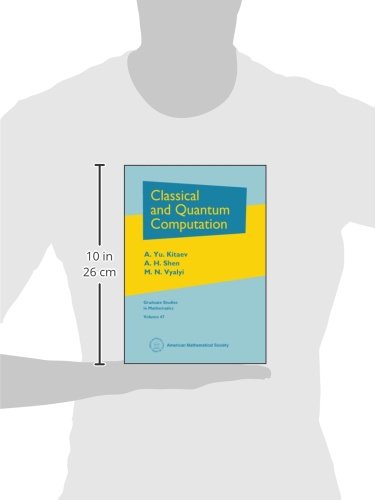
- Q: What are the dimensions of this book? A: The dimensions of this book are seven point twenty-five inches in length, zero point fifty-one inches in width, and ten point twenty-five inches in height. This size makes it portable and easy to store.
- Q: Who is the author of this book? A: The author of this book is A. Yu. Kitaev. He is recognized for his contributions to theoretical computer science and quantum computing.
- Q: What topics are covered in this book? A: This book covers classical computation topics such as Turing machines and NP-complete problems, and quantum computation topics like Grover's and Shor's algorithms. It provides a solid foundation in both areas.
- Q: Is this book suitable for beginners? A: Yes, this book is suitable for beginners. It starts with basic concepts and gradually introduces more complex theories in quantum computation.
- Q: What reading level is this book appropriate for? A: This book is appropriate for graduate-level readers. It is designed for students and professionals interested in advanced topics in computation.
- Q: How can I use this book for study? A: You can use this book as a textbook or reference guide for quantum computing and theoretical computer science. It includes key algorithms and proofs that are essential for understanding the subject.
- Q: Is there any prior knowledge required to understand this book? A: Yes, some prior knowledge of classical computation is recommended. Familiarity with basic algorithms and complexity theory will enhance comprehension.
- Q: How should I store this book? A: You should store this book in a cool, dry place away from direct sunlight. This will help preserve the quality of the paperback binding and pages.
- Q: Can this book be used for research purposes? A: Yes, this book can be used for research purposes. It provides insights into both theoretical frameworks and practical algorithms in quantum computing.
- Q: What if I receive a damaged copy of the book? A: If you receive a damaged copy of the book, you should contact the seller for a return or replacement. Most sellers have policies in place to handle such issues.
- Q: Is there a warranty for this book? A: No, there is typically no warranty for books. However, check the seller's return policy for any specific guarantees.
- Q: What if I have questions while reading the book? A: If you have questions while reading, you may find related resources or forums online. Engaging with study groups can also provide valuable insights.
- Q: Does this book include any exercises or problems? A: No, this book does not include exercises or problems. It focuses on theoretical concepts and algorithms rather than practical applications.