
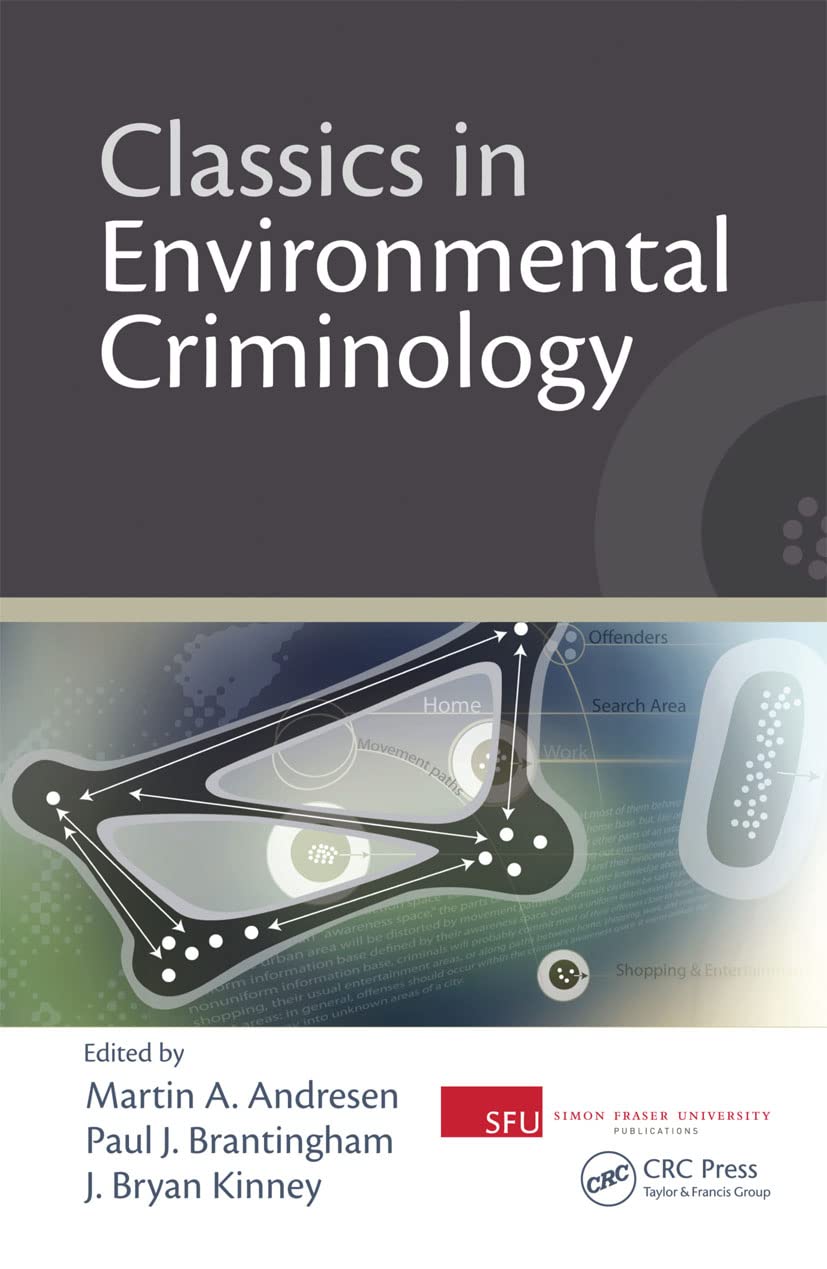
Title
Classics in Environmental Criminology,Used
Sold by Ergodebooks, an authorized reseller.
Returns accepted within 30 days | support@ergodebooks.com
Shipping Information
- Free Standard Shipping — United States only
- Processing Time: 3–5 business days
- Estimated Delivery: 6–10 business days after dispatch
- Double-boxed, fully insured & discreetly packaged
- Tracking number sent via email once dispatched
Returns & Refund
Returns accepted within 30 days of delivery.
Damaged or Defective Item
Free return shipping + replacement or full refund
Wrong Item Received
Free return shipping + replacement or full refund
Change of Mind
Return shipping at customer's expense · 25% restocking fee applies
Payment Option

A careful analysis of environmental factors is key to understanding the causes of crime, to solving crimes, and eventually helping to predict and prevent them. Classics in Environmental Criminology is a comprehensive collection of seminal pieces from legendary contributors who focus on the role that the immediate environment plays in the occurrence of a crime.Defines the fieldDivided into three parts, the book begins by highlighting the development of environmental criminology as a discipline through its origins in spatial criminology. It examines social disorganization theory, which explains criminal activity with reference to the characteristics of the community that delinquents live in. It then discusses the ecology of crime with reference to macroenvironments and microenvironments. The next section introduces concepts such as routine activity theory, the geometric theory of crime, the rational choice theory of offending, and crime pattern theory.Offers perspectives on preventionThe last part focuses on the concept of crime prevention, examines the idea of altering the environment in order to prevent crime, and discusses situational crime factors and efforts to reduce the opportunities for crimes to be committed. It considers the impact of routine activities on crime prevention initiatives and advocates a flexible approach to crime prevention based on the dynamic nature of our environment. The book concludes with a chapter outlining how environmental criminology has evolved in recent years and provides a future outlook on where it may be headed.Invaluable as a textbook and as a professional reference, this volume is a comprehensive survey of a critical field in contemporary criminological theory. Offering insight assembled by top academic figures within the criminology community, this work is destined to provoke further inquiry and research.
⚠️ WARNING (California Proposition 65):
This product may contain chemicals known to the State of California to cause cancer, birth defects, or other reproductive harm.
For more information, please visit www.P65Warnings.ca.gov.
- Q: What is the main focus of 'Classics in Environmental Criminology'? A: The book focuses on understanding the relationship between environmental factors and crime, exploring how the immediate surroundings can influence criminal behavior.
- Q: Who is the author of 'Classics in Environmental Criminology'? A: The book is authored by Martin A. Andresen.
- Q: What topics are covered in the book? A: The book covers topics such as social disorganization theory, ecology of crime, routine activity theory, rational choice theory, and crime prevention strategies.
- Q: Is 'Classics in Environmental Criminology' suitable for academic use? A: Yes, it is invaluable as a textbook and a professional reference for students and practitioners in the field of criminology.
- Q: What is the format of the book? A: The book is available in hardcover format and contains 552 pages.
- Q: When was 'Classics in Environmental Criminology' published? A: The book was published on May 25, 2010.
- Q: What edition of the book is available? A: The available edition is the first edition.
- Q: How does the book address crime prevention? A: The last section of the book discusses altering the environment to prevent crime and examines situational factors that reduce crime opportunities.
- Q: What is the item condition of the book? A: The item condition of 'Classics in Environmental Criminology' is listed as new.
- Q: Can this book help in understanding contemporary criminological theory? A: Yes, it provides comprehensive insights into the evolution of environmental criminology and encourages further inquiry and research in the field.