
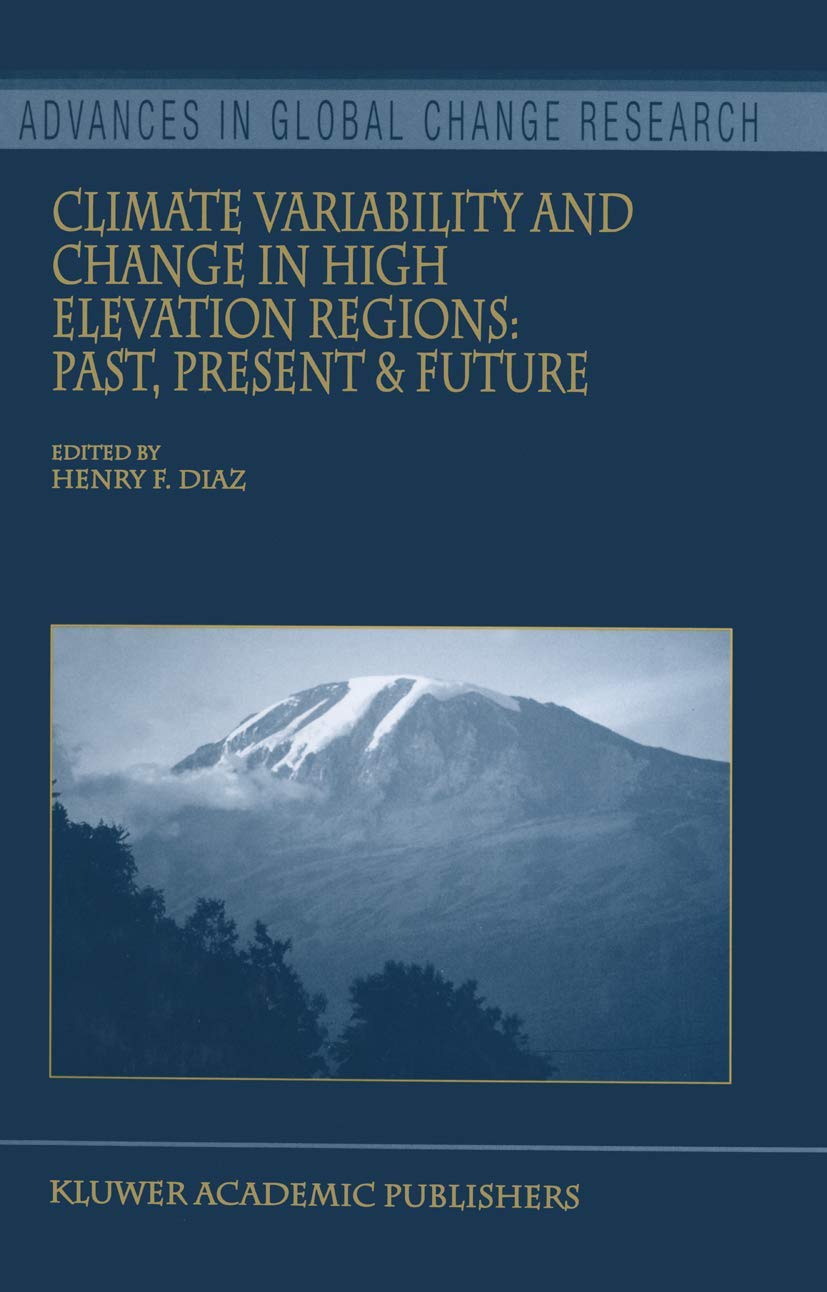
Title
Climate Variability and Change in High Elevation Regions: Past, Present & Future (Advances in Global Change Research, 15),Used
Sold by Ergodebooks, an authorized reseller.
Returns accepted within 30 days | support@ergodebooks.com
Shipping Information
- Free Standard Shipping — United States only
- Processing Time: 3–5 business days
- Estimated Delivery: 6–10 business days after dispatch
- Double-boxed, fully insured & discreetly packaged
- Tracking number sent via email once dispatched
Returns & Refund
Returns accepted within 30 days of delivery.
Damaged or Defective Item
Free return shipping + replacement or full refund
Wrong Item Received
Free return shipping + replacement or full refund
Change of Mind
Return shipping at customer's expense · 25% restocking fee applies
Payment Option

Glaciers in the Andes are particularly important natural archives of present and past climatic and environmental changes, in significant part because of the NS trend of this topographic barrier and its influence on the atmospheric circulation of the southern hemisphere. Strong gradients in the seasonality and amount of precipitation exist between the equator and 30 S. Large differences in amount east and west of the Andean divide also occur, as well as a change from tropical summer precipitation (additionally modified by the seasonal shift of the circulation belts) to winter precipitation in the west wind belt (e. g. , Yuille, 1999; Garraud and Aceituno, 2001). The socalled 'dry axis' lies between the tropical and extra tropical precipitation regimes (Figure 1). The high mountain desert within this axis responds most sensitively to the smallest changes in effective moisture. An important hydrometeorological feature on a seasonal to interannual timescale is the occurrence of EN SO events, which strongly control the mass balance of glaciers in this area (e. g. , Wagnon et ai. , 2001; Francou et ai. , in press). The precipitation pattern is an important factor for the interpretation of climatic and environmental records extracted from ice cores, because much of this information is related to conditions at the actual time of precipitation, and this is especially so for stable isotope records. Several ice cores have recently been drilled to bedrock in this area. From Huascanin (Thompson et ai. , 1995), Sajama (Thompson et ai.
⚠️ WARNING (California Proposition 65):
This product may contain chemicals known to the State of California to cause cancer, birth defects, or other reproductive harm.
For more information, please visit www.P65Warnings.ca.gov.