If you have any questions, you are always welcome to contact us. We'll get back to you as soon as possible, withing 24 hours on weekdays.
Customer service
All questions about your order, return and delivery must be sent to our customer service team by e-mail at yourstore@yourdomain.com
Sale & Press
If you are interested in selling our products, need more information about our brand or wish to make a collaboration, please contact us at press@yourdomain.com
Help
If you have any questions, you are always welcome to contact us. We'll get back to you as soon as possible, withing 24 hours on weekdays.
Customer service
All questions about your order, return and delivery must be sent to our customer service team by e-mail at yourstore@yourdomain.com
Sale & Press
If you are interested in selling our products, need more information about our brand or wish to make a collaboration, please contact us at press@yourdomain.com
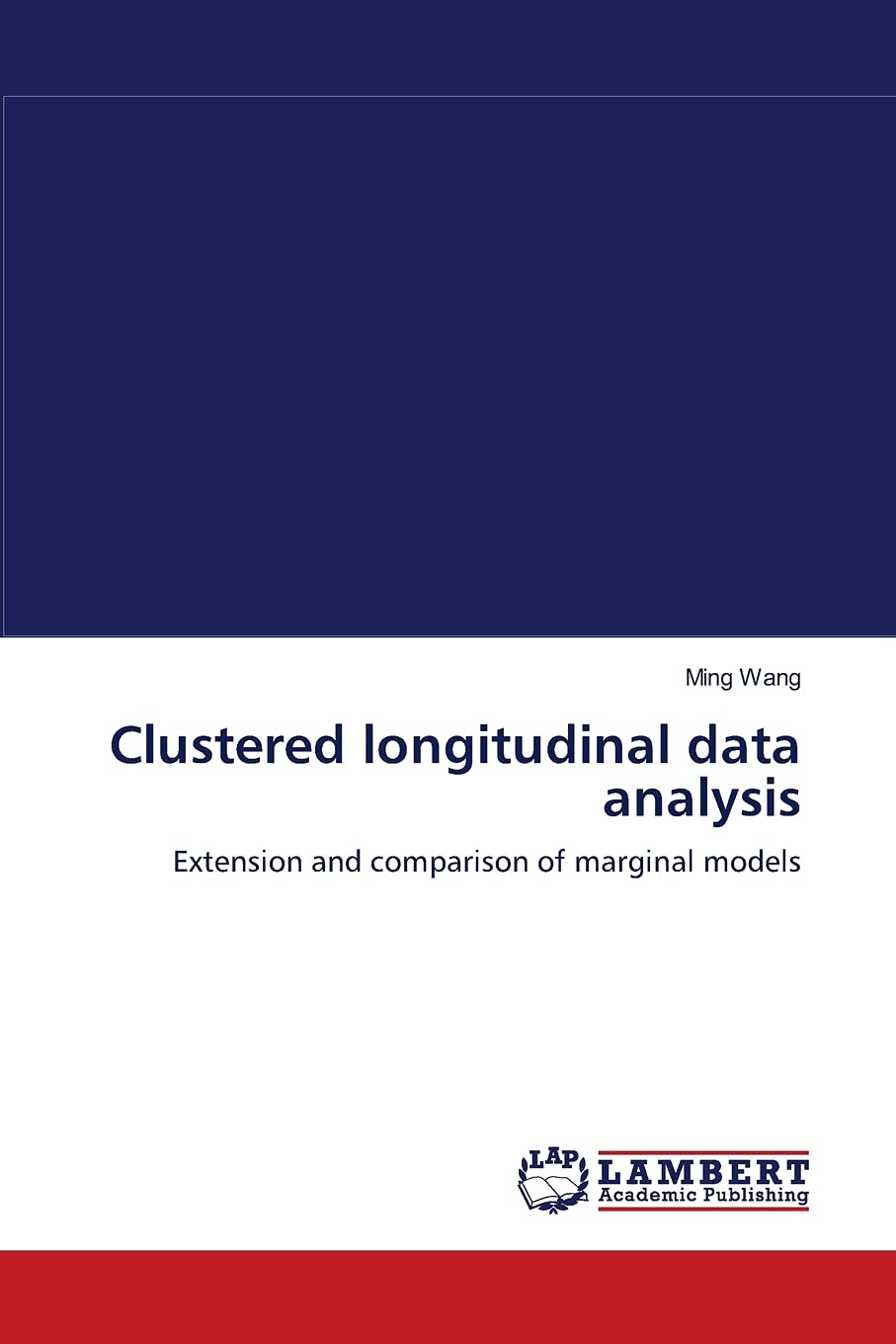
Clustered longitudinal data are often collected as repeated measures on subjects arising in clusters. Examples include periodontal disease study, where the measurements related to the disease status of each tooth are collected over time for each patient which is considered as a cluster. For such applications, the number of teeth for each patient may be related to the overall oral health of the individual and hence may influence the distribution of the outcome measure of interest leading to an informative cluster size. Under such situations, three competing marginal linear models are proposed for clustered longitudinal data,namely, generalized estimating equations (GEE), within cluster resampling (WCR), and clusterweighted generalized estimating equations (CWGEE). Using simulations, theoretical calculations and real data analysis on periodontal disease, when the cluster size is informative, CWGEE appears to be the recommended choice for marginal parametric inference with clustered longitudinal data that achieves similar parameter estimates and test statistics as WCR while avoiding Monte Carlo computation, while GEE gets biased estimators.
⚠️ WARNING (California Proposition 65):
This product may contain chemicals known to the State of California to cause cancer,
birth defects, or other reproductive harm.
For MAP (Minimum Advertised Price) violations and Intellectual Property (IP) or Trademark concerns, please contact:
support@ergodebooks.com
⚠️ California Proposition 65 Warning: Some products sold on this website may expose you to chemicals known to the State of California to cause cancer, birth defects, or other reproductive harm. For more information, visit www.P65Warnings.ca.gov.