
Title
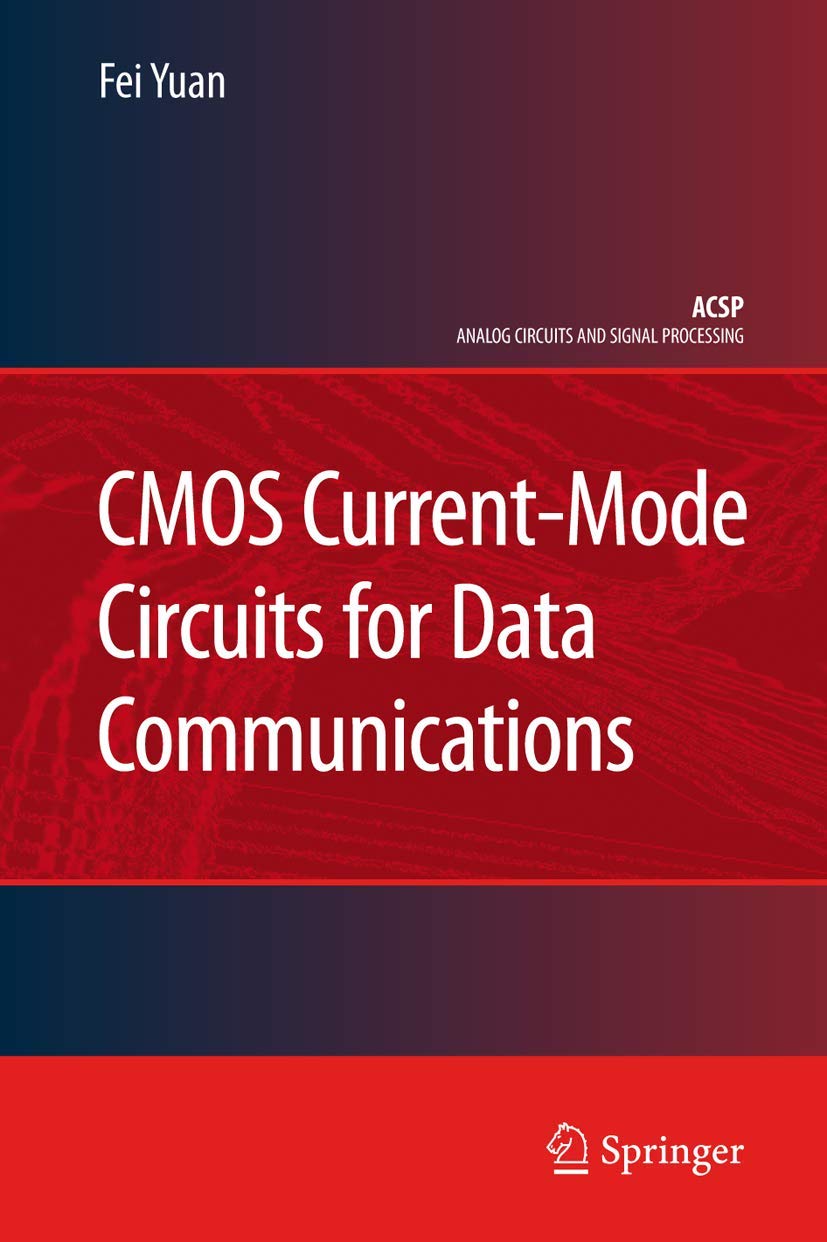
CMOS CurrentMode Circuits for Data Communications (Analog Circuits and Signal Processing),Used
Sold by Ergodebooks, an authorized reseller.
Returns accepted within 30 days | support@ergodebooks.com
Shipping Information
- Free Standard Shipping — United States only
- Processing Time: 3–5 business days
- Estimated Delivery: 6–10 business days after dispatch
- Double-boxed, fully insured & discreetly packaged
- Tracking number sent via email once dispatched
Returns & Refund
Returns accepted within 30 days of delivery.
Damaged or Defective Item
Free return shipping + replacement or full refund
Wrong Item Received
Free return shipping + replacement or full refund
Change of Mind
Return shipping at customer's expense · 25% restocking fee applies
Payment Option

Currentmode circuits, where information is represented by the branch currents of the circuits rather than the nodal voltages as of voltagemode circuits, possess many unique and attractive characteristics over their voltagemode counterparts including a small nodal time constant, high current swing in the presence of a low supply voltage, reduced distor tion, a low input impedance, a high output impedance, less sensitive to switching noise, and better ESD immunity. CMOS currentmode circuits have found increasing applications in telecommunication sys tems, instrumentation, analog signal processing, multiprocessors, high speed computer interfaces, and the backplane of complex electronic sys tems. This book deals with the analysis and design of continuoustime CMOS currentmode circuits for data communications over wire chan nels. CMOS currentmode sampleddata networks, such as switch current circuits, and currentmode logic circuits, are excluded. The book is organized as the followings : Chapter 1 examines the distinct characteristics of ideal voltagemode and currentmode circuits. The topology duaUty of these two classes of circuits is investigated using the concept of interreciprocity and adjoint network. A critical comparison of the input and output impedances, bandwidth, slew rate, propagation delay, signal swing, supply voltage sensitivity, and ESD sensitivity of voltagemode and currentmode cir cuits is provided. Chapter 2 investigates design techniques that improve the perfor mance of lowvoltage currentmode circuits including input impedance reduction, output impedance boosting, bandwidth enhancement, mis match compensation, power consumption reduction, and swing improve ment. Chapter 3 investigates the modeling of wire channels.
⚠️ WARNING (California Proposition 65):
This product may contain chemicals known to the State of California to cause cancer, birth defects, or other reproductive harm.
For more information, please visit www.P65Warnings.ca.gov.