If you have any questions, you are always welcome to contact us. We'll get back to you as soon as possible, withing 24 hours on weekdays.
Customer service
All questions about your order, return and delivery must be sent to our customer service team by e-mail at yourstore@yourdomain.com
Sale & Press
If you are interested in selling our products, need more information about our brand or wish to make a collaboration, please contact us at press@yourdomain.com
Help
If you have any questions, you are always welcome to contact us. We'll get back to you as soon as possible, withing 24 hours on weekdays.
Customer service
All questions about your order, return and delivery must be sent to our customer service team by e-mail at yourstore@yourdomain.com
Sale & Press
If you are interested in selling our products, need more information about our brand or wish to make a collaboration, please contact us at press@yourdomain.com
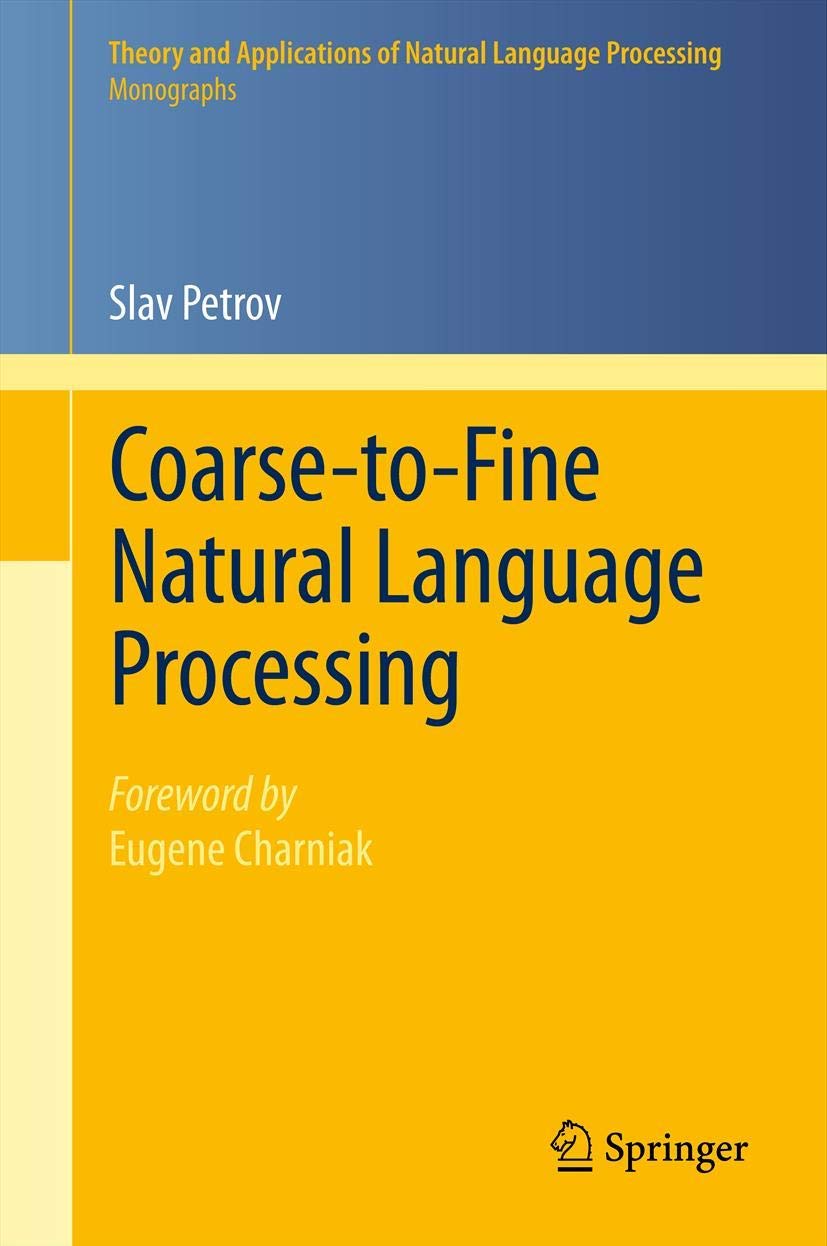
The impact of computer systems that can understand natural language will be tremendous. To develop this capability we need to be able to automatically and efficiently analyze large amounts of text. Manually devised rules are not sufficient to provide coverage to handle the complex structure of natural language, necessitating systems that can automatically learn from examples. To handle the flexibility of natural language, it has become standard practice to use statistical models, which assign probabilities for example to the different meanings of a word or the plausibility of grammatical constructions.This book develops a general coarsetofine framework for learning and inference in large statistical models for natural language processing.Coarsetofine approaches exploit a sequence of models which introduce complexity gradually. At the top of the sequence is a trivial model in which learning and inference are both cheap. Each subsequent model refines the previous one, until a final, fullcomplexity model is reached. Applications of this framework to syntactic parsing, speech recognition and machine translation are presented, demonstrating the effectiveness of the approach in terms of accuracy and speed. The book is intended for students and researchers interested in statistical approaches to Natural Language Processing.Slavs work CoarsetoFine Natural Language Processing represents a major advance in the area of syntactic parsing, and a great advertisement for the superiority of the machinelearning approach.Eugene Charniak (Brown University)
⚠️ WARNING (California Proposition 65):
This product may contain chemicals known to the State of California to cause cancer,
birth defects, or other reproductive harm.
For MAP (Minimum Advertised Price) violations and Intellectual Property (IP) or Trademark concerns, please contact:
support@ergodebooks.com
⚠️ California Proposition 65 Warning: Some products sold on this website may expose you to chemicals known to the State of California to cause cancer, birth defects, or other reproductive harm. For more information, visit www.P65Warnings.ca.gov.