
Title
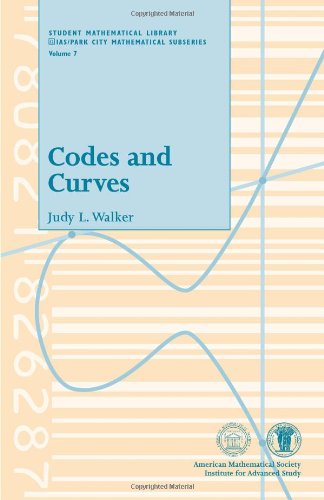
Codes and Curves (Student Mathematical Library, Vol. 7),New
Sold by Ergodebooks, an authorized reseller.
Returns accepted within 30 days | support@ergodebooks.com
Shipping Information
- Free Standard Shipping — United States only
- Processing Time: 3–5 business days
- Estimated Delivery: 6–10 business days after dispatch
- Double-boxed, fully insured & discreetly packaged
- Tracking number sent via email once dispatched
Returns & Refund
Returns accepted within 30 days of delivery.
Damaged or Defective Item
Free return shipping + replacement or full refund
Wrong Item Received
Free return shipping + replacement or full refund
Change of Mind
Return shipping at customer's expense · 25% restocking fee applies
Payment Option

When information is transmitted, errors are likely to occur. This problem has become increasingly important as tremendous amounts of information are transferred electronically every day. Coding theory examines efficient ways of packaging data so that these errors can be detected, or even corrected.The traditional tools of coding theory have come from combinatorics and group theory. Since the work of Goppa in the late 1970s, however, coding theorists have added techniques from algebraic geometry to their toolboxes. In particular, by reinterpreting the ReedSolomon codes as coming from evaluating functions associated to divisors on the projective line, one can see how to define new codes based on other divisors or on other algebraic curves. For instance, using modular curves over finite fields, Tsfasman, Vladut, and Zink showed that one can define a sequence of codes with asymptotically better parameters than any previously known codes.This book is based on a series of lectures the author gave as part of the IAS/Park City Mathematics Institute (Utah) program on arithmetic algebraic geometry. Here, the reader is introduced to the exciting field of algebraic geometric coding theory. Presenting the material in the same conversational tone of the lectures, the author covers linear codes, including cyclic codes, and both bounds and asymptotic bounds on the parameters of codes. Algebraic geometry is introduced, with particular attention given to projective curves, rational functions and divisors. The construction of algebraic geometric codes is given, and the TsfasmanVladutZink result mentioned above is discussed.
⚠️ WARNING (California Proposition 65):
This product may contain chemicals known to the State of California to cause cancer, birth defects, or other reproductive harm.
For more information, please visit www.P65Warnings.ca.gov.
- Q: What is the main focus of 'Codes and Curves'? A: 'Codes and Curves' primarily focuses on coding theory, specifically how to efficiently package data to detect and correct errors in information transmission.
- Q: Who is the author of this book? A: The author of 'Codes and Curves' is Judy L. Walker.
- Q: What topics are covered in this book? A: The book covers linear codes, cyclic codes, algebraic geometry, projective curves, rational functions, divisors, and the construction of algebraic geometric codes.
- Q: Is this book suitable for beginners? A: 'Codes and Curves' is designed for readers with some prior knowledge of algebraic geometry and coding theory, making it more suitable for advanced students or professionals in the field.
- Q: What is the condition of the used book? A: The used book is listed in good condition, meaning it may have minimal wear and tear but is generally well-preserved.
- Q: How many pages does the book have? A: 'Codes and Curves' contains a total of 66 pages.
- Q: What format is this book available in? A: The book is available in paperback format.
- Q: When was 'Codes and Curves' published? A: 'Codes and Curves' was published on January 1, 2000.
- Q: What is the significance of algebraic geometry in coding theory as discussed in the book? A: Algebraic geometry provides new techniques for defining codes, allowing for better error detection and correction through the use of modular curves and other algebraic structures.
- Q: Can this book help in understanding modern coding techniques? A: Yes, 'Codes and Curves' introduces readers to modern coding techniques by integrating algebraic geometry with traditional coding theory concepts.