If you have any questions, you are always welcome to contact us. We'll get back to you as soon as possible, withing 24 hours on weekdays.
Customer service
All questions about your order, return and delivery must be sent to our customer service team by e-mail at yourstore@yourdomain.com
Sale & Press
If you are interested in selling our products, need more information about our brand or wish to make a collaboration, please contact us at press@yourdomain.com
Help
If you have any questions, you are always welcome to contact us. We'll get back to you as soon as possible, withing 24 hours on weekdays.
Customer service
All questions about your order, return and delivery must be sent to our customer service team by e-mail at yourstore@yourdomain.com
Sale & Press
If you are interested in selling our products, need more information about our brand or wish to make a collaboration, please contact us at press@yourdomain.com
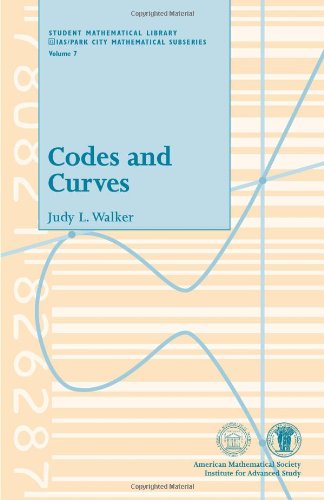
When information is transmitted, errors are likely to occur. This problem has become increasingly important as tremendous amounts of information are transferred electronically every day. Coding theory examines efficient ways of packaging data so that these errors can be detected, or even corrected.The traditional tools of coding theory have come from combinatorics and group theory. Since the work of Goppa in the late 1970s, however, coding theorists have added techniques from algebraic geometry to their toolboxes. In particular, by reinterpreting the ReedSolomon codes as coming from evaluating functions associated to divisors on the projective line, one can see how to define new codes based on other divisors or on other algebraic curves. For instance, using modular curves over finite fields, Tsfasman, Vladut, and Zink showed that one can define a sequence of codes with asymptotically better parameters than any previously known codes.This book is based on a series of lectures the author gave as part of the IAS/Park City Mathematics Institute (Utah) program on arithmetic algebraic geometry. Here, the reader is introduced to the exciting field of algebraic geometric coding theory. Presenting the material in the same conversational tone of the lectures, the author covers linear codes, including cyclic codes, and both bounds and asymptotic bounds on the parameters of codes. Algebraic geometry is introduced, with particular attention given to projective curves, rational functions and divisors. The construction of algebraic geometric codes is given, and the TsfasmanVladutZink result mentioned above is discussed.
⚠️ WARNING (California Proposition 65):
This product may contain chemicals known to the State of California to cause cancer,
birth defects, or other reproductive harm.
For MAP (Minimum Advertised Price) violations and Intellectual Property (IP) or Trademark concerns, please contact:
support@ergodebooks.com
⚠️ California Proposition 65 Warning: Some products sold on this website may expose you to chemicals known to the State of California to cause cancer, birth defects, or other reproductive harm. For more information, visit www.P65Warnings.ca.gov.