If you have any questions, you are always welcome to contact us. We'll get back to you as soon as possible, withing 24 hours on weekdays.
Customer service
All questions about your order, return and delivery must be sent to our customer service team by e-mail at yourstore@yourdomain.com
Sale & Press
If you are interested in selling our products, need more information about our brand or wish to make a collaboration, please contact us at press@yourdomain.com
Help
If you have any questions, you are always welcome to contact us. We'll get back to you as soon as possible, withing 24 hours on weekdays.
Customer service
All questions about your order, return and delivery must be sent to our customer service team by e-mail at yourstore@yourdomain.com
Sale & Press
If you are interested in selling our products, need more information about our brand or wish to make a collaboration, please contact us at press@yourdomain.com
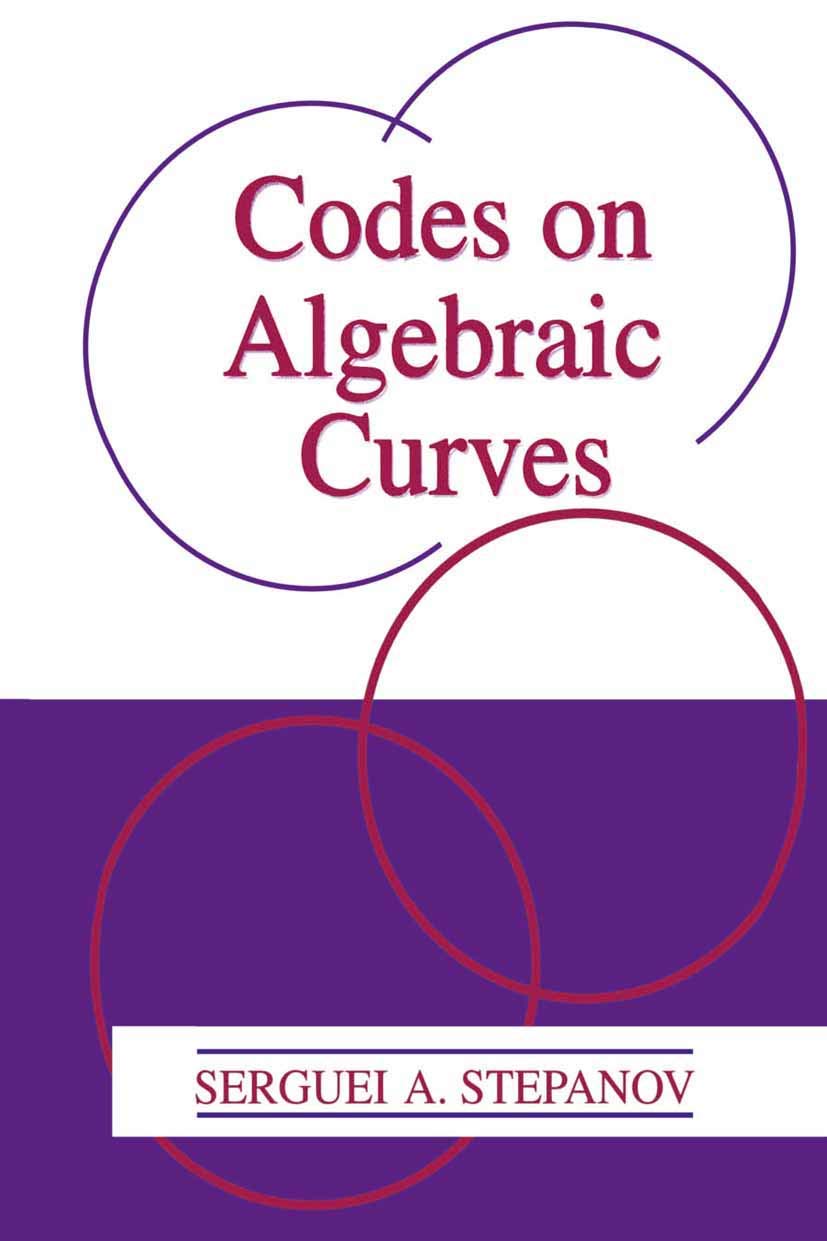
This is a selfcontained introduction to algebraic curves over finite fields and geometric Goppa codes. There are four main divisions in the book. The first is a brief exposition of basic concepts and facts of the theory of errorcorrecting codes (Part I). The second is a complete presentation of the theory of algebraic curves, especially the curves defined over finite fields (Part II). The third is a detailed description of the theory of classical modular curves and their reduction modulo a prime number (Part III). The fourth (and basic) is the construction of geometric Goppa codes and the production of asymptotically good linear codes coming from algebraic curves over finite fields (Part IV). The theory of geometric Goppa codes is a fascinating topic where two extremes meet: the highly abstract and deep theory of algebraic (specifically modular) curves over finite fields and the very concrete problems in the engineering of information transmission. At the present time there are two essentially different ways to produce asymptotically good codes coming from algebraic curves over a finite field with an extremely large number of rational points. The first way, developed by M. A. Tsfasman, S. G. Vladut and Th. Zink [210], is rather difficult and assumes a serious acquaintance with the theory of modular curves and their reduction modulo a prime number. The second way, proposed recently by A.
⚠️ WARNING (California Proposition 65):
This product may contain chemicals known to the State of California to cause cancer,
birth defects, or other reproductive harm.
For MAP (Minimum Advertised Price) violations and Intellectual Property (IP) or Trademark concerns, please contact:
support@ergodebooks.com
⚠️ California Proposition 65 Warning: Some products sold on this website may expose you to chemicals known to the State of California to cause cancer, birth defects, or other reproductive harm. For more information, visit www.P65Warnings.ca.gov.