
Title
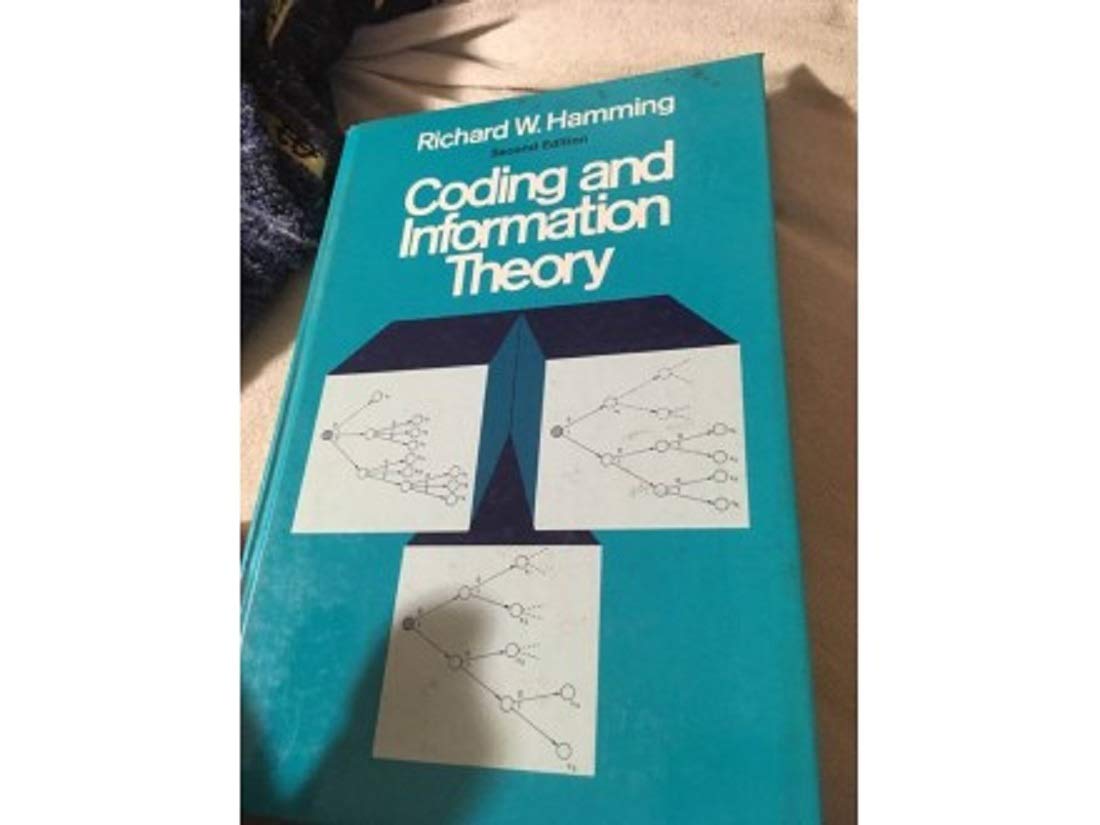
Coding and Information Theory,Used
Sold by Ergodebooks, an authorized reseller.
Returns accepted within 30 days | support@ergodebooks.com
Shipping Information
- Free Standard Shipping — United States only
- Processing Time: 3–5 business days
- Estimated Delivery: 6–10 business days after dispatch
- Double-boxed, fully insured & discreetly packaged
- Tracking number sent via email once dispatched
Returns & Refund
Returns accepted within 30 days of delivery.
Damaged or Defective Item
Free return shipping + replacement or full refund
Wrong Item Received
Free return shipping + replacement or full refund
Change of Mind
Return shipping at customer's expense · 25% restocking fee applies
Payment Option

Chpt 1Intro, Chpt 2ErrorDetecting Codes, Chpt 3 Error Correcting Codes, Chpt 4VariableLength Huffman, Chpt 5Miscellaneous Codes, Chpt 6Entropy and Shannon's first Theorem, Chpt 7 Channel and Mutual Information, Chpt 8 Channel Capacity, Chpt 9 Some Mathematical Preliminaries, Chpt 10 Shannon's Main Theorem, Chpt 11 Algebraic Coding, Appendix Bandwidth and the Sample Theorem, Appendix Some tables for Entropy Calculations.
⚠️ WARNING (California Proposition 65):
This product may contain chemicals known to the State of California to cause cancer, birth defects, or other reproductive harm.
For more information, please visit www.P65Warnings.ca.gov.
- Q: What topics are covered in 'Coding and Information Theory'? A: The book covers a range of topics including error-detecting codes, error-correcting codes, variable-length Huffman coding, entropy, channel capacity, and Shannon's main theorem, among others.
- Q: Who is the author of 'Coding and Information Theory'? A: The author of the book is Richard W. Hamming, a noted mathematician and computer scientist known for his work in information theory.
- Q: What is the page count of 'Coding and Information Theory'? A: 'Coding and Information Theory' contains 259 pages, providing a comprehensive exploration of the subject.
- Q: What type of binding does this book have? A: This book is available in hardcover binding, which offers durability and a professional appearance.
- Q: When was 'Coding and Information Theory' published? A: The book was published on January 1, 1985.
- Q: Is there any supplementary material included in the book? A: Yes, the book includes appendices with tables for entropy calculations and additional information on bandwidth and the sample theorem.
- Q: What edition of the book is available? A: The book is available in its subsequent edition, which may include updates or revisions from previous editions.
- Q: What is the primary focus of 'Coding and Information Theory'? A: The primary focus of the book is to explore the fundamental concepts of coding theory and its applications in information transmission and processing.
- Q: Is this book suitable for beginners in coding theory? A: While the book covers advanced topics, it begins with introductory concepts, making it suitable for readers who have a basic understanding of mathematics and are interested in coding theory.
- Q: Can I find exercises or problems in 'Coding and Information Theory'? A: Yes, the book includes various problems and examples to help reinforce the concepts discussed throughout the chapters.