
Title
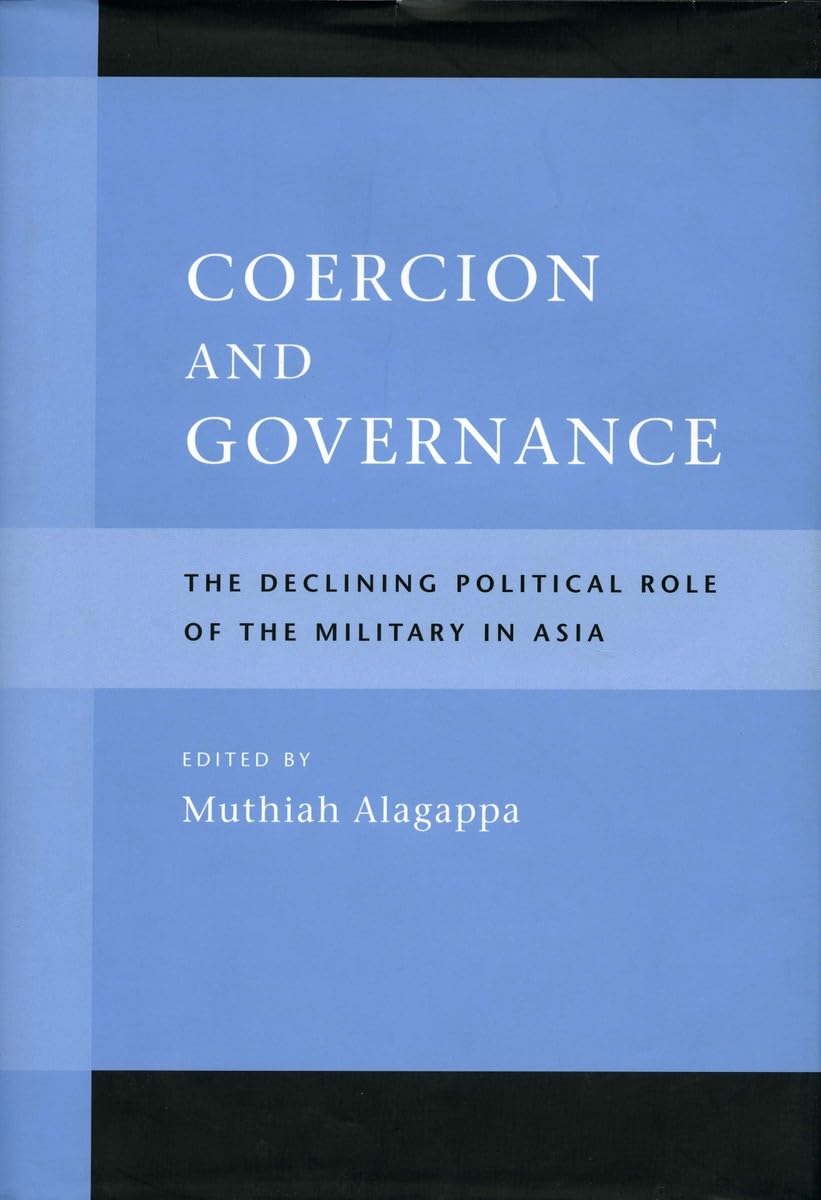
Coercion And Governance: The Declining Political Role Of The Military In Asia,Used
Sold by Ergodebooks, an authorized reseller.
Returns accepted within 30 days | support@ergodebooks.com
Shipping Information
- Free Standard Shipping — United States only
- Processing Time: 3–5 business days
- Estimated Delivery: 6–10 business days after dispatch
- Double-boxed, fully insured & discreetly packaged
- Tracking number sent via email once dispatched
Returns & Refund
Returns accepted within 30 days of delivery.
Damaged or Defective Item
Free return shipping + replacement or full refund
Wrong Item Received
Free return shipping + replacement or full refund
Change of Mind
Return shipping at customer's expense · 25% restocking fee applies
Payment Option

About the Author Muthiah Alagappa is Distinguished Senior Fellow at the EastWest Center. He is the editor of Asian Security Order: Instrumental and Normative Features (Stanford, 2003), Coercion and Governance: The Declining Political Role of the Military in Asia (Stanford, 2001), Asian Security Practice: Material and Ideational Influences (Stanford, 1998), and Political Legitimacy in Southeast Asia: The Quest for Moral Authority (Stanford, 1995). Product Description This farranging volume offers both a broad overview of the role of the military in contemporary Asia and a close look at the state of civilmilitary relations in sixteen Asian countries. It provides indepth discussion of civilmilitary relations in countries where the military still continues to dominate the political helm as well as others where, in varying degrees, the military is disengaging from politics. Conceptually, the study connects the explanation for the changing relationship of the military to the state to the processes associated with the construction of nation, state, and political system, as well as the development of state capacity, economic growth, and change in the international system.The book argues that the key to understanding civilmilitary relations in Asia and elsewhere is the role of coercion, in state and nation building and in the exercise of political authority. As coercion in these processes increases or decreases, so does the political power and influence of the military. Civilian supremacy requires superior political, ideational, moral, and economic power translated into strong institutions that can regulate the military and limit its role in governance.A key finding of the volume is that, overall, the political power and influence of the military in Asia, though still considerable in some countries, is on the decline. At present only Burma and Pakistan are under military rule, though the military is the central pillar of the totalitarian regime in North Korea. The number of Asian countries under civilian rule has increased dramatically. However, the relationship between the state and the soldier is not a settled issue, and in democratizing countries, civilmilitary relations is still a contested domain that is being redefined incrementally, often through struggle. The study concludes that, in the long term, the power of the military will continue to decline, and that the growing dominance of democratic civilian control in Asia is likely to endure. Review This outstanding book will have a lasting impact on the study of civilmilitary relations and of the comparative politics of Asia. It is by far the best collection of case studies of civilmilitary relations I have read, for any part of the world.Larry Diamond, Hoover Institution From the Inside Flap This farranging volume offers both a broad overview of the role of the military in contemporary Asia and a close look at the state of civilmilitary relations in sixteen Asian countries. It provides indepth discussion of civilmilitary relations in countries where the military still continues to dominate the political helm as well as others where, in varying degrees, the military is disengaging from politics. Conceptually, the study connects the explanation for the changing relationship of the military to the state to the processes associated with the construction of nation, state, and political system, as well as the development of state capacity, economic growth, and change in the international system.The book argues that the key to understanding civilmilitary relations in Asia and elsewhere is the role of coercion, in state and nation building and in the exercise of political authority. As coercion in these processes increases or decreases, so does the political power and influence of the military. Civilian supremacy requires superior political, ideational, moral, and economic power translated into strong institutions that can regulate the
⚠️ WARNING (California Proposition 65):
This product may contain chemicals known to the State of California to cause cancer, birth defects, or other reproductive harm.
For more information, please visit www.P65Warnings.ca.gov.