If you have any questions, you are always welcome to contact us. We'll get back to you as soon as possible, withing 24 hours on weekdays.
Customer service
All questions about your order, return and delivery must be sent to our customer service team by e-mail at yourstore@yourdomain.com
Sale & Press
If you are interested in selling our products, need more information about our brand or wish to make a collaboration, please contact us at press@yourdomain.com
Help
If you have any questions, you are always welcome to contact us. We'll get back to you as soon as possible, withing 24 hours on weekdays.
Customer service
All questions about your order, return and delivery must be sent to our customer service team by e-mail at yourstore@yourdomain.com
Sale & Press
If you are interested in selling our products, need more information about our brand or wish to make a collaboration, please contact us at press@yourdomain.com
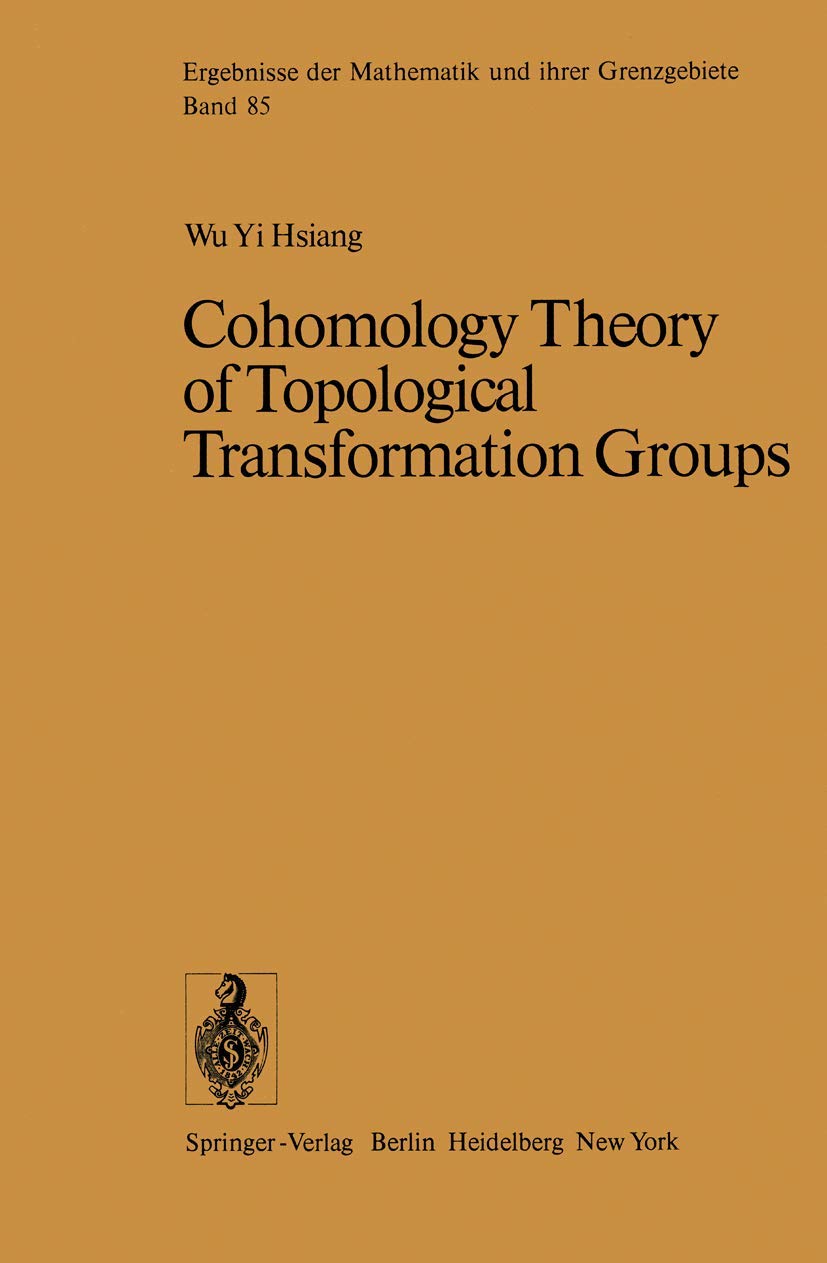
Historically, applications of algebraic topology to the study of topological transformation groups were originated in the work of L. E. 1. Brouwer on periodic transformations and, a little later, in the beautiful fixed point theorem ofP. A. Smith for prime periodic maps on homology spheres. Upon comparing the fixed point theorem of Smith with its predecessors, the fixed point theorems of Brouwer and Lefschetz, one finds that it is possible, at least for the case of homology spheres, to upgrade the conclusion of mere existence (or nonexistence) to the actual determination of the homology type of the fixed point set, if the map is assumed to be prime periodic. The pioneer result of P. A. Smith clearly suggests a fruitful general direction of studying topological transformation groups in the framework of algebraic topology. Naturally, the immediate problems following the Smith fixed point theorem are to generalize it both in the direction of replacing the homology spheres by spaces of more general topological types and in the direction of replacing the group tl by more general compact groups.
⚠️ WARNING (California Proposition 65):
This product may contain chemicals known to the State of California to cause cancer,
birth defects, or other reproductive harm.
For MAP (Minimum Advertised Price) violations and Intellectual Property (IP) or Trademark concerns, please contact:
support@ergodebooks.com
⚠️ California Proposition 65 Warning: Some products sold on this website may expose you to chemicals known to the State of California to cause cancer, birth defects, or other reproductive harm. For more information, visit www.P65Warnings.ca.gov.