
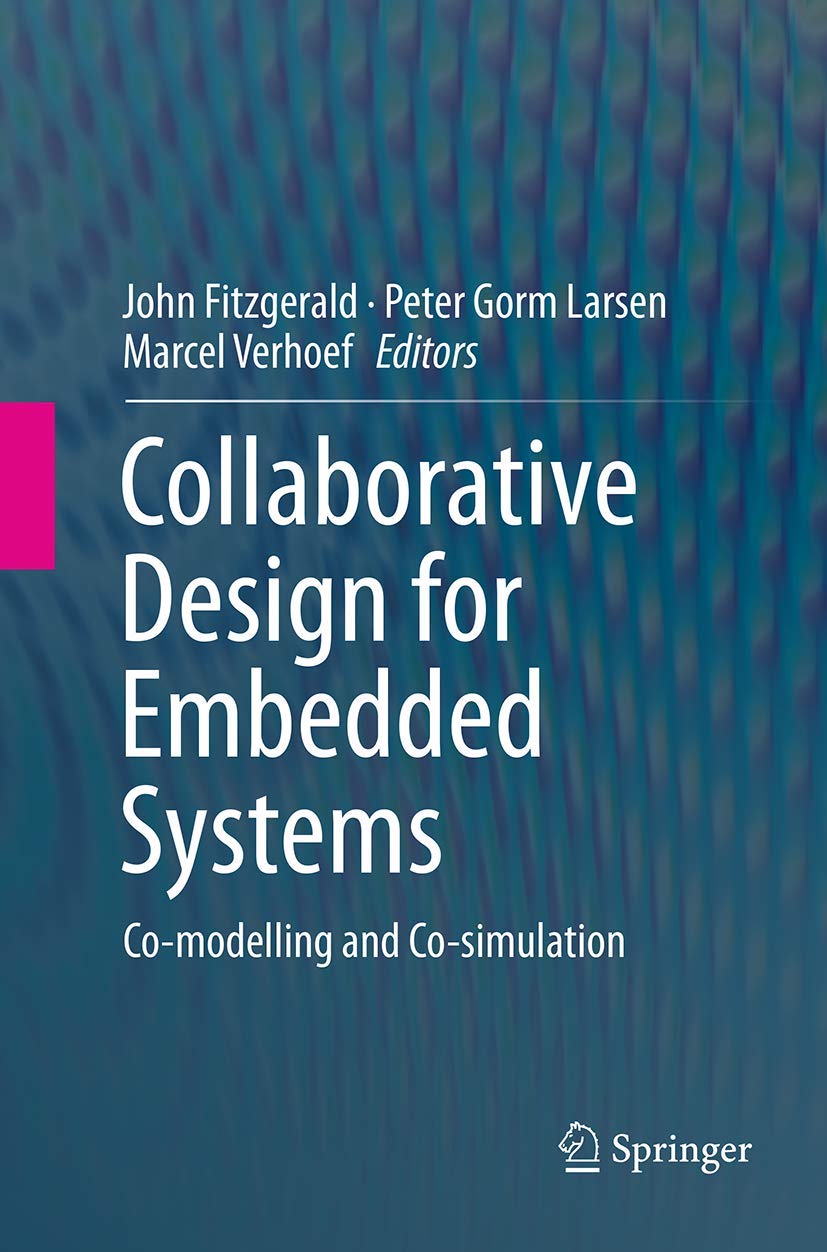
Title
Collaborative Design for Embedded Systems: Comodelling and Cosimulation,Used
Sold by Ergodebooks, an authorized reseller.
Returns accepted within 30 days | support@ergodebooks.com
Shipping Information
- Free Standard Shipping — United States only
- Processing Time: 3–5 business days
- Estimated Delivery: 6–10 business days after dispatch
- Double-boxed, fully insured & discreetly packaged
- Tracking number sent via email once dispatched
Returns & Refund
Returns accepted within 30 days of delivery.
Damaged or Defective Item
Free return shipping + replacement or full refund
Wrong Item Received
Free return shipping + replacement or full refund
Change of Mind
Return shipping at customer's expense · 25% restocking fee applies
Payment Option

One of the most significant challenges in the development of embedded and cyberphysical systems is the gap between the disciplines of software and control engineering. In a marketplace, where rapid innovation is essential, engineers from both disciplines need to be able to explore system designs collaboratively, allocating responsibilities to software and physical elements, and analyzing tradeoffs between them.To this end, this book presents a framework that allows the very different kinds of design models discreteevent (DE) models of software and continuous time (CT) models of the physical environment to be analyzed and simulated jointly, based on common scenarios. The individual chapters provide introductions to both sides of this cosimulation technology, and give a stepbystep guide to the methodology for designing and analyzing comodels. They are grouped into three parts: Part I introduces the technical basis for collaborative modeling and simulation with the Crescendo technology. Part II continues with different methodological guidelines for creating comodels and analyzing them in different ways using case studies. Part III then delves into more advanced topics and looks into the potential future of this technology in the area of cyberphysical systems. Finally various appendices provide summaries of the VDM and 20sim technologies, a number of valuable design patterns applicable for comodels, and an acronym list along with indices and references to other literature. By combining descriptions of the underlying theory with records of real engineers experience in using the framework on a series of case studies the book appeals to scientists and practitioners alike. It is complemented by tools, examples, videos, and other material on www.crescendotool.org. Scientists/researchers and graduate students working in embedded and cyberphysical systems will learn the semantic foundations for collaborative modeling and simulation,as well as the current capabilities and limitations of methods and tools in this field. Practitioners will be able to develop an appreciation of the capabilities of the comodeling techniques, to assess the benefits of more collaborative approaches to modeling and simulation, and will benefit from the included guidelines and modeling patterns.
⚠️ WARNING (California Proposition 65):
This product may contain chemicals known to the State of California to cause cancer, birth defects, or other reproductive harm.
For more information, please visit www.P65Warnings.ca.gov.