
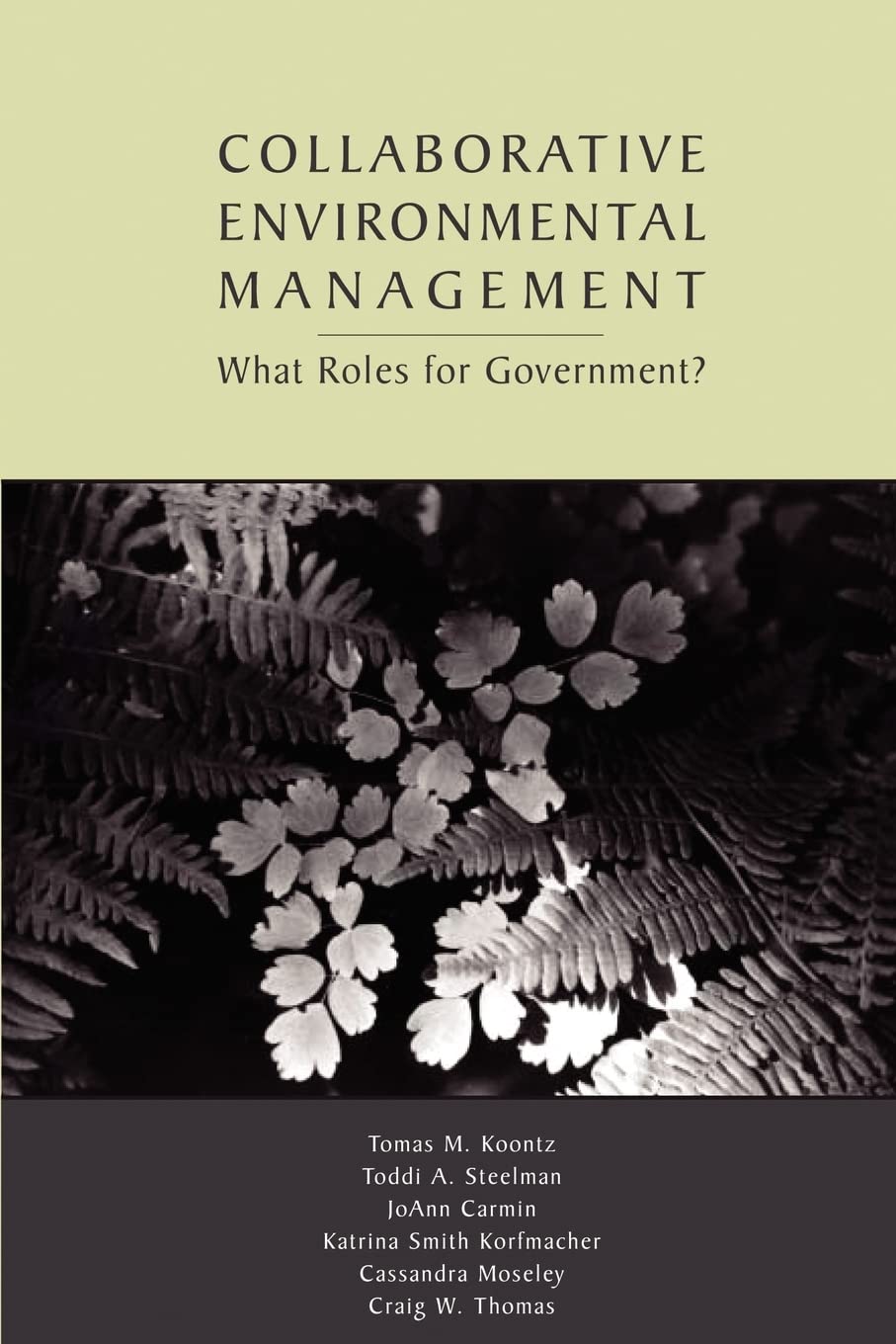
Title
Collaborative Environmental Management,New
Sold by Ergodebooks, an authorized reseller.
Returns accepted within 30 days | support@ergodebooks.com
Shipping Information
- Free Standard Shipping — United States only
- Processing Time: 3–5 business days
- Estimated Delivery: 6–10 business days after dispatch
- Double-boxed, fully insured & discreetly packaged
- Tracking number sent via email once dispatched
Returns & Refund
Returns accepted within 30 days of delivery.
Damaged or Defective Item
Free return shipping + replacement or full refund
Wrong Item Received
Free return shipping + replacement or full refund
Change of Mind
Return shipping at customer's expense · 25% restocking fee applies
Payment Option

Collaboration has become a popular approach to environmental policy, planning, and management. At the urging of citizens, nongovernmental organizations, and industry, government officials at all levels have experimented with collaboration. Yet questions remain about the roles that governments play in collaborationwhether they are constructive and support collaboration, or introduce barriers. This thoughtful book analyzes a series of cases to understand how collaborative processes work and whether government can be an equal partner even as government agencies often formally control decision making and are held accountable for the outcomes. Looking at examples where government has led, encouraged, or followed in collaboration, the authors assess how governmental actors and institutions affected the way issues were defined, the resources available for collaboration, and the organizational processes and structures that were established. Cases include collaborative efforts to manage watersheds, rivers, estuaries, farmland, endangered species habitats, and forests. The authors develop a new theoretical framework and demonstrate that government left a heavy imprint in each of the efforts. The work concludes by discussing the choices and challenges faced by governmental institutions and actors as they try to realize the potential of collaborative environmental management.
⚠️ WARNING (California Proposition 65):
This product may contain chemicals known to the State of California to cause cancer, birth defects, or other reproductive harm.
For more information, please visit www.P65Warnings.ca.gov.
- Q: How many pages does the book have? A: This book has two hundred twenty-six pages. It provides a comprehensive exploration of collaborative environmental management.
- Q: What is the binding type of this book? A: The book is paperback bound. This binding style is ideal for easy handling and portability.
- Q: What are the dimensions of the book? A: The book measures six point fourteen inches in length, zero point fifty-one inches in width, and nine point twenty-one inches in height. These dimensions make it a convenient size for reading.
- Q: Who is the author of this book? A: The author is Katrina Smith M. Korfmacher. She brings a wealth of knowledge in environmental policy and collaboration.
- Q: What category does this book belong to? A: The book falls under the category of Environmental Economics. It addresses critical issues in environmental policy and management.
- Q: What is the main focus of this book? A: The main focus is on collaborative approaches to environmental management. It analyzes the roles of government and other stakeholders in these processes.
- Q: Can anyone read this book? A: Yes, the book is suitable for anyone interested in environmental policy and management. It is ideal for students, professionals, and policymakers.
- Q: Is this book relevant for environmental professionals? A: Yes, it is highly relevant for environmental professionals. It provides insights into collaboration strategies and governmental roles in environmental management.
- Q: What themes are explored in the book? A: The book explores themes of collaboration, government roles, and case studies in environmental management. It provides a theoretical framework for understanding these dynamics.
- Q: How should I care for this book? A: To maintain the book's condition, keep it in a dry place. Avoid exposing it to direct sunlight to prevent fading.
- Q: What if my book arrives damaged? A: If your book arrives damaged, you should contact the seller for a return or exchange. Most sellers offer policies for damaged items.
- Q: How do I store this book? A: Store the book upright on a shelf to prevent bending. Ensure it is in a cool, dry environment to avoid moisture damage.
- Q: Is this book suitable for beginners in environmental studies? A: Yes, it is suitable for beginners. The content is accessible and provides a solid foundation in collaborative environmental management.
- Q: Can I use this book for academic purposes? A: Yes, it can be used for academic purposes. The book includes case studies that are valuable for research and coursework in environmental studies.
- Q: What if I have questions about the book's content? A: If you have questions about the book's content, consider reaching out to the author or discussing it in academic forums. Engaging with others can enhance your understanding.