
Title
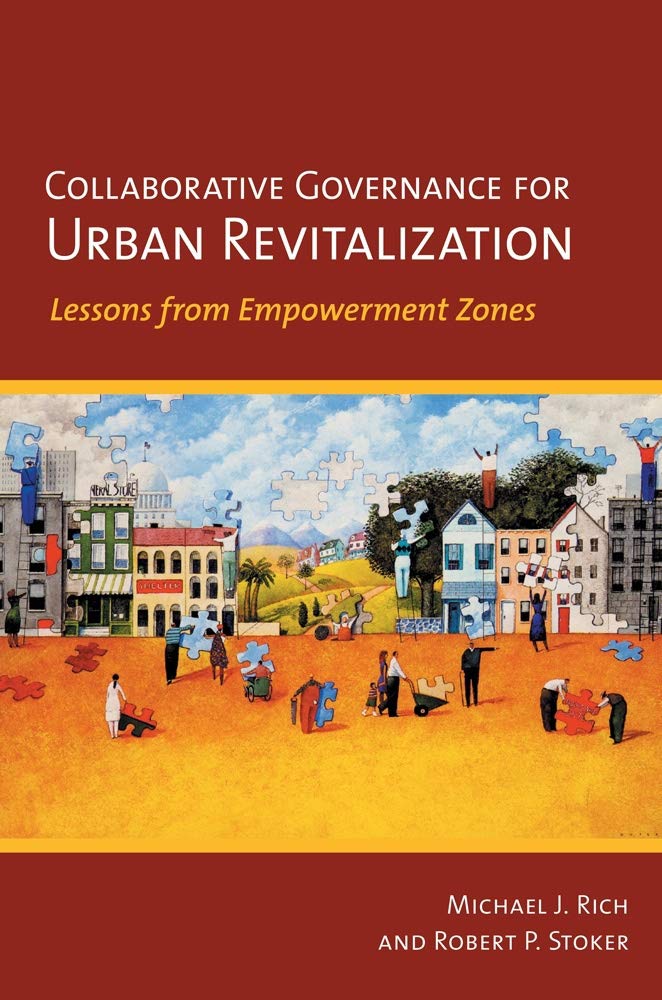
Collaborative Governance for Urban Revitalization: Lessons from Empowerment Zones,Used
Sold by Ergodebooks, an authorized reseller.
Returns accepted within 30 days | support@ergodebooks.com
Shipping Information
- Free Standard Shipping — United States only
- Processing Time: 3–5 business days
- Estimated Delivery: 6–10 business days after dispatch
- Double-boxed, fully insured & discreetly packaged
- Tracking number sent via email once dispatched
Returns & Refund
Returns accepted within 30 days of delivery.
Damaged or Defective Item
Free return shipping + replacement or full refund
Wrong Item Received
Free return shipping + replacement or full refund
Change of Mind
Return shipping at customer's expense · 25% restocking fee applies
Payment Option

For more than one hundred years, governments have grappled with the complex problem of how to revitalize distressed urban areas. In 1995, the original urban Empowerment Zones (Atlanta, Baltimore, Chicago, Detroit, New York, and Philadelphia) each received a $100 million federal block grant and access to a variety of marketoriented policy tools to support the implementation of a tenyear strategic plan to increase economic opportunities and promote sustainable community development in highpoverty neighborhoods. In Collaborative Governance for Urban Revitalization, Michael J. Rich and Robert P. Stoker confront the puzzle of why the outcomes achieved by the original Empowerment Zones varied so widely given that each city had the same set of federal policy tools and resources and comparable neighborhood characteristics.The authors analysis, based on more than ten years of field research in Atlanta and Baltimore and extensive empirical analysis of EZ processes and outcomes in all six cities shows that revitalization outcomes are best explained by the quality of local governance. Good local governance makes positive contributions to revitalization efforts, while poor local governance retards progress. While policy design and contextual factors are important, how cities craft and carry out their strategies are critical determinants of successful revitalization. Rich and Stoker find that good governance is often founded on publicprivate cooperation, a stance that argues against both the strongest critics of neoliberalism (who see private enterprise as dangerous in principle) and the strongest opponents of liberalism (who would like to reduce the role of government).
⚠️ WARNING (California Proposition 65):
This product may contain chemicals known to the State of California to cause cancer, birth defects, or other reproductive harm.
For more information, please visit www.P65Warnings.ca.gov.