
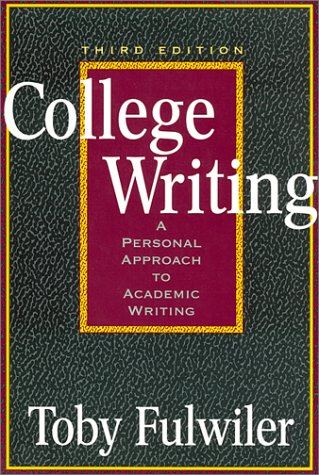
Title
College Writing: A Personal Approach To Academic Writing,New
Sold by Ergodebooks, an authorized reseller.
Returns accepted within 30 days | support@ergodebooks.com
Shipping Information
- Free Standard Shipping — United States only
- Processing Time: 3–5 business days
- Estimated Delivery: 6–10 business days after dispatch
- Double-boxed, fully insured & discreetly packaged
- Tracking number sent via email once dispatched
Returns & Refund
Returns accepted within 30 days of delivery.
Damaged or Defective Item
Free return shipping + replacement or full refund
Wrong Item Received
Free return shipping + replacement or full refund
Change of Mind
Return shipping at customer's expense · 25% restocking fee applies
Payment Option

Writing Is A Varied Critical And Imaginative Process, Not A Rigid Adherence To A Set Of Conventions. Based On That Premise, The Third Edition Of College Writing, Like Its Previous Editions, Continually Exhorts Students To Find And Celebrate Their Own Voices. In Fact, It Is This Affirmation Of Individual Creativity That Sets College Writing Apart From Other Processoriented Rhetorics.Lively And Conversational In Tone, The Third Edition Boasts A Writertowriter Perspective That Will Put Students At Ease. College Writing Walks Students Through The Main Elements Of Writing, From Discovery And Research To Revising And Editing. At The Same Time, Author Toby Fulwiler Allows For Many Detours In His Stepbystep Approach, With Frequent Reminders That Everyone'S Processes Are Unique And That Establishing And Maintaining A Personal Voice Can Be Achieved While Meeting Conventional Academic Expectations.Fulwiler Examines The Different, Yet Overlapping Stages Of Writing. He Addresses Rhetorical Issues Of Audience, Purpose, And Voice, As Well As The Details Of Field, Library, And Internet Research, With Particular Attention To Evaluating Sources. He Also Offers These New Features To Keep Students And Teachers Up To Date:New Webbased Research Information The Most Recent Mla Guidelines Increased Coverage Of Visual Elements Of Texts More On Approaches To Writing 'Alternative' Pieces A Look At The Role Of Creative Nonfiction In An Academic Settingwith Frequent Examples Of The Best Of Undergraduate Writing For Inspiration, The Inclusion Of Student Statements About Their Writing Problems For Reassurance, And Appended Guides To Portfolios, Punctuation, And Publishing For Reference, College Writing, Third Edition, Is A Student'S Best Companion For Starting The Writing Process Right.Since 1983, Toby Fulwiler Has Directed The Writing Program At The University Of Vermont, Where He Teaches Writing And Literature Courses. Author Of Teaching With Writing (1987) And Coauthor Of The Letter Book (2000), Both Published By Boynton/Cook, He Has Also Coedited Numerous Publications, Including When Writing Teachers Teach Literature: Bringing Writing To Reading (1996), Programs That Work: Models And Methods For Writing Across The Curriculum (1990), And The Journal Book (1987), All Published By Boynton/Cook.
⚠️ WARNING (California Proposition 65):
This product may contain chemicals known to the State of California to cause cancer, birth defects, or other reproductive harm.
For more information, please visit www.P65Warnings.ca.gov.
- Q: How many pages does this book have? A: This book has two hundred fifty-six pages. It offers ample content to guide students through academic writing.
- Q: What is the binding type of this book? A: The book is paperback bound. This makes it lightweight and easy to handle for students.
- Q: What are the dimensions of this book? A: The book measures six inches in length, zero point fifty-five inches in width, and nine point zero two inches in height. These dimensions make it a convenient size for carrying.
- Q: How do I approach the writing process described in this book? A: Begin by exploring your personal voice and creativity. The book offers step-by-step guidance on writing, from discovery to editing.
- Q: Is this book suitable for beginners in academic writing? A: Yes, this book is suitable for beginners. It provides a friendly, conversational tone aimed at easing students into writing.
- Q: How can I use this book to improve my writing skills? A: You can use the book as a guide through various writing stages, including research and revision. It includes examples and exercises for practice.
- Q: How should I care for this book? A: To keep the book in good condition, store it in a dry place and avoid exposing it to extreme temperatures. Handle it gently to prevent wear.
- Q: Is this book appropriate for young adults? A: Yes, it is appropriate for young adults. The content is designed to support college students in their writing endeavors.
- Q: What if the book arrives damaged? A: If the book arrives damaged, contact the seller for a return or exchange. Most sellers have policies in place for such situations.
- Q: Are there any specific writing challenges addressed in this book? A: Yes, the book addresses common writing challenges faced by students, including finding a personal voice and meeting academic standards.
- Q: Can I use this book for creative nonfiction writing? A: Yes, the book includes a section on creative nonfiction within an academic context. It helps students explore various writing forms.
- Q: Does the book provide examples of good writing? A: Yes, it includes frequent examples of strong undergraduate writing. These serve as inspiration for students to enhance their own work.
- Q: What kind of research methods does this book cover? A: The book covers multiple research methods, including library and Internet research, with a focus on evaluating sources effectively.
- Q: Is there a focus on visual elements in writing? A: Yes, the book has increased coverage of visual elements in texts. This helps students understand how to integrate visuals into their writing.
- Q: Who is the author of this book? A: The author is Toby Fulwiler. He has extensive experience teaching writing and literature and directs the writing program at the University of Vermont.
- Q: What is the main theme of this book? A: The main theme is celebrating individual voice and creativity in academic writing. It encourages students to express themselves while adhering to conventions.