
Title
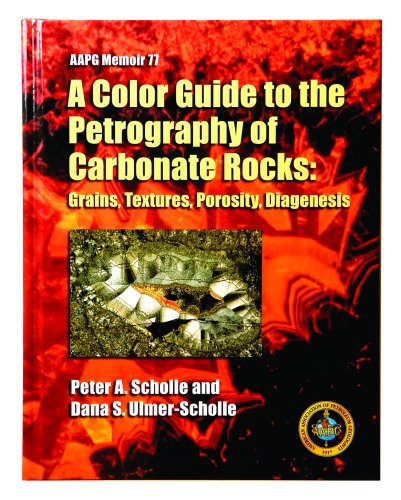
Color Guide to the Petrography of Carbonate Rocks: Grains, Textures, Porosity, Diagenesis (AAPG Memoir),Used
Sold by Ergodebooks, an authorized reseller.
Returns accepted within 30 days | support@ergodebooks.com
Shipping Information
- Free Standard Shipping — United States only
- Processing Time: 3–5 business days
- Estimated Delivery: 6–10 business days after dispatch
- Double-boxed, fully insured & discreetly packaged
- Tracking number sent via email once dispatched
Returns & Refund
Returns accepted within 30 days of delivery.
Damaged or Defective Item
Free return shipping + replacement or full refund
Wrong Item Received
Free return shipping + replacement or full refund
Change of Mind
Return shipping at customer's expense · 25% restocking fee applies
Payment Option

This volume expands and improves the AAPG 1978 classic, A Color Illustrated Guide to Carbonate Rock Constituents, Textures, Cements, and Porosities (AAPG Memoir 27). Carbonate petrography can be quite complicated. Changing assemblages of organisms through time, coupled with the randomness of thinsection cuts through complex shell forms, add to the difficulty of identifying skeletal grains. Furthermore, because many primary carbonate grains are composed of unstable minerals (especially aragonite and highMg calcite), diagenetic alteration commonly is quite extensive in carbonate rocks. The variability of inorganic and biogenic carbonate mineralogy through time, however, complicates prediction of patterns of diagenetic alteration.This book is designed to help deal with such challenges. It includes a wide variety of examples of commonly encountered skeletal and nonskeletal grains, cements, fabrics, and porosity types. It includes extensive new tables of age distributions, mineralogy, morphologic characteristics, environmental implications and keys to grain identification. It also encompasses a number of noncarbonate grains, that occur as accessory minerals in carbonate rocks or that may provide important biostratigraphic or paleoenvironmental information in carbonate strata. With this guide, students and other workers with little formal petrographic training should be able to examine thin sections or acetate peels under the microscope and interpret the main rock constituents and their depositional and diagenetic history.
⚠️ WARNING (California Proposition 65):
This product may contain chemicals known to the State of California to cause cancer, birth defects, or other reproductive harm.
For more information, please visit www.P65Warnings.ca.gov.
- Q: What is the main focus of the book 'Color Guide to the Petrography of Carbonate Rocks'? A: The book primarily focuses on carbonate petrography, including the identification of skeletal and nonskeletal grains, diagenesis, and the complexities involved in analyzing carbonate rocks.
- Q: Who is the author of this book? A: The book is authored by Peter A. Scholle.
- Q: What edition of the book is available? A: The book does not specify an edition, but it was published on November 1, 2003.
- Q: How many pages does the book contain? A: The book contains a total of 474 pages.
- Q: What type of binding does the book have? A: The book is available in hardcover binding.
- Q: Is this book suitable for beginners in geology? A: Yes, the book is designed to assist students and individuals with little formal petrographic training.
- Q: What topics are covered in the book? A: The book covers a wide variety of topics including mineralogy, environmental implications, and keys to identifying rock constituents, as well as examples of skeletal and nonskeletal grains.
- Q: Does the book include visual aids or illustrations? A: While the description does not specify, it indicates that the book includes extensive examples and tables which likely contain visual aids to assist in understanding the material.
- Q: What is the condition of the book being sold? A: The book is listed as 'New'.
- Q: Is this book relevant for professionals in geology? A: Yes, the book provides valuable insights and resources for both students and professionals in the field of geology, particularly those specializing in carbonate rocks.