If you have any questions, you are always welcome to contact us. We'll get back to you as soon as possible, withing 24 hours on weekdays.
Customer service
All questions about your order, return and delivery must be sent to our customer service team by e-mail at yourstore@yourdomain.com
Sale & Press
If you are interested in selling our products, need more information about our brand or wish to make a collaboration, please contact us at press@yourdomain.com
Help
If you have any questions, you are always welcome to contact us. We'll get back to you as soon as possible, withing 24 hours on weekdays.
Customer service
All questions about your order, return and delivery must be sent to our customer service team by e-mail at yourstore@yourdomain.com
Sale & Press
If you are interested in selling our products, need more information about our brand or wish to make a collaboration, please contact us at press@yourdomain.com
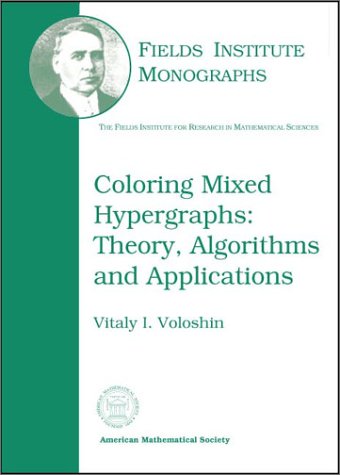
The theory of graph coloring has existed for more than 150 years. Historically, graph coloring involved finding the minimum number of colors to be assigned to the vertices so that adjacent vertices would have different colors. From this modest beginning, the theory has become central in discrete mathematics with many contemporary generalizations and applications. Generalization of graph coloringtype problems to mixed hypergraphs brings many new dimensions to the theory of colorings. A main feature of this book is that in the case of hypergraphs, there exist problems on both the minimum and the maximum number of colors. This feature pervades the theory, methods, algorithms, and applications of mixed hypergraph coloring. The book has broad appeal. It will be of interest to both pure and applied mathematicians, particularly those in the areas of discrete mathematics, combinatorial optimization, operations research, computer science, software engineering, molecular biology, and related businesses and industries. It also makes a nice supplementary text for courses in graph theory and discrete mathematics. This is especially useful for students in combinatorics and optimization. Since the area is new, students will have the chance at this stage to obtain results that may become classic in the future.
⚠️ WARNING (California Proposition 65):
This product may contain chemicals known to the State of California to cause cancer,
birth defects, or other reproductive harm.
For MAP (Minimum Advertised Price) violations and Intellectual Property (IP) or Trademark concerns, please contact:
support@ergodebooks.com
⚠️ California Proposition 65 Warning: Some products sold on this website may expose you to chemicals known to the State of California to cause cancer, birth defects, or other reproductive harm. For more information, visit www.P65Warnings.ca.gov.