
Title
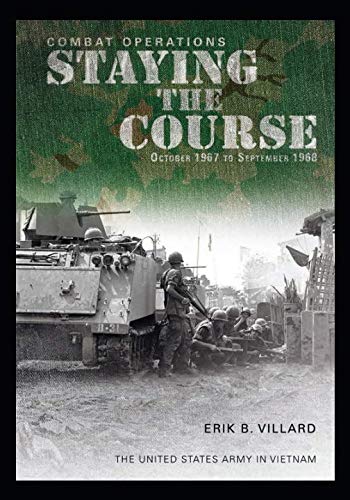
Combat Operations: Staying the Course October 1967 to September 1968: The U.S. Army in Vietnam,Used
Sold by Ergodebooks, an authorized reseller.
Returns accepted within 30 days | support@ergodebooks.com
Shipping Information
- Free Standard Shipping — United States only
- Processing Time: 3–5 business days
- Estimated Delivery: 6–10 business days after dispatch
- Double-boxed, fully insured & discreetly packaged
- Tracking number sent via email once dispatched
Returns & Refund
Returns accepted within 30 days of delivery.
Damaged or Defective Item
Free return shipping + replacement or full refund
Wrong Item Received
Free return shipping + replacement or full refund
Change of Mind
Return shipping at customer's expense · 25% restocking fee applies
Payment Option

To many Americans, the war in Vietnam was, and remains, a divisive issue. But nearly fifty years after the end of major U.S. combat operations in Vietnam, well over half the U.S. population is too young to have any direct memory of the conflict. The massive American commitmentpolitical, economic, diplomatic, and militaryto the mission of maintaining an independent and nonCommunist South Vietnam deserves widespread attention, both to recognize the sacrifice of those who served and to remember how those events have impacted our nation.U.S. involvement in Southeast Asia began after World War II when elements of the Vietnamese population fought back against the reimposition of French colonial rule. Although the United States generally favored the idea of an independent Vietnam, it supported France because the Viet Minh rebels were led by Communists and U.S. policy at that point in the Cold War sought to contain any expansion of communism. France? defeat in 1954 led to the division of Vietnam into a Communist North (Democratic Republic of Vietnam) and a nonCommunist South (Republic of Vietnam). The United States actively supported the latter as it dealt with a growing Communistled insurgent force (the Viet Cong) aided by the North Vietnamese. The initial mission of training South Vietnam? armed forces led to deepening American involvement as the situation grew increasingly dire for the Republic of Vietnam.By the time President Lyndon B. Johnson committed major combat units in 1965, the United States already had invested thousands of men and millions of dollars in the effort to build a secure and stable Republic of Vietnam. That commitment expanded rapidly through 1969, when the United States had over 365,000 Army soldiers (out of a total of a half million troops of all services) in every military region of South Vietnam, with thousands of other Army personnel throughout the Pacific area providing direct support to operations. The war saw many innovations, including the massive use of helicopters to conduct airmobile tactics, new concepts of counterinsurgency, the introduction of airborne radio direction finding, widescale use of computers, and major advances in battlefield medicine. Yet, as in most wars, much of the burden was still borne by soldiers on the ground who slogged on foot over the hills and through the rice paddies in search of an often elusive foe. The enormous military effort by the United States was, however, matched by the resolve of North Vietnamese leaders to unify their country under communism at whatever cost. That determination, in the end, proved decisive as American commitment wavered in the face of high casualties and economic and social challenges at home. Negotiations accompanied by the gradual withdrawal of U.S. forces led to the Paris Peace Accords in January 1973, effectively ending the American military role in the conflict. Actual peace was elusive, and two years later the North Vietnamese Army overran South Vietnam, bringing the war to an end in April 1975.The vast majority of American men and women who went to Vietnam did so in the uniform of the U.S. Army. They served their country when called, many at great personal cost, against a backdrop of growing uncertainty and unrest at home. This book, the twelfth volume of the U.S. Army? official history of the Vietnam War, is dedicated to them.
⚠️ WARNING (California Proposition 65):
This product may contain chemicals known to the State of California to cause cancer, birth defects, or other reproductive harm.
For more information, please visit www.P65Warnings.ca.gov.
- Q: How many pages does this book have? A: This book contains seven hundred seventy-four pages. It provides an in-depth exploration of U.S. Army operations in Vietnam.
- Q: What is the binding type of this book? A: This book is available in paperback binding. Paperback is lightweight and flexible, making it easy to handle.
- Q: What are the dimensions of the book? A: The book measures seven point zero one inches in length, one point nine four inches in width, and ten inches in height. These dimensions make it a standard size for easy reading.
- Q: Who is the author of this book? A: The author is the United States Army. This book is part of the official history of the Vietnam War.
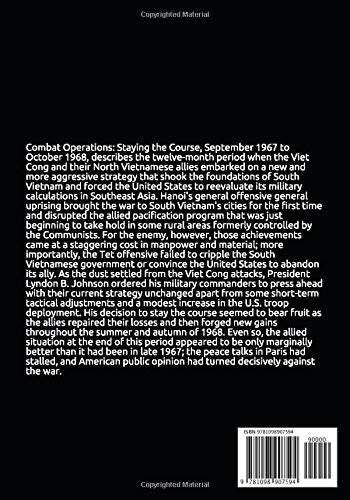
- Q: What is the main theme of this book? A: The main theme revolves around U.S. Army operations during the Vietnam War from October nineteen sixty-seven to September nineteen sixty-eight. It highlights the challenges faced by American soldiers.
- Q: How does this book cover the Vietnam War? A: This book provides a detailed account of the U.S. commitment to South Vietnam and the military operations conducted during the war. It emphasizes the sacrifices made by soldiers.
- Q: Is this book suitable for young readers? A: This book is generally aimed at adult readers. It contains complex themes and historical details that may not be suitable for children.
- Q: Can I use this book for research purposes? A: Yes, this book is a valuable resource for research on the Vietnam War. It is part of the U.S. Army's official history and contains extensive information.
- Q: What type of content can I expect in this book? A: You can expect historical accounts, military strategies, and personal stories from soldiers. The content covers various aspects of the Vietnam War.
- Q: How should I store this book? A: Store the book in a cool, dry place on a shelf. Avoid direct sunlight to prevent fading and damage to the cover.
- Q: Is there any special care needed for this book? A: No special care is needed. Just handle the book gently and avoid exposing it to moisture or extreme temperatures.
- Q: What if the book arrives damaged? A: If the book arrives damaged, you should contact the seller for a return or replacement. Most sellers have policies in place for such situations.
- Q: Can I return this book if I don't like it? A: Yes, you can return the book if it doesn't meet your expectations. Check the seller's return policy for specific details.
- Q: How does this book compare to other Vietnam War books? A: This book is part of an official series and offers a comprehensive military perspective, making it distinct from general history books on Vietnam.
- Q: Is this book appropriate for a military history class? A: Yes, this book is highly appropriate for a military history class. It provides factual accounts and analysis of U.S. Army operations in Vietnam.