
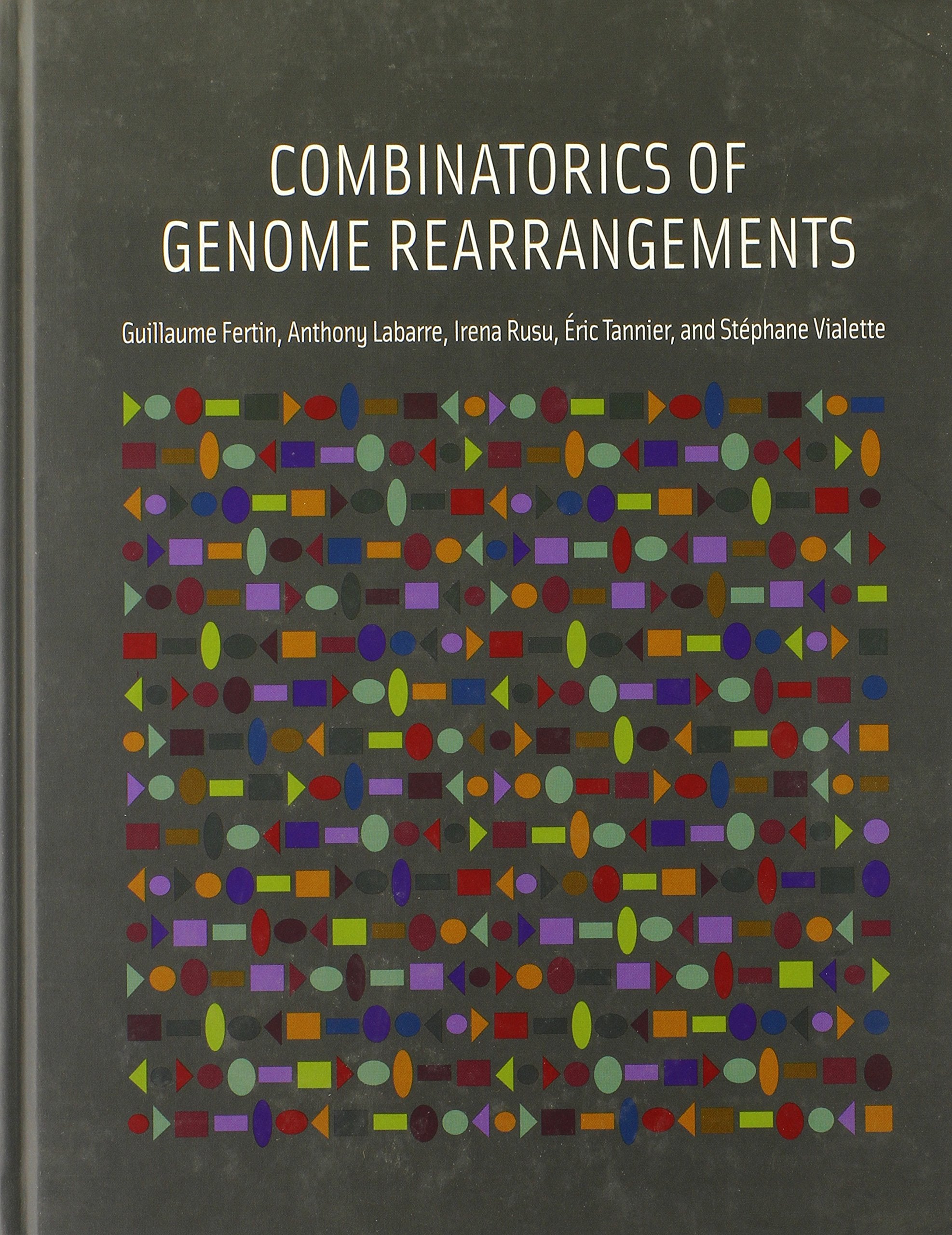
Title
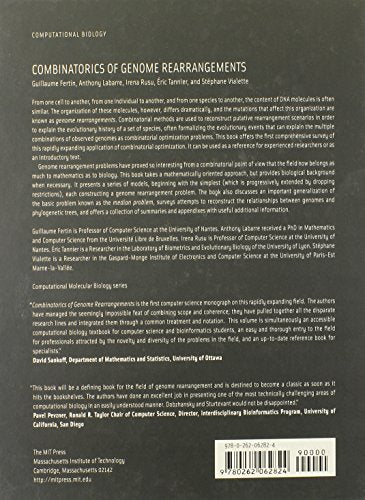

Combinatorics of Genome Rearrangements (Computational Molecular Biology),New
Sold by Ergodebooks, an authorized reseller.
Returns accepted within 30 days | support@ergodebooks.com
Shipping Information
- Free Standard Shipping — United States only
- Processing Time: 3–5 business days
- Estimated Delivery: 6–10 business days after dispatch
- Double-boxed, fully insured & discreetly packaged
- Tracking number sent via email once dispatched
Returns & Refund
Returns accepted within 30 days of delivery.
Damaged or Defective Item
Free return shipping + replacement or full refund
Wrong Item Received
Free return shipping + replacement or full refund
Change of Mind
Return shipping at customer's expense · 25% restocking fee applies
Payment Option

A comprehensive survey of a rapidly expanding field of combinatorial optimization, mathematically oriented but offering biological explanations when required.From one cell to another, from one individual to another, and from one species to another, the content of DNA molecules is often similar. The organization of these molecules, however, differs dramatically, and the mutations that affect this organization are known as genome rearrangements. Combinatorial methods are used to reconstruct putative rearrangement scenarios in order to explain the evolutionary history of a set of species, often formalizing the evolutionary events that can explain the multiple combinations of observed genomes as combinatorial optimization problems. This book offers the first comprehensive survey of this rapidly expanding application of combinatorial optimization. It can be used as a reference for experienced researchers or as an introductory text for a broader audience. Genome rearrangement problems have proved so interesting from a combinatorial point of view that the field now belongs as much to mathematics as to biology. This book takes a mathematically oriented approach, but provides biological background when necessary. It presents a series of models, beginning with the simplest (which is progressively extended by dropping restrictions), each constructing a genome rearrangement problem. The book also discusses an important generalization of the basic problem known as the median problem, surveys attempts to reconstruct the relationships between genomes with phylogenetic trees, and offers a collection of summaries and appendixes with useful additional information.
⚠️ WARNING (California Proposition 65):
This product may contain chemicals known to the State of California to cause cancer, birth defects, or other reproductive harm.
For more information, please visit www.P65Warnings.ca.gov.