
Title
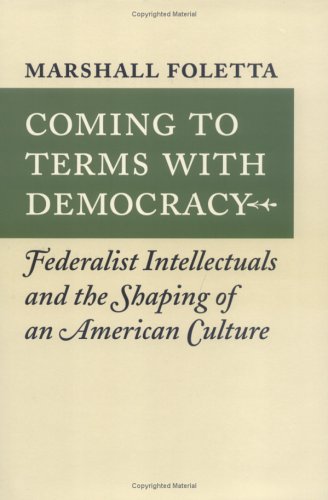
Coming To Terms With Democracy: Federalist Intellectuals And The Shaping Of An American Culture, 18001828,Used
Sold by Ergodebooks, an authorized reseller.
Returns accepted within 30 days | support@ergodebooks.com
Shipping Information
- Free Standard Shipping — United States only
- Processing Time: 3–5 business days
- Estimated Delivery: 6–10 business days after dispatch
- Double-boxed, fully insured & discreetly packaged
- Tracking number sent via email once dispatched
Returns & Refund
Returns accepted within 30 days of delivery.
Damaged or Defective Item
Free return shipping + replacement or full refund
Wrong Item Received
Free return shipping + replacement or full refund
Change of Mind
Return shipping at customer's expense · 25% restocking fee applies
Payment Option

William Tudor, Willard Phillips, and Richard Henry Dana were not their fathers' Federalists. When these young New England intellectuals and their contemporaries attempted to carve out a place for themselves in the rapidly changing and increasingly unfriendly culture of the early nineteenth century, the key to their efforts was the founding, in 1815, of the North American Review.Raised as Federalists, and encouraged to believe that they had special responsibilities as 'the wise and the good,' they came of age within a cultural and political climate that no longer deferred to men of their education and background. But unlike their fathers, who retreated in disgust before the emerging forces of democracy, these young Federalist intellectuals tried to adapt their parents' ideology to the new political and social realities and preserve for themselves a place as the first public intellectuals in America.In Coming to Terms with Democracy, Marshall Foletta contends that by calling for a new American literature in their journal, the secondgeneration Federalists helped American readers break free from imported neoclassical standards, thus paving the way for the American Renaissance. Despite their failure to reconstitute in the cultural sphere their fathers' lost political prominence, Foletta concludes that the original contributors to the North American Review were enormously influential both in the creation of the role of the American public intellectual, and in the development of a vision for the American university that most historians place in a much later period. They have earned a prominent place in the history of American literature, magazines and journals, law and legal education, institutional reform, and the cultural history of New England.
⚠️ WARNING (California Proposition 65):
This product may contain chemicals known to the State of California to cause cancer, birth defects, or other reproductive harm.
For more information, please visit www.P65Warnings.ca.gov.