
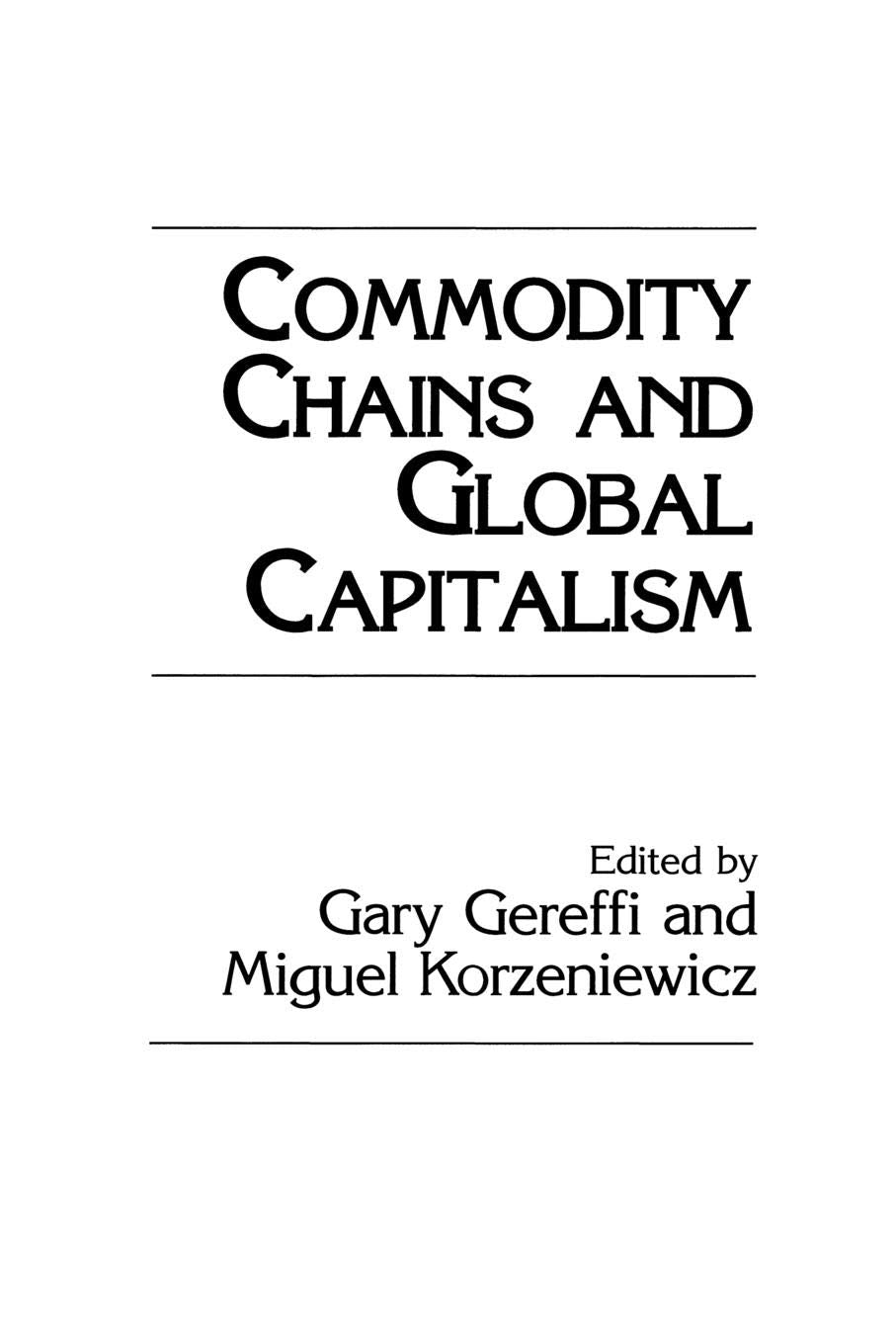
Title
Commodity Chains and Global Capitalism (Contributions in Economics and Economic History),Used
Sold by Ergodebooks, an authorized reseller.
Returns accepted within 30 days | support@ergodebooks.com
Shipping Information
- Free Standard Shipping — United States only
- Processing Time: 3–5 business days
- Estimated Delivery: 6–10 business days after dispatch
- Double-boxed, fully insured & discreetly packaged
- Tracking number sent via email once dispatched
Returns & Refund
Returns accepted within 30 days of delivery.
Damaged or Defective Item
Free return shipping + replacement or full refund
Wrong Item Received
Free return shipping + replacement or full refund
Change of Mind
Return shipping at customer's expense · 25% restocking fee applies
Payment Option

The current restructuring of the worldeconomy under global capitalism has further integrated international trade and production. It thus has brought to the fore the key role of commodity chains in the relationships of capital, labor, and states. Commodity chains are most simply defined as the link between successive processes of manufacturing that result in a final product available for individual consumption. Each production site in the chain involves organizing the acquisition of necessary raw materials plus semifinished inputs, the recruitment of labor power and its provisioning, arranging transportation to the next site, and the construction of modes of distribution (via markets and transfers) and consumption.The contributors to this volume explore and elaborate the global commodity chains (GCCs) approach, which reformulates the basic conceptual categories for analyzing varied patterns of global organization and change. The GCC framework allows the authors to pose questions about development issues, past and present, that are not easily handled by previous paradigms and to more adequately forge the macromicro links between processes that are generally assumed to be discretely contained within global, national, and local units of analysis. The paradigm that GCCs embody is a networkcentered, historical approach that probes above and below the level of the nationstate to better analyze structure and change in the contemporary world.
⚠️ WARNING (California Proposition 65):
This product may contain chemicals known to the State of California to cause cancer, birth defects, or other reproductive harm.
For more information, please visit www.P65Warnings.ca.gov.
- Q: What is the main topic of 'Commodity Chains and Global Capitalism'? A: The book focuses on the restructuring of the world-economy under global capitalism, emphasizing the role of commodity chains in the relationships between capital, labor, and states.
- Q: Who is the author of this book? A: The author of 'Commodity Chains and Global Capitalism' is Gary Gereffi.
- Q: When was this book published? A: The book was published on November 30, 1993.
- Q: What is the format of the book? A: This book is available in a reprint paperback edition.
- Q: How many pages does the book contain? A: The book contains a total of 352 pages.
- Q: What kind of insights does the book provide? A: The book offers insights into the global commodity chains (GCCs) approach, which helps analyze development issues and macro-micro links in global, national, and local contexts.
- Q: Is the book suitable for academic study? A: Yes, 'Commodity Chains and Global Capitalism' is suitable for academic study, particularly in fields related to economics and economic history.
- Q: What is the condition of the book? A: The book is in new condition.
- Q: What topics are covered in the book? A: The book covers topics related to international trade, production processes, labor recruitment, transportation, and distribution within the context of global capitalism.
- Q: Does the book include case studies or examples? A: Yes, the contributors explore various case studies and examples to elaborate on the global commodity chains approach.