If you have any questions, you are always welcome to contact us. We'll get back to you as soon as possible, withing 24 hours on weekdays.
Customer service
All questions about your order, return and delivery must be sent to our customer service team by e-mail at yourstore@yourdomain.com
Sale & Press
If you are interested in selling our products, need more information about our brand or wish to make a collaboration, please contact us at press@yourdomain.com
Help
If you have any questions, you are always welcome to contact us. We'll get back to you as soon as possible, withing 24 hours on weekdays.
Customer service
All questions about your order, return and delivery must be sent to our customer service team by e-mail at yourstore@yourdomain.com
Sale & Press
If you are interested in selling our products, need more information about our brand or wish to make a collaboration, please contact us at press@yourdomain.com
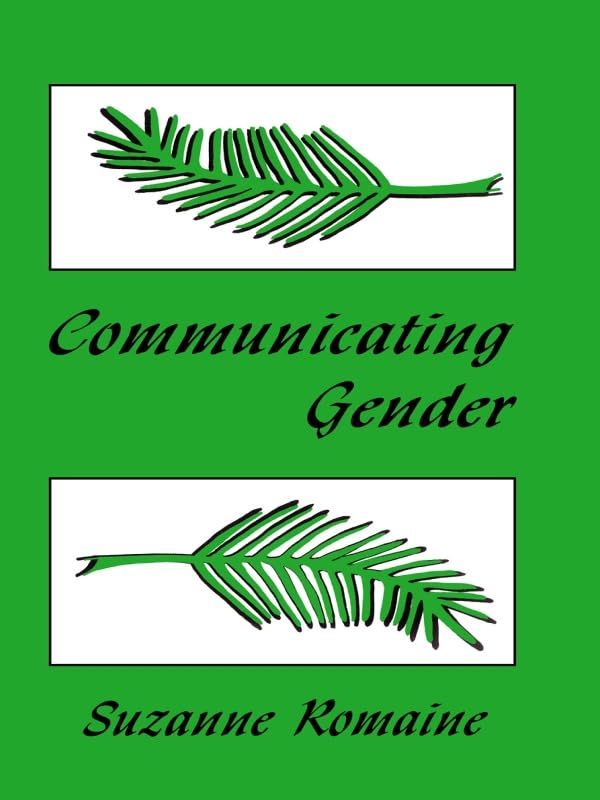
Taking a crossdisciplinary approach, Suzanne Romaine's main concern is to show how language and discourse play key roles in understanding and communicating gender and culture. In addition to linguisticswhich provides the starting point and central focus of the bookshe draws on the fields of anthropology, biology, communication, education, economics, history, literary criticism, philosophy, psychology, and sociology. The text covers the 'core' areas in the study of language and gender, including how and where gender is indexed in language, how men and women speak, how children acquire gender differentiated language, and sexism in language and language reform. Although most of the examples are drawn primarily from English, other European languages and nonEuropean languages, such as Japanese are considered. The text is written in an accessible way so that no prior knowledge of linguistics is necessary to understand the chapters containing linguistic analysis. Each chapter is followed by exercises and discussion questions to facilitate the book's use as a classroom text.The author reviews scholarly treatments of gender, and then uses her own data material from the corpora of spoken and written English usage. Special features include an examination of contemporary media sources such as newspapers, advertising, and television; a discussion of women's speculative fiction; a study of gender and advertising, with special attention paid to the role played by language in these domains; and a review of French feminist thought, particularly as it relates to the issue of language reform.
⚠️ WARNING (California Proposition 65):
This product may contain chemicals known to the State of California to cause cancer,
birth defects, or other reproductive harm.
For MAP (Minimum Advertised Price) violations and Intellectual Property (IP) or Trademark concerns, please contact:
support@ergodebooks.com
⚠️ California Proposition 65 Warning: Some products sold on this website may expose you to chemicals known to the State of California to cause cancer, birth defects, or other reproductive harm. For more information, visit www.P65Warnings.ca.gov.