
Title
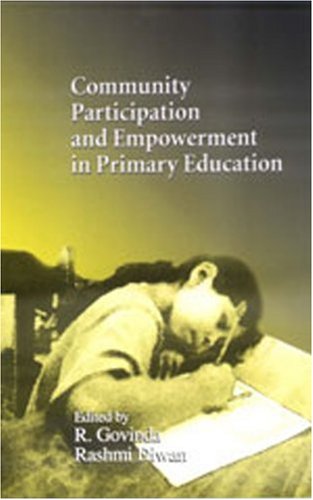
Community Participation and Empowerment in Primary Education,New
Sold by Ergodebooks, an authorized reseller.
Returns accepted within 30 days | support@ergodebooks.com
Shipping Information
- Free Standard Shipping — United States only
- Processing Time: 3–5 business days
- Estimated Delivery: 6–10 business days after dispatch
- Double-boxed, fully insured & discreetly packaged
- Tracking number sent via email once dispatched
Returns & Refund
Returns accepted within 30 days of delivery.
Damaged or Defective Item
Free return shipping + replacement or full refund
Wrong Item Received
Free return shipping + replacement or full refund
Change of Mind
Return shipping at customer's expense · 25% restocking fee applies
Payment Option

It is widely recognized that community participation can play an important role in promoting primary education. It also has the potential to increase awareness levels and to bring about improvements in health and living conditions. In India, too, decentralization has been identified in recent years as an essential component of the processes of educational reform and change. This has resulted in many efforts to bring community and school closer together as also to involve community members in the development of primary education programmes.This volume presents the grassroots experiences, problems encountered, and lessons learnt from initiatives launched in five Indian states. The contributors cover a range of important issues including how community participation works in an environment characterized by deeprooted socioeconomic divisions; the equitable distribution of participation; identifying and defining the community; and ensuring the genuine representation of those who are traditionally excluded from decisionmaking in rural areas.The five case studies cover Madhya Pradesh, Karnataka, Rajasthan, Bihar and Kerala. They collectively shed light on how decentralization in education has been actualized in different parts of the country and the dynamics of empowering the community to manage primary education. Two chapters cover, respectively, the total literacy campaign and watershed management in the framework of sustainable development. These experiences contain valuable insights which can be fruitfully applied to the primary education sector. Finally, both the introduction and the concluding chapter draw attention to the issues that need to be tackled in the years ahead in terms of building capacities for educational governance and community involvement at the local level. A theme running through the volume as a whole is ways to bring about genuine partnerships between civil society, the administration and NGOs in the drive to achieve universal education.Providing a comprehensive and analytical review of experiments and innovation in primary education, this volume will attract the attention of all those involved with education (including educational policy and planning), social work and the sociology of education. It will be of equal value to activists, administrators and NGOs.
⚠️ WARNING (California Proposition 65):
This product may contain chemicals known to the State of California to cause cancer, birth defects, or other reproductive harm.
For more information, please visit www.P65Warnings.ca.gov.